
Guilin 1-Week Itinerary: 7 Days Exploring China’s Most Beautiful Region
Out of all the places we explored in China, Guilin completely stole our hearts. It’s one of the most breathtaking regions in the country, and also one of the most iconic. In fact, Guilin has been a top tourist destination in China for centuries, long before spots like Zhangjiajie gained fame. Chinese poets and painters have been romanticizing this dreamy landscape since ancient times. And after spending a week here, we totally get why.
We spent seven days exploring what we consider the three most iconic areas in the region: the layered rice terraces of Longsheng County, the vast karst peaks and river valleys of Yangshuo, and the ancient charm and epic scenery of Xingping. Each one offered a totally different vibe and view, and together they gave us a full picture of what makes Guilin so magical.
In this post, you’ll find everything you need to know to plan a one-week Guilin adventure—including how to get there, the best way to structure your days, and a breakdown of how to explore these three picture-perfect corners of Southern China’s Guangxi province.
How to Get to Guilin
Arriving in Guilin is pretty straightforward. You can either fly into the Guilin Liangjiang International Airport, or take the train into the city at Guilin Railway Station.
Whether you’re flying domestically or taking the China railway, it’s so much more hassle free to book your flights and train tickets on trip.com. Most of the China airline websites are often not user friendly, or usable at all, for foreigners, and when it comes to the train tickets, trip.com is the only way to book them online in advance. It was the only way we got around China from Dalian all the way to Kunming, and made our lives so much easier.
One you arrive at either the airport or the railway station, you can take a taxi or use DiDi, China’s rideshare app! DiDi is the cheapest ridesharing app we’ve ever used across the world and it makes it so easy to pay for directly through the DiDi app, or through AliPay.
Make sure to read up on my list of everything you need to know before visiting China!
Overview of Guilin 7-Day Itinerary
Across the 7 days, this itinerary will take you to three distinct areas of Guilin: Longsheng County, Yangshuo and Xingping.
Starting in Guilin City, we’ll make our way to the Longji Rice Terraces where we’ll spend a night amidst the gorgeous verdant hills of rice paddies before coming back to Guilin City the following day.
On day 3, you’ll take a slow morning cruise up the Li River to Yangshuo County, where you’ll get to explore the more bustling countryside of Guilin’s karst mountains. With vast rice fields framed with triangular limestone mountains on all sides, it creates the most tranquil backdrop. We’ll also get to experience a unique cultural bamboo boat raft floating down the Yulong River!
For our final destination, Xingping will take the adventuring up a notch. Surrounding a charming ancient town lie jagged mountains upon which the Li River laps at their feet. Here it’s all about chasing iconic views that you’ll find on Chinese banknotes and postcards for centuries to come. A couple of sunset and sunrise hikes are in the books for this final day of exploring Guilin’s scenic area.

On the last day, you can then get yourself to the closest railway station to Xingping, which is Yangshuo Railway Station (it’s actually closer to Xingping than to Yangshuo, funnily enough) and make yourself to your next destination from there.
Day 1 – Arrival in Guilin City
This could either be your first day in China and you might be in recovery mode from the jetlag, or your first day in the Guangxi province after a long travel day. Depending on what time you’ll arrive in Guilin City, you might not be able to have much planned at all for this day.
If this is in fact your first day in China, getting yourself equipped will be a top priority. Especially if you haven’t gotten yourself acquainted with the apps you’ll need in China, or a SIM card. I go through all the necessary apps, and whether a physical SIM or eSIM is suitable for you, in my full guide to visiting China.
Where to Stay in Guilin City
We’re going to keep it simple for day 1. If you’re arriving by the afternoon, you’ll have time to check-in to your accommodation, visit a few scenic spots within the city and grab a hearty meal before an early sleep.
Guilin City isn’t where all the action is after all, so you won’t be missing out on much. But to make your time worthwhile, make sure to book your stay near the river—it’s the most central and scenic area of the city. Anywhere around the Xiangshan Scenic Area or the Diecaishan Scenic Spot, or anywhere in between, is going to be a notable area to stay in, at least for the one night.
We stayed in a cute hotel along the river called the Yifang Landscape Hotel. It had very modern rooms, some with a gorgeous view of the river and mountainous landscape, a pool, inclusive breakfast and nearby restaurants.
What to See and Eat in Guilin City
With enough time, you could explore the Diecai Hill Scenic Area along with its Crane Peak, or the Two Rivers & Four Lakes Scenic Area and the Elephant Trunk Hill adjacent to it.
For food in the Guilin region, you’ve got to try Guilin rice noodles, which are a breakfast staple, but you can also enjoy different versions of it for other meals of the day. You’ll probably get offered it for breakfast every morning, no matter your hotel!
Yangshuo beer fish is a must try, though the small bones can be a pain to get through. And steamed buckwheat buns in which you spoon a meat and vegetable filling are delicious. This was definitely our favourite dish, and if only I could remember what it was called!

Day 2 – Longji Rice Terraces
With your first day settling in and getting a small taste of what Guilin has to offer, it’s time to head on out and explore the most notable areas of the Guangxi province!
Depending on the time of year you’ll be visiting Guilin, the Longsheng County is 110% worth including in your itinerary. It is bountiful in mountains and valleys that are lined with cascading rice terraces. One particular region of the Longsheng County is called the Jinkeng Dazhai Rice Terraces, of which Longji Rice Terraces are a part. This is the postcard location of mountainous rice paddies in Guilin.
Longji, meaning “dragon’s backbone”, received its name because the rice terraces appear to have the curvature and scales of dragon’s back.
Best Time to Visit Longji Rice Terraces
The best time to visit the Longji Rice Terraces is in late September to early October. It’s at the tail end of the rice’s harvest cycle, right when the paddies turn into a sea of golden fields. We caught Longji right at the cusp of the rice being harvested, and it truly was a scene to remember.

Though we loved seeing the rice fields in full bloom, there are plenty of amazing times throughout the year to visit the rice terraces. Between late April and late June, the rice paddies are flooded with water in preparation for planting, creating calm pools of water, reflecting the sky and sunlight of spring time. It becomes a photographer’s playground, giving plenty of angles to shoot amazing reflections of the cascading terraces.
We also love visiting rice terraces during mid harvest cycle, ideally during the latter half, when the rice emits a vibrant green with decent growth to the stalk. For Longji, this would be in the summer months, from July to September. It creates a verdant blanket over the mountainous scenery, and we honestly couldn’t get enough of this scenery when we were in Bali, namely at the Jatiluwih Rice Terraces.
How to Get to Longsheng County
To visit Longji Rice Terraces, it takes 2-2.5 hours by car from Guilin City to reach the Jinkeng Dazhai terminal. You can either take a private transfer—or taxi or Didi like we did—or take a bus. We opted to go with a private Didi ride to save ourselves the headache of getting ourselves to the bus terminal, waiting for a scheduled bus and not knowing how long it might take through the traffic to reach the rice terraces.
If you do opt for the bus, you’ll want to get yourself to one of these bus terminals:
- Guilin Railway Station
- Guilin North Railway Station
- Guilin West Railway Station (yes, there are many train stations in Guilin City)
- Qintang Bus Terminal
It should cost about 50 RMB per person for a bus ticket, though we haven’t tested that theory to say with certainty. A Didi ride from the city to the Jinkeng Dazhai terminal should put you at around 200-250 RMB, which we thought was worth the convenience for double the cost for the two of us.
About 1.5 hours the way on the road to the Longsheng County, we reached the Jinkeng Dazhai entrance gate, where an attendant came to our car window and we paid for our entrance tickets on the spot. It cost 80 RMB per person, which we paid using WeChatPay—you can also use AliPay, but our physical cards were not accepted. You can also buy the entrance tickets in advance on trip.com for the same price. The entrance ticket validity lasts for however long you’ll be staying within the limits of the Jinkeng Dazhai area.
At the end of our DiDi journey, we arrived at the Jinkeng Dazhai bus terminal, where visitors can either start hiking the paths leading up the low profile mountain ridges of the rice terraces, take the cableway (which costs 100 RMB per person roundtrip, or 55 RMB one way), or if you’re staying at a homestay/hotel that offers complimentary roundtrip shuttles, contact them for your pickup.
We did the latter, and when the 4×4 blue pickup truck came around, we hopped on for a 15-minute ride along the winding road leading up the vast mountain.
Where to Stay in Longji Rice Terraces
There are more than a few stunning and new hotels to stay in at Longji Rice Terraces if you choose to stay overnight. They suit a variety of different budgets, though if you ask me, they are incredibly low in cost for what you get. We absolutely recommend staying at least one night amidst the mountainous rice terraces, because it gives you time to breathe and take in the view without the hordes of day trippers.
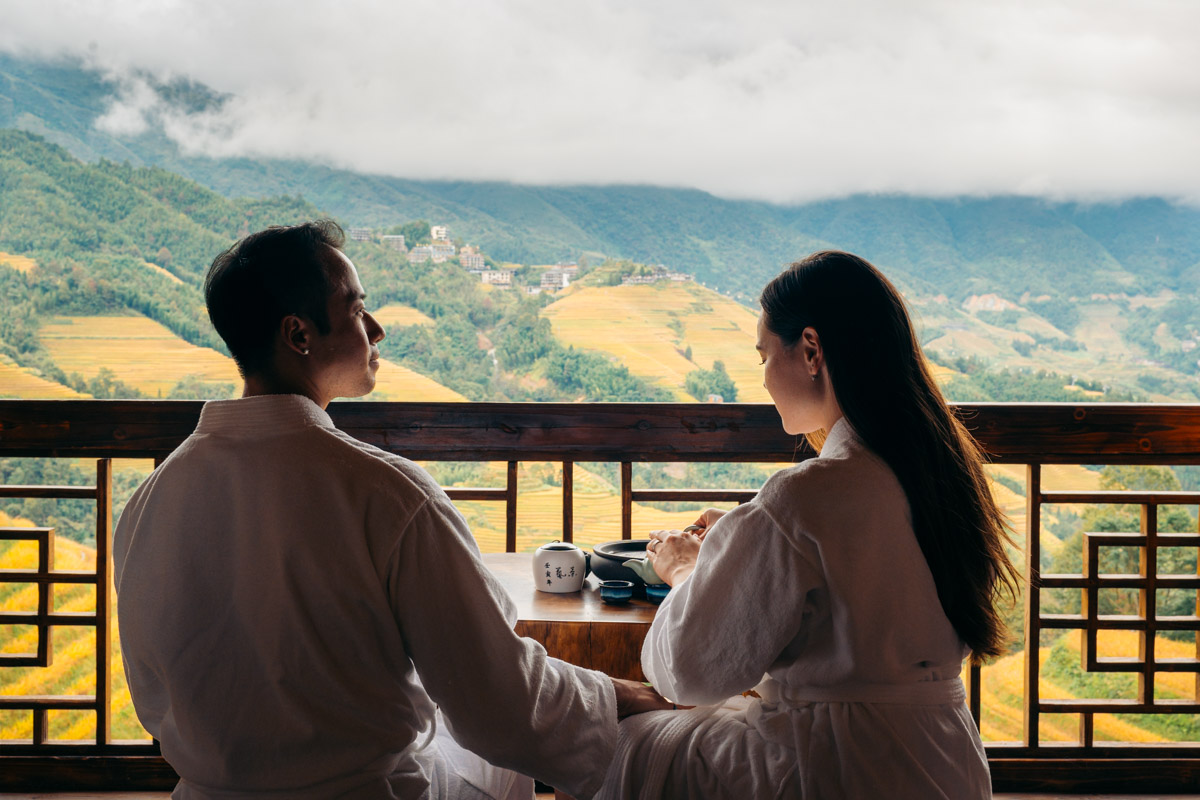
We stayed at the Xia Tiruijing Homestay, which was our “splurge” for our China trip. It was decked out in traditional wooden walls, ceilings and floors, with beautiful intricate Chinese styling for the balcony, yet had modern elements like smart home hardware, automatic toilets, a circular bed and bathtub with a view, and acoustic wall paneling.


The hero was absolutely the money shot view out of our balcony, where we could sit on an elegant handcrafted wooden table, sipping on Guilin tea and look out the mountain ridge lines and cascading golden terraces. This made it all the more worth it to have stayed a night in the area.

For our meals, we dined at our homestay for lunch and the next door hotel for dinner, while our breakfast the next day was included with our nightly rate. There aren’t too many options for dining if you stay here, as practically all the restaurants are part of the accommodations.
You could venture further up or down the road in search of better dining outlets, but since we didn’t drive into Longji with our own rented vehicle, we would have had to walk the hills instead.
Day 3 – Morning in Longji and Back to Guilin City
We spent our morning soaking in our final views of Longji from our balcony, as well as hitting up a final viewpoint before checking out. That’s something you could do while in the vast rice terrace area!
Best Viewpoints in Longji
There are three unique viewpoints you’ll want to check out in Longji Rice Terraces.
The first is just a couple of minutes walk uphill from our hotel, the Xia Tiruijing Homestay. Viewpoint #1 is probably the most postcard picturesque of the three, and has a large observation deck to marking it as such. A lot of the day visitors come up to this spot, dressed in traditional attire from the Zhuang and Yao tribes.

Below the platform is a short trail that curves around the face of the terraced hill, peaked at the top of it. This is the main viewing area amidst the rice fields, where a lot of folks get their pictures taken, and we wanted to go check it out. It turns out that the trail has a small entry fee of 10 RMB per person to enter, as it’s private property. An attendant sat at the entrance to take our payment over WeChat before we walked through.

It’s honestly worth the small payment to come and walk through the rice terraces themselves and certainly made for amazing photos amidst the sea of golden rice stalks.
Viewpoint #2 is about 15 minutes downhill walk from our homestay, and it’s indicated by signage on the way down as the “multi-layer skyscraper viewing deck”. It’s not as visited as viewpoint #1 and is a little bit more of an intimate viewing area.

Walking the trail here didn’t cost us a fee, and it was well worth it as we took the corner to see up towards the mountain and our homestay, and down into the nearby valley. What we loved about the scenery here was the fact that the hill was horseshoe shaped, reminding me a bit of the Moray terraces in Sacred Valley, Peru.

Viewpoint #3 is found at the top of the Longji cableway. You can se it across the valley from viewpoints #1 and #2. It’s a decent walk to get there from the latter two, so we opted not to visit, as we also heard that the view is quite similar. Just a lookout in the opposite direction of viewpoints #1 and #2, but feel free to check it out for yourself!

Bus Back to Guilin City
Once we were ready to checkout, the homestay’s driver took us back to Jinkeng Dazhai terminal at the scheduled time we communicated with reception.
We got dropped off right beside the bus, thankfully, which was a mid-size blue inter-city transport bus. It was a little obscure amongst all the parked cars, and no big sign on it, apart from a letter-size paper on the windshield.
We confirmed with the bus driver that this was indeed heading back to the city, paid our 50 RMB per person for the ticket, and hopped on. It was a speedy and windy ride along the narrow cliffside behind a line of traffic, but we made it safely back to Guilin City at a central Ji Hotel, where we caught a Didi ride back to our hotel, the Yifang Landscape Hotel.
If you have lots of time to spare and haven’t yet checked out the spots mentioned for Day 1, this is the time to do it! After that, relax and get yourself prepped for Day 4.
Day 4 – Li River Cruise to Yangshuo
What better way to get to your next destination in Guilin than by river cruise? It’s not the only way for you to get to Yangshuo—driving or taking the train would definitely make it faster—but this it’s a travel experience and transportation all in one.
Yangshuo Li River Cruise
Before we embarked on our morning river cruise, a tour bus was arranged to come pick us up from our hotel as part of the package. Given that our hotel was located on a narrow one-way street across from the river, we walked two minutes to a designated pickup point to get on the bus.
As this was a one-way trip, we had all our luggage with us which was easily stowed at the back of the large bus.
The tour guide continued to fill the time with history and geology about our destination, background stories and legends, and must-try foods and drinks when in the Guilin region—mostly all said in Mandarin. She even came around the bus passing around sweets, snacks and tea samples we could take home, without overly encouraging us to buy! Our favourite was definitely the dried monk fruit tea which we could even steep in our room temperature water bottle.
1.5 hours later, we arrived at the Zhujiang pier to start our Li River journey. The tour guide checked us in, and going through the ticket gates and security was really smooth. We were also given wristbands to indicate which boat and cruise class we would be going on. The 4-Star cruise options are definitely the most worth it, as they have slightly more premium seating and a buffet lunch is included!
The 4-star cruise is what we wanted to book, but because it’s so popular, they sold out and we got bumped to a 3-star. It was definitely still a great and comfortable experience, but we had to purchase lunch à la carte. We opted for these pre-made meal kits that were heated up on a metal tray. It was really not bad at all for 30RMB per, but we would’ve enjoyed a buffet more, along with a 4-star experience, for only an extra 100RMB per person extra.
Taking the river cruise from Guilin to Yangshuo was easily one of the highlights of our trip. The journey itself felt like stepping into a Chinese painting—those iconic limestone karsts rising out of the water in every direction, slowly revealing themselves as the boat glided along the Li River.

We had comfortable and spacious seating on the main deck, with large dining tables that could be shared between eight travellers, although there was enough room for just the two of us to take our own table.
It wasn’t crowded, and the setup actually made it easy to enjoy the ride in our own privacy. We sipped on hot jasmine tea, snacked on some candies and eventually had our simply hot lunch served—with a beef and carrot stew, marinated chicken, sweet corn, fermented veggies on the side and a ton of white rice—as we cruised deeper into the scenery.
But the real magic happened upstairs on the open deck. It was breezy and quiet, and you had a 360-degree view of the surroundings: rolling green hills, farmers walking cattle along the river shore, karst mountain peaks towering across the value in a perfect sequence of triangles, making the large cruise boats and small motorized bamboo floats along the river seem so small.


The boat moved at a slow, peaceful pace, giving us time to just stand there and take it all in. Every twist and turn in the river felt like a reveal of something even more dramatic. As we neared Yangshuo, we also marvelled at the frame captured on the ¥20 bank note. We were glued to the views the entire time, and 4 hours later, we made it to the Yangshuo pier.

Where to Stay in Yangshuo
Once we got off the boat, we dragged our luggage along the long stone walkway, which was not very suitcase friendly, so beware of that if you’ve got heavy baggage with you! It was a busy part of town as we were near the centre of Yangshuo, and we were very glad to be heading out to the countryside for our stay.
We opted to stay by the Yulong River, which is the second and smaller river that runs through Yangshuo. It’s the beating heart of Yangshuo’s countryside, and is brimming with rural beauty known to China in all directions.

There are quite a number of modern homestays that have sprouted throughout this part of Yangshuo, in close proximity to the main, yet quiet, one-lane road. Most of these contemporary 5-storey hotels offer rooms with full floor-to-ceiling glass windows that peer out to the mountain view.
We stayed at the Shijian Boutique Homestay which gave us just that, and I’m not ashamed to say, I got my very Instagrammable bathtub view photo from our very modern mountain view room!

I might add that it’s hard to comprehend just how affordable these stays are for what you get. Yes, they’re a little out of the way, but the remote location makes them all the more worth it. Add on the room comforts, amenities, inviting atmosphere through the lobby, and a hearty complimentary breakfast, there’s really no denying that China’s rural accommodations give you a ton of bang for your buck.
The only downside of staying in this part of the county, is the lack of dining variety. However, we weren’t visiting Yangshuo for the food, so we made do with the restaurant options available, which by the way, had some of the kindest owners and servers we dealt with in China.
Sunset by the Yulong River
To wrap up our first day in Yangshuo, we walked the short 5 minutes to the river from our hotel, just north of the Chaoyang Marina. We came here as the afternoon light was drawing to a close, but it was still bumping. Families were soaking their feet in the water, a few folks were casually trying to fish with some simple rods and wire, and a handful of food trucks and vendors were stations along the bike path ready to finalize their last orders for hot snacks, fresh fruit juices and delicious coffee and tea drinks.

If we didn’t plan on going straight to dinner afterwards, I would’ve definitely grabbed a few bites and drinks while they were still open. The sun started to go down and the soften glow and golden hues illuminated the sky behind the symmetrical karst mountains that lined just beyond the river.
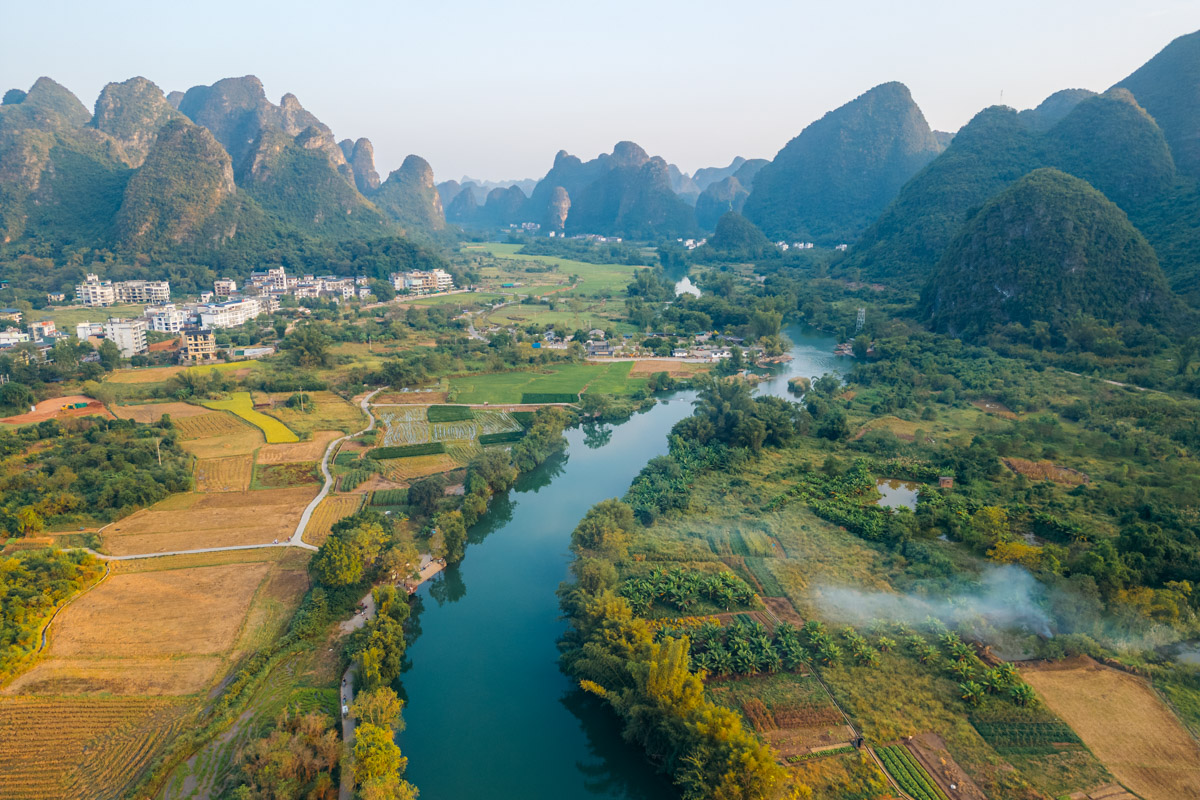
The calm water of Yulong this time of year, and lack of wind, made for a pristine reflection. Lush trees and shrubs lined the opposite shore, adding greenery to the dark blue scenery. As the sun kept setting, we popped up the drone to catch an aerial view of the landscape. A few of the residents were doing some controlled burns near their fields, so a layer of light smoke gathered under the mountain, making it look quite dreamy.


And with that, we were all the more looking forward to exploring the Ynagshuo countryside the following day.
Day 5 – Explore Yangshuo
The night prior, we coordinated with our homestay’s hostess to rent an electric scooter for the day. It was delivered for us to have it around 7:30am and all we needed was to have it back and parked at the homestay that same night for the scooter rental company to charge it overnight. It only cost us 40RMB for the day, which is fantastic, considering we also don’t need to worry about paying for gas.
Traditional Bamboo Rafting Down Yulong River
The first activity you’ll want to do your first morning in Yangshuo is hop on a relaxing bamboo raft ride down the Yulong River. It’s an iconic must-do experience when in the region, and we wanted to go with the authentic, non-motorized rafts.
If you go over to the much larger Li River, you’ll notice that the bamboo rafts are bigger, motorized and have an awning for shelter. On the Yulong River, they offer smaller raft rides with a rower who uses a long bamboo stick to push against the river floor as you head downstream.

There are tons of different start and end points along the Yulong, depending on which route and how long you want your ride to be. With some research, we figured the best one for us starts at Shuiedi Wharf and ends at Gongnong Bridge. It’s a 3-km route and costs 200 RMB for a two-person raft.

Since the bamboo rafts are traditionally made, there is a weight limit to how much they can carry and float. 160kg is the limit for the passengers and whatever items they may bring on the raft, and you actually get weighed on a scale altogether at the ticket gate to ensure this safety precaution is met.
You’ll want to bring waterproof shoes (we wore our hotel’s provided slides) and do note that the bamboo slatted seats are not the most comfortable. Good thing our ride was only about 45-minutes, and the time of the ride depends mostly on the depth and flow rate of the river.
The experience left an imprint on our butts as well as on our memories! It was such a glorious way to experience the river and the awe-inspiring scenes that transpired through the valley of Yangshuo. Absolutely stunning at every moment, and we loved floating down the constructed dam cascades as it was a short burst of exhilaration and a calm splash of water to keep us on our toes.


Surprisingly, it was much busier than we had expected. We thought our early start would mean fewer people, but there were still many rafts heading down with us. Even so, it didn’t compare to how busy it gets later in the day, so we were glad to do this first thing. Our recommendation is to come around opening time, provided that it’s good weather and lighting!
Since it’s one-way going downstream, we parked our e-scooter at the Shuiedi Wharf parking lot and then called a Didi ride to take us back after we disembarked the raft.
Exploring the Ten Mile Gallery by Electric Scooter
Once we got back to our scooter, we headed back to our hotel to switch out some gear and our shoes, and went out to chase the scenic views of the Ten-Mile Gallery. If you gave our Zhangjiajie visiting guide a read, you’ve probably seen this term before. It’s a fairly common phrase used in China—translated from “Shili Hualang”—to describe a long stretch of scenic area that is perfect to travel by foot, bike or electric scooter like this one.

On our way to the bamboo raft wharf in the morning, we passed by this large open rice field with the most amazing mountainous backdrop. So first thing was to go back to that very spot and explore by foot.

On Apple Maps, it’s denoted as Dreams Yulong Huaying Daoxiang Scenic Area, and more than a handful of groups stopped here too to walk around, even though it didn’t feel like a manufactured photo spot, like other places you might find in China.


We loved this authentic slice of Yuangshuo, and it reminded me a lot of walking the muddy, narrow trails between the rice stocks in Bali.
Most of your afternoon can be spent just riding along the main road, and the smaller streets dedicated to the bikes and pedestrians. We loved wandering aimlessly through the countryside, taking in new views in every which way. It was definitely our Eat Pray Love moment, and something we don’t often do on our travels: drive somewhere without a destination.
Heading west on the main road—called the Shili Hualang, meaning Ten Mile Gallery—from the Gongnong Bridge, we found ourselves getting a caffeine refuel at the Yuexia Coffee space. It’s set outdoors with seating and canvas tents, with a small coffee house to make your order. The setting is gorgeous, as it’s right beside a persimmon orchard, in which you can peruse around. The mountains appear to sit right at our feet too!
It’s a little rustic spot, not quite developed, but we enjoyed it for that very reason. The Yuexia Coffee’s location isn’t accurate on Google or Apple Maps, but keep an eye out for a sign for it (in Chinese Hanzi characters) on the main road!

There are some restaurants that line the main road here as well for you to take a lunch. We enjoyed a meal with Guilin’s famous bamboo stuffed rice at one of the open-air restaurants here.
Night at West Street
After the sun sets, make your way to Yangshuo’s city centre to walk the bustling West Street. Much like Nanjing Road in Shanghai, this street is best to visit at night, when it comes to life with restaurants, food vendors, souvenir shops, and so much more.
Some of the facets of West Street can be tourist traps, but as someone who likes to browse without buying, people watch and see the contrast between day in the mountains and night in the city, this was a place for us to get just that. The dining options here were also much more abundant then in the countryside, with various ranges in price. You’ll see some dining being more tailored towards Westerners too, in that you can order a meal for one, instead of family style like most Chinese restaurants.
Make sure, before you head to West Street, to charge up your e-scooter! You can ask your hotel to help you and charge it during your break between afternoon and evening.
Our electric scooter just about died after driving to West Street, and we had to ask a benevolent shop manager, where we parked the scooter, if we could charge it up while we went out for the night. Luckily, we could still access the wall plug-in after the closed up for the night, and the couple of hours of battery charging got us home. Definitely a mistake we hope you can avoid!
Day 6 – Explore Xingping
Before we checked out of our homestay in Yangshuo, we took advantage of the crowdless small roads and morning light to go back to some favourite spots near us and the Yulong River to snap some final shots.
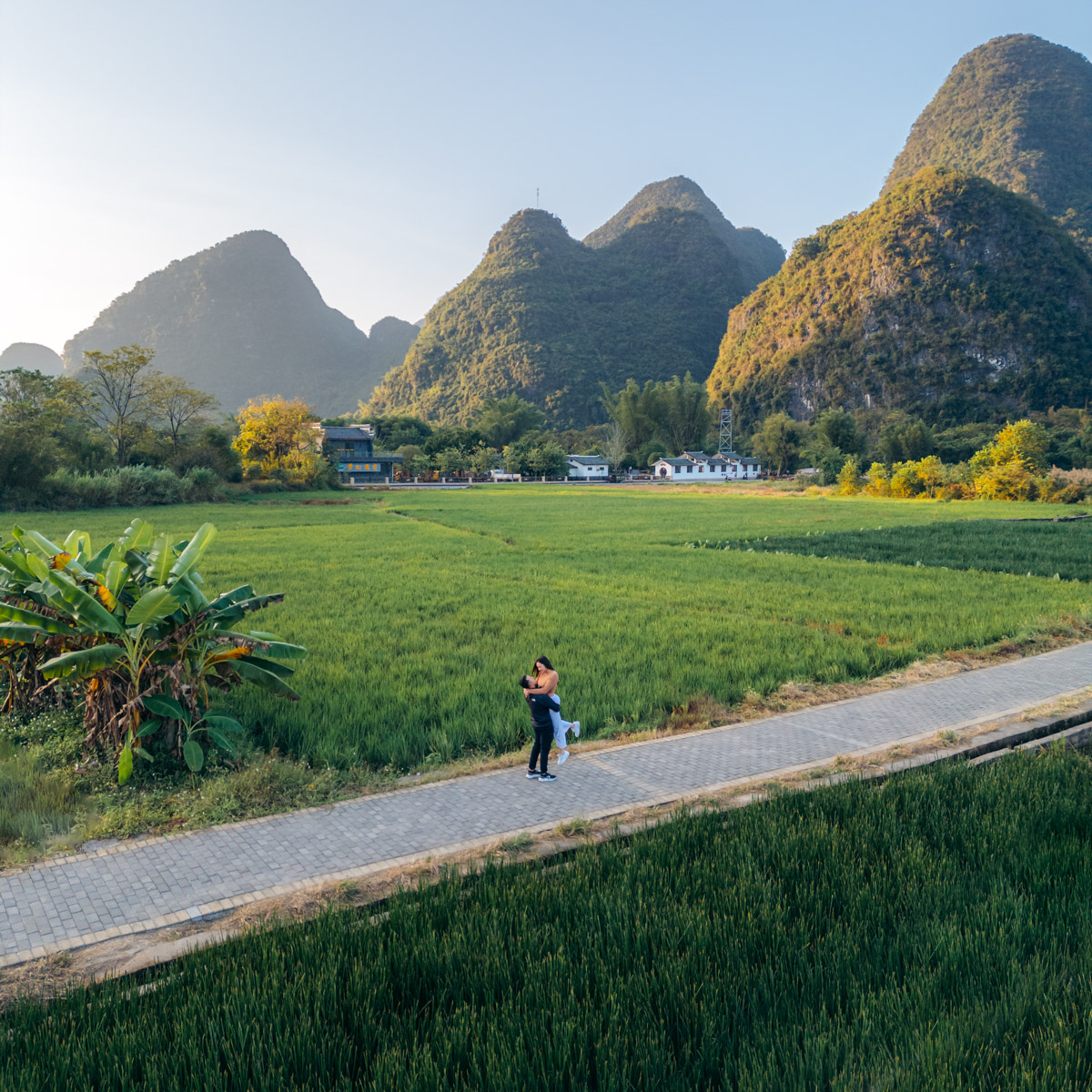
This spot right here, where the bike road diverges towards the riverfront road, was an absolute gem, with the rice fields on both sides, and a backdrop of the mountains.

When we were ready to checkout, we called a Didi to take us to our final destination on this Guilin itinerary, Xingping. The drive took less than an hour and we arrived in the small yet busy town centre just in time to checkin.
Where to Stay in Xingping
Within such a small footprint of a town, there aren’t too many options for accommodations here, but we honestly found the best one for you. It’s a new and large hotel, holding the international Mercure brand name, located right on the main street and a stone’s throw away from the ancient town and the boat pier.
We loved our stay here, not only because we were granted an early checkin and an upgrade to their two-storey loft room type, but the atmosphere, cleanliness and staff were amazing, and the hotel boasted a large rooftop terrace and bar area that we could access freely, with 360-degree mountain views with zero obstructions. The perks of visiting a small town with low profile buildings!
Just around the corner from Mercure Guilin Yangshuo Xingping is a McDonald’s and Luckin Coffee, if you’re seeking some fast food and a change from the local Chinese eats and drinks.
But if you’ve still got a craving for them, then it’s time to venture into the streets of Xingping’s ancient town.
Explore Xingping’s Old Town
Xingping’s ancient town in Guilin feels like stepping back a few centuries, but with just enough modern charm to keep you lingering. This small, pedestrian-only old town is a maze of narrow cobblestone lanes lined with traditional buildings that tell stories through their weathered wooden beams and dark, sloping roofs.
The architecture consists of two-story wooden structures with carved lattice windows and grey-tiled, upturned eaves that add a poetic curve to the skyline. Some walls still carry the faded patina of age, while others have been carefully restored, blending history with present-day life.
Here, you’ll find a mix of cozy restaurants serving local Guilin rice noodles (or Yangshuo beer fish like we had), tiny tea houses, and clothing shops selling both modern wear and traditional pieces. Souvenir stalls tempt you with hand-painted fans, bamboo crafts and postcards featuring the iconic karst scenery that surrounds the town.
Street vendors set up shop piled high with Chinese sweets, like sesame brittles, candied hawthorns and steaming buns with sweet red bean filling. The air carries a medley of scents: roasted chestnuts, herbal tea, and sizzling skewers.
Wandering through Xingping is slow travel at its finest—no cars, no rush, just centuries-old charm framed by the dramatic limestone peaks that tower in the background. It’s the kind of place where you can spend hours meandering, nibbling your way through the streets, and soaking in a living piece of history.
Afternoon Walk to the ¥20 Bank Note Viewpoint
After an afternoon well spent in the Xingping stone alleyways, we headed over to the parking lot adjacent to the wharf, just south ticket office building. This was in order for us to arrange our sunrise mission with potential local vendors, which I’ll get into detail later.
Once that was sorted, we kept walking north along the main road as it curved across the bridge and back, before we reached the 20 RMB banknote scenic view.

It’s a gorgeous spot, with local fishing boats and bamboo rafts scattered along the receding edges of the river bank. The viewpoint also stretches in a wooden sheltered walkway all along the edge of the river, acting as an area to queue for bamboo raft and boat rides, but also offering passersby an open vantage point to the iconic view.
Sunset Hike on Mount Laozhai
Wrapping up, head back to the parking lot just south of the ferry ticket office building, where parked electric mopeds and scooters are lined adjacent to the next building. The trailhead to Mount Laozhai is quite obscure, so if you have trouble finding it, just ask any passing by locals for “Laozhai Shan” and they should point you in the right direction.
It’s essentially at the end of the Rongtan Road, if you walk westward, with the building to your left and the parked bikes and cars to your right. Wild trees grown on the mountain keep you well and shaded as you start your steep ascent on the stone stairs and rustic path leading you up Laozhai Mountain.
It can be a daunting climb up and down, and once you reach the summit, it only gets more relentless. The peak is made up of a small area of jagged pointy rocks with deep crevasses sizeable enough to get feet stuck. Only a small concrete gazebo creates a more comfortable viewing area, though the main view itself is obstructed.
So please only climb this mountain at your own risk!

We had no regrets but we’re well experienced with daunting summits coming from the Canadian Rockies, as well as scrambles and questionable footholds. So just keep this in mind if you decide to head up.
The hike up took us less than half an hour, even with traffic heading up there as well. There’s a metal vertical ladder towards the end that causes a bottleneck, so give yourself plenty of time to go up and down (we waited a good 10-15 minutes waiting for others to head down the ladder when we too were climbing back down).

You would think that only a few people would hike up given that there’s no viewing platform and uninviting jagged boulders that carve into your butt when you sit, but much like many other photo spots in China, Mount Laozhai was equally packed. We weren’t the only people with the idea of watching sunset from the summit.

In spite of these set backs, it was well worth it to watch the sky turn orange behind the karst mountains of Xingping, with the Li River carving through the narrow valley in a serpentine form. Exhilarating journey and amazing reward.
Day 7 – Sunrise on Xianggong Mountain
No better way to end your time exploring Guilin than with a sunrise mission to the best view in the entire Yangshuo region. It’s an early start, but so long as the weather pans out, you’ll be dreaming about this view for days on end afterwards.
I mentioned earlier that we went over to the wharf the previous afternoon, to arrange with potential vendors to make this very experience happen. Our research had led us to find local transport to take us across the river by small boat, and drive us up to the entrance to Mount Xianggong.
It was way easier than we had expected. There were already a couple of ladies in the parking lot awaiting potential customers, who organize round trips from Xingping town to Xianggong Shan. And it was way less costly than we had anticipated, perhaps because Jason spoke the language, so we didn’t get the “foreign tourist” price. Who knows.
All in all, for a roundtrip boat river crossing, and shared car drive up to the mountain entrance gate—while the driver waited for us until after sunrise—it only cost us 60 RMB per person. What’s crazy is that 60 RMB was also the same cost of our entrance tickets to go up Xianggong Mountain!
There was no need for us to negotiate as the price was more than reasonable.
And so, at 4:20am the next morning, we headed over to meet with our guide at the same spot at the wharf, who would take us over to the other side of the river, and introduce us to our driver. Two other girls travelling here joined us and we moved together as a group.
You might be wondering why we had such an early start when sunrise isn’t until after 6:30am during the fall in this region. Well, the thing about Xianggong Mountain, is that many others are doing the same thing, trying to catch sunrise from there.
Fortunately, our 4:30am kickoff ensured that we reached the mountain entrance parking lot at 4:50am. We got in line for tickets while we waited a brief few minutes before they opened up, we got our tickets, and quickly rushed through the gate to get a head start on the walk up.
The steps were miles easier than Laozhai, my goodness. Perfectly built concrete steps, dressed with a soft fake grass carpeting on the steps, secure rails, it felt less like walking up a mountain and more like walking up a building. We took them two out of time, passed groups of people, making it up there in seven minutes, just at 5:05am.
We reached the top platform with barely any others ahead, and so we managed to pitch our tripod, and ourselves, in the perfect spot, right at the edge of the deck.
There are five viewing platforms that make up the summit of Xianggong, so if the top floor seems too busy when you arrive, just make your way to a lower level for more space.

Fortunately, it wasn’t as cold as I expected. No wind, no chill or high humidity, it was just perfect, even though we had to stand for the next 1.5 hours at the least. Once it did start getting crowded with new arrivals, people were quite respectful of each other’s space, as best as we could be anyway. As there were quite a few photographers out here, we could understand the struggle of getting a good shot, so we shuffled out of the way when we could.
We watched as the orange horizon spread upwards, enveloping the landscape in all colours of light. Seeing the star-specked sky above to then watching the imposing postcard view of Xingping unravel in front of us, was so worth being on our feet for a couple of hours and having an early wakeup.


And what a way to finish off our week-long journey through Guilin’s best! We stuck around as the sun lit up the whole panoramic view and the crowds thinned out, to soak in every last moment before scurrying down the stairs back to our pickup.

After the eventful morning, we checked out and headed to the Yangshuo Railway Station, which in actual fact is situated nearest Xingping, before we headed to our next epic destination, Zhangjiajie.
Thanks for Reading!
Well that concludes our three-fold adventures to the ancient and timeless beauty of Guilin. From the serene golden beauty of Longji Rice Terraces, to cruising along the Li River, riding aimlessly through the small countryside streets of Yangshuo to climbing mountains in Xingping, we hope that this 7-day itinerary is as impactful on your China travels as it was for us!
Make sure to catch yourself up on important tips for travelling to China in 2025/26 with my detailed guide. And check out our visiting guides for Zhangjiajie National Forest and the fairytale valley of Wangxian if you haven’t already!


Comments (6)
Esraa
September 24, 2025 at 11:56 am
Hello, I am very grateful for your vlogs and all the amazing tips. My friend and I are planning a trip this October and will be staying for a month! we are planning to end our trip in Guilin and following your itinerary. so between maybe November 10th to 18th. Do you think this is a good time to visit? Also where do we store luggage when we are moving so much. i have both a checked in and a carry on. Any advice? Thank you so much in advance!
laurenslighthouse
September 25, 2025 at 10:02 am
Hi! Thanks so much for the kind words, I’m glad our vlogs and written guides have been a helpful tool in your China trip planning. I would say mid-November is still a great time to explore Guilin, though the climate would be different than what we experienced. For instance, the Longji rice terraces, or any rice fields for that matter, will have been harvested by then. The mountain views are still gorgeous, but if not seeing the rice dissuades you from going, I would say it would be okay to skip Longji and spend more time in the other destinations in the region. In regards to luggage storage, we didn’t have any experience with it as we lugged ours around with us (we shared one check-in and one carry-on between the two of us so it was easier). If you plan on doing a loop, starting and ending in Guilin City, I would say to contact your hotel there and ask if you could store with them.
Esraa
September 28, 2025 at 1:36 pm
Thank you so much for getting back to us so quickly! we booked our ticket to beijing to arrive on October 20. and so far we want to travel to beijing, Xi an , Chengdu, Zhangjiajie( after seeing your incredible vlog) and Guilin. we are staying for a month. and we were sequencing the cities in the order I wrote them. Based on your experience, do you thing we should modify the sequence to go from Beijing to Guilin first? if we arrive in Guilin on October 27th, Will we be able to see the beautiful rice seeds? Which order would you do it?
laurenslighthouse
October 2, 2025 at 10:33 am
It’s tough to say. Typically the rice gets harvested before the last week of October but that might be different this year. I saw on China Highlights that it’s supposed to start on November 2nd and last five days, but this is only from one source. I would recommend contacting a local guide from the Jinkeng Dazhai area who could tell you the date of when harvest is supposed to start. Your itinerary sounds like a great trajectory. I would recommend looking at what the train options are using trip.com to see if the scheduling/train itineraries suit your needs. Or you can fly too, especially if you can make it out to Guilin after Beijing, in time before the harvest!
f
March 28, 2026 at 10:00 am
hello! thanks for this lovely post- guilin has been on my wishlist a long time and i’m feeling this year might be our year! i know you said in your post late sept-early oct would be the best time and was wondering if you mind sharing the exact dates or at least month you went for reference?
was also just wondering if your homestay at longji was able to help yall procure the tickets from longji back to guilin in advance! i’d be worried abt reaching the station and being told that tickets were sold out or smth.
thanks in advance!
laurenslighthouse
April 4, 2026 at 10:10 pm
Hi, that’s so exciting, I too hope this will be your year to visit Guilin! We were in the Guilin region specifically from October 18th to 26th, with Longji from October 19th to 20th. It should be very easy to procure bus tickets from Longji back to Guilin City as the bus runs pretty often. The bus wasn’t very busy at all either when we boarded, and we just paid for our transit once we got on. You might be able to book bus tickets in advance by asking your homestay, or at least ask them for assurance if you are worried about missing it.