3 Days in Lijiang: Complete Guide to Exploring Lijiang, China
There’s something instantly magical about Lijiang. The moment you step into its cobblestone streets, you feel like you’ve entered a living postcard—where ancient canals wind past red lanterns, and the crisp mountain air carries the scent of pine and local delicacies, like mushroom hotpot and flower cakes. Watching over it all is Jade Dragon Snow Mountain, a dramatic, ensemble of 13 snow-dusted peaks that form the gateway to the southern Himalayas. And a powerful reminder of just how diverse China’s landscapes really are.
Lijiang is one of those rare destinations that blends culture, history, and natural beauty so seamlessly. Between its beautifully preserved Naxi ancient towns, lively markets, and alpine scenery, it’s easy to see why this part of the Yunnan province has been enchanting travellers for centuries.
In this 3-day itinerary and guide, I’ll share how we spent our time exploring Lijiang’s old towns, wandering between Shuhe and Baisha, and venturing up to Jade Dragon Snow Mountain. Whether you’re here for culture, scenery, or a touch of adventure, Lijiang will absolutely steal your heart, just like it did ours.
How to Get to Lijiang
Though the Lijiang Sanyi Airport (LJG) is an international airport, it has a very limited international route network. Unless you can find a route that works for you and your departure airport, you’ll likely need to enter China via one of the bigger hubs, like Shanghai or Beijing, then take a domestic flight to Lijiang.
If you’re coming from Southeast Asia, you could potentially fly into Kunming, the largest hub in the Yunnan province, and then take the train into Lijiang. Kunming is also the start and end point of the China-Laos Railway, a trajectory that many visitors take to explore the Yunnan on a short-term China visa-exemption. We took this same railway when we left China at the end of our trip to then travel through Laos.
We entered Yunnan through Shangri-La (or Xianggelila)—the largest city in the Diqing Tibetan Autonomous Prefecture—when we flew out of Chongqing. It really depends on how you want to set up your Yunnan itinerary, whether you want to start from the north like we did or the south, and what makes sense for you in how you want to acclimate yourself to the altitude.
That’s something I’ll be discussing later on in this post, as Lijiang sits at a staggering elevation of 2400m above sea level, which is no small elevation.
Best Time to Visit Lijiang
The best time of the year to visit Lijiang is during spring and autumn. From late March to mid-June, spring tends to offer cool and dry conditions, with the potential to catch the window of cherry blossom season. September to November is also a very pleasant time with typically cooler temperatures, mild and sunny conditions, as it avoids the summer monsoon season.
You’ll want to absolutely avoid travel in China during Golden Week (the first week of October) as well as the Lunar New Year period. China is already busy year-round in its most highly rated destinations, so you don’t want to subject yourself to the chaos that is travel during Chinese national holidays.
Jade Dragon (Yulong) Snow Mountain is—contrary to what its name would indicate—not always covered in snow. During the summer months, you’ll likely witness most of the peaks be bare and jagged rocks. Though it is still very much a sight to behold, a lot of the magic of Jade Dragon is in its snowy form. This is why we loved visiting Lijiang in November (the second week of the month, to be exact). November to April is the best window to capture the mountain in snow.

Where to Stay
There are three ancient towns that are worth considering when trying to find a place to stay. You can stay outside of the old towns as well, but there’s a unique experience in actually staying overnight amidst the charming alleys and courtyards with the pulse of history vibrating through the streets.
Baisha provides a bustling yet authentic local atmosphere and is positioned closest to Jade Dragon Snow Mountain, allowing you to admire the peaks a little more up close. Shuhe is another smaller ancient town that has much quieter vibes but maybe less variety in terms of stays and food.
Lijiang Old Town is where we recommend staying. It’s our favourite ancient town in all of China, and probably where you’ll want to spend the most time during your trip to Lijiang. So why not make the most of it and stay within the ancient city walls?

There are a number of boutique hotels in the old town district that blend in well with the surroundings. We loved our stay at the Sedona Yuhe Pavilion Hotel—for the very reasonable price, the room, the aesthetic, and the daily afternoon tea with delicious barista coffees that we got in their courtyard dining area. It was also steps away from one of the Lijiang entryways, which made it easier to get dropped off and picked up by car.
3-Day Lijiang Itinerary Breakdown
Lijiang has a lot of sights to tackle but we found that three days and four nights was the perfect amount to see all the major scenic spots.
The first day is a great time to dedicate to wandering Lijiang’s very own ancient city by foot. Your second day can be devoted to getting closer to Jade Dragon Snow Mountain and exploring the smaller ancient towns of Shuhe and Baisha.
And on your final day, a trip to the Jade Dragon Snow Mountain will take your breath away (literally) but you’ll be soaring to new heights at the foot of the Southern Himalayas with veritable postcards for memories.
Here’s our breakdown of our itinerary, showing the places to explore in Lijiang across the three days:
- Day 1: Explore Lijiang’s ancient town
- Day 2: Discover Shuhe and Baisha old towns
- Day 3: Adventure to Jade Dragon Snow Mountain
Day 0 would be your day of arrival, and if you do decide on staying within the Lijiang old town limits, be sure to see if your accommodation offers complimentary pickup from the railway station or airport. Some hotels and homestays like the Sedona Yuhe Pavilion that we stayed at, offers this free transfer from the Lijiang train station and airport.
You would need to coordinate in advance, but it will definitely save you the hassle of figuring out a ride and nearest drop off area to the closest entry point to the accommodation. If your accommodation doesn’t offer a pickup option, make sure to figure out the nearest entry point to your stay in order to pinpoint it to your taxi or Didi (China’s rideshare service) driver.
Day 1: Explore Lijiang Ancient Town
Morning Walk Through Colourful Streets
Before the rest of the city wakes up and the outside tour groups make their way into the town, head on out for some quiet wandering and get a lay of the land of the old town’s alleys and squares while the morning light starts to glow on the roof tops.


Before you do, you can take your breakfast, if you have it included at your hotel. At Sedona, we had the local specialty of rice noodles in soup that is served on a wooden bridge along with fermented toppings that you can toss into your soup to your taste. Grab some tea or coffee as well before you get your day started.
Upon us getting our first taste of the town, we walked the adjacent streets of the main north gate where the water wheel can be found. Our aimless wandering took us to the stream that goes through the town with arched stone footbridges that lead you to a market square. We took paths leading to colourful umbrella strewn alleys, larger streets carved by brick-framed shopping stalls, their uniform wooden panels marking them as not yet open. Willow trees, potted flowers and lanterns swayed along the vine covered storefronts.
It wasn’t long before some of the first pastry shops started to open and the smell of egg-yolk coated baked dough wafted through the streets. We came across one shop that sold a local delicacy of flower cakes and bought one rose-flavoured with a crispy purple rice coating.

Lunch Along the Canal
If you didn’t yet get the chance to try the local specialty noodle soup, now would be the perfect time at one of the many flower adorned restaurants that line the canal. Not all of the restaurants are the same in quality and service, but when it comes to the noodles, you can count on them to do it right.

The dish is called Crossing the Bridge Noodles and it’s a Yunnan specialty, made famous for its rich yet clear broth and fascinating bowl assembling ritual. The origin is based on a legend that entails a devoted wife crossing over to an island to deliver meals to her scholar husband. In an effort to keep the ingredients as fresh as possible and the soup as warm, she keeps the noodles contained in a hot broth that uses chicken fat to maintain the heat, and the fresh added ingredients are only tossed into the bowl when it is served.
And so, when you enjoy Crossing the Bridge Noodles, you’re brought noodles that are in a boiling rich, clear broth that is served in a hot stone pot, and all fresh ingredients are served on small saucers that are placed on a miniature wooden arched bridge like the one crossed in the legend.

All the meat, tofu and eggs, fresh vegetables, mushrooms and other herbs and aromatics are tossed into the hot soup to your own taste, and cooked within seconds before you can dig in. If there is one food specialty in Lijiang you need to try, it will be these noodles!
Mu Mansion and Lion Hill
If you’re looking to dive further into the Naxi architecture and history, there’s no better place to do so than at the Mu Mansion, the old residence of the Mu family. Though it is a recent reconstruction of the original palace from the 13th century due to an earthquake back in the 1990’s, it still feels like stepping behind the scenes of Lijiang’s history. The moment you walk through the gates, you’re surrounded by grand courtyards, carved wooden pillars and those classic red accents that make the place feel almost like a smaller, more intimate version of the Forbidden City.

One of the most memorable parts of visiting the mansion is how peaceful it feels once you reach the back garden. There are ponds, rock formations and quiet pavilions where you can catch your breath away from the bustle of the old town. If you keep going, a short climb takes you up to a viewing pavilion perched on the hill behind the complex. The view from up there is incredible. A full sweep of Lijiang’s rooftops with Jade Dragon Snow Mountain rising behind the city on a clear day.
If you’re wanting to step away from the old city bustle and immerse yourself in a nature’s setting, you can make your way through the alleys to reach Lion Hill. It’s a secret rooftop of sorts that overlooks the old town itself.

The trail through the park is fairly easy and wide, perfectly suitable for families. It winds uphill through a forested path, with ancient cypress trees covering you, and shaded stone steps for added ease. About half an hour at a slow pace will land you at higher viewpoints where you can already get sweeping views of the sea of tiled rooftops in the old town.
At the top of Lion Hill sits Wangu Tower, a multi-storey wooden pavilion that offers a 360-degree panorama. From up there, on a clear day, you’ll be able to see the old town’s rooftops spreading beneath you fully unobstructed, and hopefully the mountain in the distance as well! t’s an unforgettable vantage point: sunrise or sunset especially, with soft light casting long shadows, and lanterns beginning to glow as evening sets over the ancient alleys.
Both the Mu Mansion and Lion Hill do come with an entrance cost. The price to enter Mu Mansion is 40-60 RMB for adults, depending on whether a guided tour in included. For Lion Hill, you’ll need to pay the adult 50 RMB price at the foot of hill, whether you take the pathway up from Square Street or the path behind Mu Mansion. However, sometimes the ticket booths are left open and uncontrolled outside of operating hours, so you might be able to enter freely in the morning.
Rooftop Café
If you haven’t yet got enough of the Lijiang old town views and the elevated sight of Jade Dragon Snow Mountain, you’ll want to make time in the afternoon to hit up a rooftop café. We visited one called Roof Caf. It’s a humble yet stunning cafe and teahouse, with its own courtyard, and on the second floor, there is a small open terrace and an indoor space with cozy seating and circular windows to peer out to the mountain view.

The coffee here was by no means cheap, though. We paid 60 RMB (U$8.50) per drink, which is by far the most we’ve ever paid for coffee or tea drinks. I went with a signature iced milk tea that I think had butterfly pea flower tea, and Jason got an osmanthus rice iced latte. Both of them were so artfully handcrafted, but they were definitely a splurge. We were really paying for the novelty of the drinks and for the view!
Nonetheless, we enjoyed our time on the rooftop on this sunny afternoon, mostly because it was just the two of us here, looking out to all the dark grey Naxi roof tiles, and to the majestic mountain that was so clear on this day. Mind you, there was a pine tree looking cell tower dead smack in the middle of our mountain view, so that was kind of funny. But it’s one of the best views you can get in Lijiang’s old town!

If you aren’t too keen on paying a pretty penny on coffees with a view, some accommodations in the old town actually offer complimentary afternoon tea! The baristas at the Sedona Boutique Hotel, where we stayed, made a killer latte and cappuccino with exquisite latte art.
Along with the top notch coffee, comes a tray filled with small bites of fruit, dried fruit, small packaged snacks and a slice of cake. I wish I take a decent photo of the set up and the beautiful lounge and courtyard we would often take our afternoon tea, but I guess this video screen grab will have to do!

Mushroom Hotpot
For dinner, we opted to try mushroom hotpot at Mushroom Girl, a popular spot tucked inside Lijiang Old Town. Yunnan is famous for its wild mushrooms, so we definitely had to try another local specialties. The pot comes loaded with different varieties: some earthy, some floral, some with this almost herbal aroma that hits you the second the broth starts bubbling. It’s definitely an experience, and I loved getting to try flavours you just don’t come across anywhere else.

With that said, I’ll be honest, it wasn’t my personal favourite. The broth has a very distinct taste, almost medicinal in a way, and it’s one of those dishes you either adore or you don’t. I’m glad we gave it a shot because it’s such a Yunnan staple, but next time, I’d probably stick to another local dish. Still, if you’re curious about regional flavours and love mushrooms, this is a must-try stop.
Day 2: Discover Shuhe and Baisha Old Towns
After spending the whole first day exploring Lijiang’s old town, it’s time to see what charm is found in the other nearby old towns and adjacent parks. To get to these other parts, it’s a short and affordable Didi ride from Lijiang.
Shuhe Village
Shuhe ended up being one of the quietest corners of our entire China trip. It has a bit of the same old-world charm as Lijiang Old Town but with more modern complexes and businesses storefronts at the entrance and outskirts of the old town. The cobblestone lanes feel wider, the canals run a little quieter, and you actually get moments where it’s just you, a local shopkeeper offering you to try a few samples of freshly made goodies and the sound of water trickling past.
We wandered through the main alleyway where we grabbed some Chinese pastries for a light snack. Jason had a sweet chat with the shopkeepers before we made our way along the canal checking out some of the shops that were open, like cafés, leather-craft studios, and Naxi courtyard homes. It felt like we got a more down-to-earth glimpse of daily life here. If you’re someone who loves slower mornings, this is the place to grab a coffee, sit by the water, and watch the town wake up.

The best part of Shuhe is how easy it is to explore without any plan at all. You can just follow the canal, pop into tiny boutiques, taste local snacks, or stroll all the way to the edges of town where things start blending into countryside paths. We loved the main square area with the reflective pond in the centre, and walking along the tiled steps that hover above the water.
Shuhe was the kind of spot we could enjoy spending a couple of hours and not feel rushed. But there wasn’t too much happening here, so any longer and we were ready to move on and onto our next village.
Baisha Village
Baisha felt noticeably more authentic and scenic the moment we arrived, and a big part of that is how close it sits to Jade Dragon Snow Mountain. The peaks feel like you can almost touch them, like they’re looming above the town, which adds this dramatic backdrop you just don’t get in the same way elsewhere.
Because of that, Baisha was actually busier than we had expected, but we could understand the hype. The town is filled with lively boutiques, cafés and tea houses, many of which are such a vibe. Some spots even have rooftop seating where you can sit right on the tiled roofs, thanks to built-in wooden steps. Bishan Tea House – Snow Mountain Viewpoint (which you can find on Baidu Maps) is a standout and absolutely worth checking out, whether it’s for a tea break and yummy snacks or just to soak in the atmosphere.

What really sets Baisha apart, though, is how well its ancient Naxi character has been preserved. The alleys are narrower, the buildings feel less polished, and the layout is like a truer reflection of what these villages once looked like. If you’re into history or art, you’ll definitely want to stop by the Baisha Frescoes, and it’s also worth popping into some of the local embroidery studios to see Naxi craftsmanship up close.
Heilong (Black Dragon) Pool
The Jade Spring Park is perhaps the most scenic area you can visit within walking distance of Lijiang Old Town. It’s located just north of the Lijiang ancient city walls, about a 15-minute walk from the Big Water Wheel square. The path is straight and leads you through a forested area before you reach the main entrance to the park.

The Jade Spring Park is also interchangeably called the Black Dragon (Heilong) Pool Park, named after the series of ponds that is the central feature of the area. It costs 50 RMB per person for park entry, which you can purchase at the gate, but if you come early enough before opening hours, the gates will be open to everyone and you can just make your way through.
In the morning, it’s so tranquil and you’ll spot quite a few groups of retirees doing some taichi with soothing music, or families going on morning walks. But one thing to note is that, even with a forecast for a clear day, the morning air might be misty and cloudy, completely covering the hero view of Jade Dragon Snow Mountain.

We opted to try and come in the morning, before visiting Shuhe and Baisha, and loved the experience, in spite of us not being able to see Jade Dragon in all her glory. We walked through the majority of the park, walk along and across the different pools, and spent a fair amount of time checking out the pavilion and the stone bridge leading up to in.
If you do want to capture the postcard view of the main pond, bridge and pavilion, with the mountain revealed in the background, you might have to come back in the afternoon or evening if the sky clears. We did just that—visited Heilong Park in the morning and returned for sunset after traipsing around Shuhe and Baisha. And we got quite an epic shot of the calm water reflection the scene and the golden light hitting the snowy 13 peaks of Jade Dragon in the background.

Day 3: Adventure to Jade Dragon Snow Mountain
Rising dramatically just north of Lijiang, Jade Dragon (Yulong) Snow Mountain sits within the Yulong Naxi Autonomous County and feels like a world away from the ancient towns below. As I mentioned, the mountain range is made up of thirteen peaks, with its highest summit reaching 5,596 metres (18,360 feet). It truly gives us a taste of what the daunting and reverent Himalayas would be like. At the end of this section, I’ll give you a little rundown of how to best prepare for the weather and altitude of visiting this alpine park!
Getting there was surprisingly easy, and affordable. We took a DiDi straight from the edge of Lijiang Old Town, close to our hotel (Sedona Yuhe Pavilion Hotel), and the drive took about an hour, costing just 60 RMB. Even at 7:00am on a weekday, traffic built up as we approached the park entrance. Park attendants walked car-to-car collecting entrance fees, which we paid via WeChat through the car window, and our DiDi driver simply continued on once that was sorted.
Once we got through the entrance, we spotted countless people pulled over in the meadows, shooting photos, and getting photoshoots done, in the freezing cold. The sun hadn’t even risen yet, it was super cloudy, and somehow… everyone was already out there. It was a long stretch of road so all the folks could scatter throughout the meadows and face out to the cloud covered mountains.
At the end of the road, we finally reached the main parking and drop-off area, where you enter the building and hop onto the complimentary park shuttles. We followed the signs for Blue Moon Valley and boarded our first bus of the day, racing from the door to door to avoid the humid cold.
Blue Moon Valley
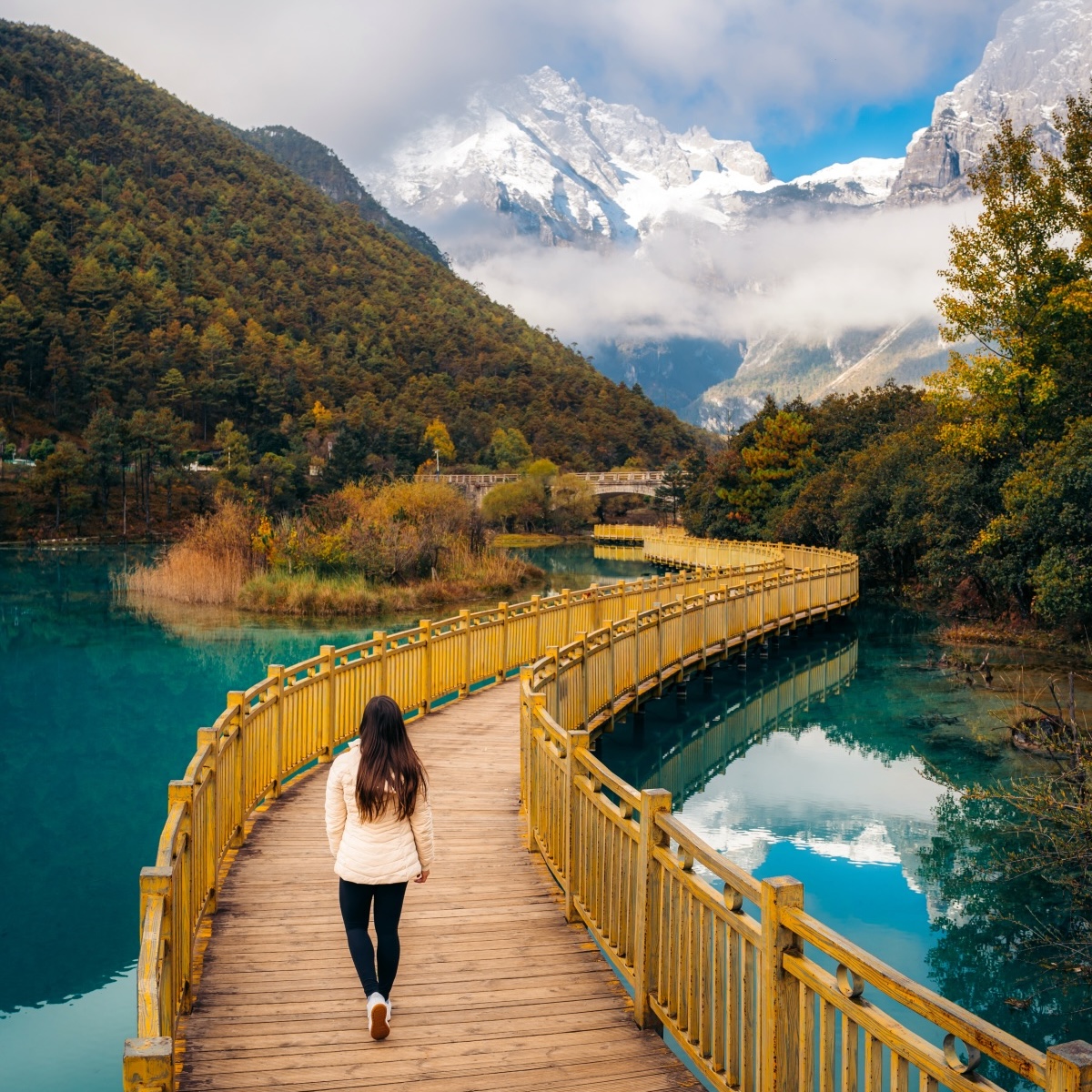
Blue Moon Valley was the section of the park that I was most excited to see, so naturally, we had to come here first before the crowds started to pour in. The valley stretches way further than I expected. It unfolds through a series of cascading pools, each glowing in different shades of turquoise, icy blue and deep emerald, all fed by glacial meltwater.

The wooden boardwalks and staircases make it incredibly easy to explore, and in some sections they hover right above the water, letting you peer straight down into the crystal-clear lakes and ponds below. The water was so calm in the early morning, so we could sometimes see straight to the bottom in the shallow areas, and spot eerily bare tree trunks still free standing against all odds.
We spent a couple of hours here, mostly waiting, very patiently, for the clouds to lift and reveal the mountain at the head of the valley. Early on, there were barely a dozen people around, which felt almost surreal given how popular this place is. By around 9:30am, the crowds were definitely rolling in, but we’d already managed to capture some truly dreamy moments: glass-calm water reflecting snowy peaks just catching the morning light, framed by pine trees and greenery brushed with soft autumn gold.

We crossed over to the quieter side of the main pool, where things felt a bit more wild and free, with lightly trodden trails and fewer people. We sat on a log while enjoying some packed snacks, watching the clouds stroke past and unveil the mountain peaks completely.
We came back again to the Blue Moon Valley later in the afternoon, and while it was much busier, the water colour had transformed, turning a shimmering, electric cyan under the stronger sun. Standing there, it reminded me so much of home in the Rockies, especially Moraine Lake in Banff. Different mountains, different continent, but that same jaw-dropping, stop-you-in-your-tracks kind of beauty.
Glacier Park
From Blue Moon Valley, we hopped back on the inner-park shuttle and headed for Glacier Park. We arrived at the cable car station about half an hour before our allotted time slot, pre-purchased tickets in hand, giving us plenty of time to inch our way through the snaking queue for the ropeway. But truly, it was worth every minute of waiting.
The Glacier Park cable car is massive. The ropeway stretches nearly 3 km, climbing from 3,356 m at the base to 4,506 m at the top—an elevation gain of 1,150 m. The ride itself takes about 15 minutes, and we were completely glued to the glass the entire time. Four glass panes, nonstop views, and scenery of jagged peaks and snow climbing to impossible angles that just kept getting more dramatic the higher we climbed. It was one of those rides where you forget to sit back because you don’t want to miss a single second.

When we reached the end, we could already feel the crisp mountain air thinning out, which is a crazy difference to feel in a matter of minutes. This is when we swiftly set up our oxygen canister to have in handy when we needed, which I’ll talk about later.

We took in the sight of the glacier and marvelled at the height we were at throughout the vast observation deck here, peering out to all the different corners. Then we set off for our slow climb up to the very top.

The wooden staircase leads you up to 4,680 m of elevation, which is the furthest point you can get to overlook the glacier and surrounding peaks. We took it nice and slow, stopping for oxygen breaks, chocolate snacks and just waiting to pass people. It’s an incredibly busy area, but the crowd thins out as you near the top, due to a lot of people turning back or pausing partway.

But once you get to the last viewing platform, the crowd bottlenecks once again, as pretty much everyone wants to take a moment to indulge in their accomplishment, and of course take their 1,000 different pics, before they head back down. Honestly, we did too!
Other Sections and Features of Jade Dragon Park
There are other areas of Jade Dragon Park that you can explore, including Spruce Meadows and Yak Meadows. They do require an additional cable car ride to reach, but are typically less popular areas to visit. So if you did have extra time (and energy) remaining, you should definitely see if you can purchase cableway tickets on the spot and visit these quieter nooks of Jade Dragon without the crowds.
There is also an incredible outdoor performance called the “Impressions of Lijiang” that is a must-watch experience, that unfortunately we didn’t get to have. It’s staged right at Ganhaizi on Jade Dragon Snow Mountain at about 3,100 m above sea level, making it one of the highers open-air theatres in the world.
It was created by the Chinese director Zhang Yimou, the same creative force behind the the opening ceremony of the 2008 Beijing Olympics, so you know it’s an epic drum sequence, and it’s a formidable cultural love letter to the region of Lijiang, Yunnan. I won’t divulge too much, but to give you an idea, the show runs for about an hour and brings together more than 500 local performers from ethnic groups like the Naxi, Bai and Yi, who dress in their traditional costumes and perform songs, dances, drumming, horseback riding and ritual ceremonies that reflect centuries-old traditions and beliefs.
The Impressions of Lijiang performance is often an add-on to various ticket combinations within the park, and you can easily combine it with your cableway ticket for Glacier Park, Spruce Meadows or Yak Meadows.
How to Purchase Jade Dragon Tickets
As I mentioned earlier, when it comes to general admission to the park, you can purchase your tickets on the spot as you drive through the entrance to Jade Dragon Snow Mountain Park. The cost was 100 RMB for each of us, and you can pay by WeChat or AliPay, the two cash apps you need to have when travelling in China. But keep yourself up to date closer to date, whether by your own online research or by asking your local accommodation, if things have changed since this post and you do indeed need to secure your admission tickets in advance.
If you didn’t hear this yet, you’ll hear it from me. You want to purchase your Glacier Park cableway tickets in advance because it is the most popular attraction in the park! Whether through your host at your local accommodation, or online through this link right here.
How to Best Prepare for Weather and Altitude
Most visitors at the Glacier Park sadly don’t come as well prepared for the altitude change as they should. Either, they don’t give themselves enough time to acclimatize in Lijiang—or other higher altitude areas of Yunnan—before visiting the Jade Dragon Park. Or they don’t supply equip themselves with additional tools to help with the pressure and oxygen level changes.
The reason we started off this itinerary with taking it slow and spending two full days exploring the old towns is to help your body acclimate to the change in altitude, if you are coming from anywhere below 2,000 m. Lijiang is positioned at 2,400 m, which is an elevation at which one can already experience high altitude.
We were coming from the Tibetan autonomous region of Shangri-La, which is situated higher at 3,160 m, even higher than Lijiang. So our bodies were already very much used to the altitude. If you are arriving from much lower, I would recommend at least three nights of good sleep at Lijiang’s elevation before undertaking the glacier walk of Jade Dragon Park.

Of course, 2,400 m to 4,680 m is a huge difference. Especially considering the stair climb of 174 m from the end of the Glacier Park cableway to the highest point. So you’ll still want to come to the park prepared with:
- good sleep the night before,
- being well hydrated with lots of water packed with you,
- sugary snacks (especially chocolate as it helps with blood flow and oxygen delivery),
- additional electrolytes like Liquid IV,
- and lastly, a handheld oxygen canister.
We were so surprised to find personal oxygen canisters sold everywhere in the towns, and even in vending machines in the Glacier Park! We purchased ours right around the corner from our hotel in Lijiang Old Town for 15 RMB for a 1.4 L canister, which is way more reasonable than what you would find on the mountain.

It was pretty hilarious hearing the constant hissing of people breathing the oxygen nonstop, even from Blue Moon Valley but definitely up at Glacier. But you don’t want to be the one without, and suffering high altitude symptoms due to a lack of preparedness!
In regards to the mountain weather, the morning was by far the coldest with the thick, cold humidity hanging on the air. In mid-November, we were okay with our packable puffer jackets, hiking shoes, thick socks and gloves. But in the winter, I would suggest considering renting one of the thick parkas that they have available in the park. You may be able to rent them in town prior to going, but they are also available for rent in the park itself.
Even though the weather forecast might look okay for the town, the mountain climate is a whole other beast. Keep a spare packable poncho in your pack, and aim to wear more windproof outerwear for your day at Jade Dragon.
Thanks for Reading!
I hope this covers all your thoughts and questions as you plan your trip to Lijiang, China! If I missed anything, make sure to drop a comment below. And if you liked this post and need more guides and inspo for your China trip, be sure to check out my blog on all the things you need to know before visiting China.
You may also like my detailed Zhangjiajie Guide, what to know before visiting the fairytale like Wangxian Valley and my 7-day itinerary to explore the best of Guilin, China.