

Ultimate Guide to Visiting Tianmen Mountain: Exploring Beyond the 999 Steps to Heaven’s Gate
If you’ve been full dive into China travel research, you’ve probably seen photos of a massive stone arch carved into a mountain with a never-ending staircase leading up to it populate your feed. Located in Hunan Province, just outside Zhangjiajie City, Tianmen Mountain feels almost unreal the first time you see it. The name “Tianmen” literally translates to “Heaven’s Gate,” inspired by the natural water-eroded archway that cuts dramatically through the mountain, standing about 131.5 meters high and 57 meters wide.
Although you’ll find Tianmenshan on the edge of Zhangjiajie City, it’s not the same place as Zhangjiajie National Forest, which is located in the Wulingyuan region an hour away. We managed to explore both back to back and they’re completely different yet incredible experiences that you can’t miss out on while in Hunan, China! If you are short on days, don’t worry because you can explore the entirety of the top of Tianmen Mountain.
And what a day it is. From riding one of the longest cable cars in the world to facing the steep 999-step stairway leading up to Heaven’s Gate, this is the kind of place that pushes you a little outside your comfort zone. Beyond the archway, you’ll find a sprawling karst plateau lined with glass walkways, cliff-hugging paths, and views that just keep going.
In this guide, I’ll walk you through exactly how to visit Tianmen Mountain. From how to get there and where to stay, to choosing the best route for your itinerary. I’ll also share what it’s really like tackling those 999 steps and exploring the dramatic cliffs beyond, so you know exactly what to expect before you go.
How to Get to Tianmen Mountain
You’ll need to first get yourself into Zhangjiajie City, and depending on where you’re coming from, that can either be flying or taking the train. There’s only one airport that serves the city, which makes things simple, and that’s the Zhangjiajie Hehua International Airport (DYG). It hosts both domestic and some international flights, so if you’re coming from afar, this might be the best option.
If you prefer to come by rail, there are two railway stations in Zhangjiajie to which you can consider arriving. There’s Zhangjiajie Central Railway Station, which handles regular and slow trains, and Zhangjiajie West Railway Station, at which most high-speed trains operate. Coming to Zhangjiajie after exploring the Guilin region for one week, the west station is where our train was bound for and was our point of entry into the city.
Whether you’re booking a flight or train into the city, trip.com is the best (or only) way for foreigners to book most flight and all train tickets online in China. When you book all your major trains in China, you won’t need to worry about presenting tickets at the station or on the train, but you’ll need to have your passport manually scanned at the gate before entering the platform. Pretty much every ticket you purchase on trip.com for China is automatically tagged to your passport.
Be sure to read up on my blog detailing everything you need to know before travelling to China!
If you do manage to get yourself to the Zhangjiajie central station, the good news is that it’s so close to the Tianmenshan Cableway Station. I’m talking a 15-minute walk, or 8-minute taxi ride. But regardless of which station you arrive at, the Didi (China’s rideshare app) ride will be short and affordable. At the time we came here, our ride cost us less than 20 RMB (US$3)!
Where to Stay
I honestly can’t stress this enough, but staying super close to the Tianmenshan Lower Cableway Station, in Zhangjiajie City, made our lives a whole lot easier and allowed us to spend ample time on the mountain. We stayed only one night in the city before exploring Tianmen Mountain the next day and headed out to the Wulingyuan area that same afternoon.
As I mentioned before, one day is all you need to visit the mountain so one night is really all you need too. We stayed at this boutique hotel located on the 13th floor of an apartment building called the Mansion Inn – Dream Mansion. It was a little confusing to find, but it had everything we needed: a cozy room with a tatami style bed, reception that accommodated our late check-in and early check-out, luggage storage while we explored the mountain the next day, but most importantly, a 3-minute walk from the Tianmenshan entrance.
Not only that, but right downstairs were small local food shops already open and offering breakfast at 6am, making it the most seamless start to our day. We ordered two hot bowls of noodle soups with braised beef and a couple of fried eggs for 42 RMB (US$6.20) which is such good value for what we got.
You’ll really want an early start and be one of the first to enter the park, so prioritizing a super close location for your stay to the cableway station will be most ideal.
Best Time to Visit Tianmen Mountain
Much like most of China, Tianmenshan is best to visit during the shoulder seasons. Spring, from April to May, it is lush with budding greenery and mild temperatures, making it much more pleasant to explore the mountain top and hike up the steep stairway. The fall, from September to November, you’ll be greeted with higher chances of clearer skies—much like the one we had—and less humidity. We visited Tianmen Mountain at the very end of October and it was as pleasant as it could’ve been, with both the weather and the size of crowds.
The times of the year you’ll want to avoid, if you can help it, are the summer and winter seasons. Summer is just too hot and crowded, with Chinese and international tourists alike, and the views can be very hazy with the high humidity. The winter can be beautiful, but it can make the walkways and steps too icy, to the point where the 999 steps may close. So keep this in mind for when you book your trip!
Regardless of what season you’ll be in Tianmen Mountain, you definitely want to try to pick a clearer day to visit. If it’s too hazy or too cloudy, you won’t be able to marvel at the jaw-dropping mountain peaks and the “heaven’s gate” in their full effect.
But the absolute absolute worst times to visit Tianmenshan, or any main tourist destination in China, is during the major Chinese holidays. Avoid at all cost coming during:
- Chinese New Year (7-9 days of holiday in either January or February, depending on the year)
- National Day Golden Week (October 1-7)
- Labour Day Week (May 1-5)
We’ve been in China over the course of at least two of those holidays, and truly the best thing you can do for yourself if your trip happens to land during those times, is to hide out and explore a city instead. Avoid all the scenic destinations in the meantime.
Understanding the Route Options (Lines A, B & C)
This section is the most crucial if you ask us, and many people, including us, got confused here. But lucky for you, we got to experience the confusion and do the research so you don’t have to!
Update 2026: As of October 13, 2026, Tianmen Mountain’s Scenic Cableway, connecting the Tianmenshan Lower Cableway Station in Zhangjiajie City to the Tianmen summit, is closed for upgrading. This means that only Route C using the Tianmen Cave Express Cableway & Bus combo will be available for the time being. (See travelchinaguide.com for more up-to-date info)
There are three route options you can choose from (before the 2026 cableway upgrade) for your Tianmen Mountain visit.
- Route A (the most popular choice)
scenic cableway up >> explore plateau >> take seven-flight escalator down to Tianmen Cave >> walk 999 steps down >> express cableway down + bus - Route B (our recommendation)
bus + express cableway up >> walk 999 steps up to Tianmen Cave >> take seven-flight escalator up >> explore plateau >> scenic cableway down - Route C (the last resort and the only available route as of October 2026)
bus + express cableway up >> walk 999 steps up to Tianmen Cave >> take seven-flight escalator up >> explore plateau >> take seven-flight escalator down >> walk 999 steps down >> express cableway down + bus
All routes start and end at the Tianmenshan Lower Cableway Station and come at the same cost (288 RMB as of early 2026). But what changes is whether you go straight for the long, scenic cableway first inside of the station, or for the bus adjacent to the station like we did. And which point you descend from at the mountain top.
The reason why Route A is considered the most popular is because most visitors want to have the unbelievable mountain views revealed to them on their way up. It’s a marvellous sight, and seeing it in the softer morning light definitely makes it more picturesque.
But the reason why we favoured Route B is because the highlight of our visit was the Tianmen stairway, and we wanted to be here first thing, before the crowds came in. We also preferred ascending the stairway with the archway slowly opening up above us, instead of walking down the stairway with no view but a daunting height below.
Whichever you choose, you’ll still be able to explore the 999 steps and entire Tianmen plateau to their fullest. Route C, however, doesn’t offer the option of taking the scenic cableway either up or down, and it’s such a big part of the park that you don’t want to miss it. But while the cableway is under maintenance in 2026, Route C will be the only option!
It’s the longest cableway in the world, climbing an elevation of 1,279m over a distance of 7,455m.
Whether you’re selecting Route A, B or C, you can book any of these entrance tickets right on trip.com for the same price as buying them directly at the ticket office. Securing tickets on the official site is always really tricky for foreigners, which is where trip.com really comes in so that you can still secure your tickets ahead of time. Plus you can use your own currency and avoid any annoying transaction fees, just like when booking your stays and trains!
Once your tickets are booked and secured under your name, all you’ll need to bring is your passport along with you. This is super important when going through any paid attraction entrance or gate in China, as your tickets are almost always tied to your passport, which becomes the key to redeeming your online ticket purchases.
Tianmen Mountain Full Day Itinerary
For this itinerary, I’ll be walking through our experience undertaking Route B. As I mentioned above, if you go with Route A, you’ll follow the itinerary in reverse but start and end at the same cableway station. Route C does too, but it’ll be a roundtrip journey without the long, scenic cablecar ride. Okay, enough explaining, let’s get into it.
Morning (6:30am to 9:30am)
If you’re staying just one night in Zhangjiajie City like we did, and near the lower cableway station, you can checkout of your stay and have a quick breakfast at one of the many food vendors just outside the apartment buildings nearby. The food stalls and small restaurants were already open by the time we came downstair around 6:30am. We ordered a couple of fried eggs and noodle soups before making the short walk to the cableway station.
Bus From Cableway Station to the Mountain Gate
Tianmen opening times do vary by season so make sure to check before going! At the end of October, we made sure to arrive at the station around 7am.
Once we walked into the station, for which there was no entry gate or ticket check-in, a bus for Lines B & C was already waiting for passengers to get on. We hopped on right away and 15 minutes later, we arrived at the Mountain Gate, where you make your way to the express cableway.

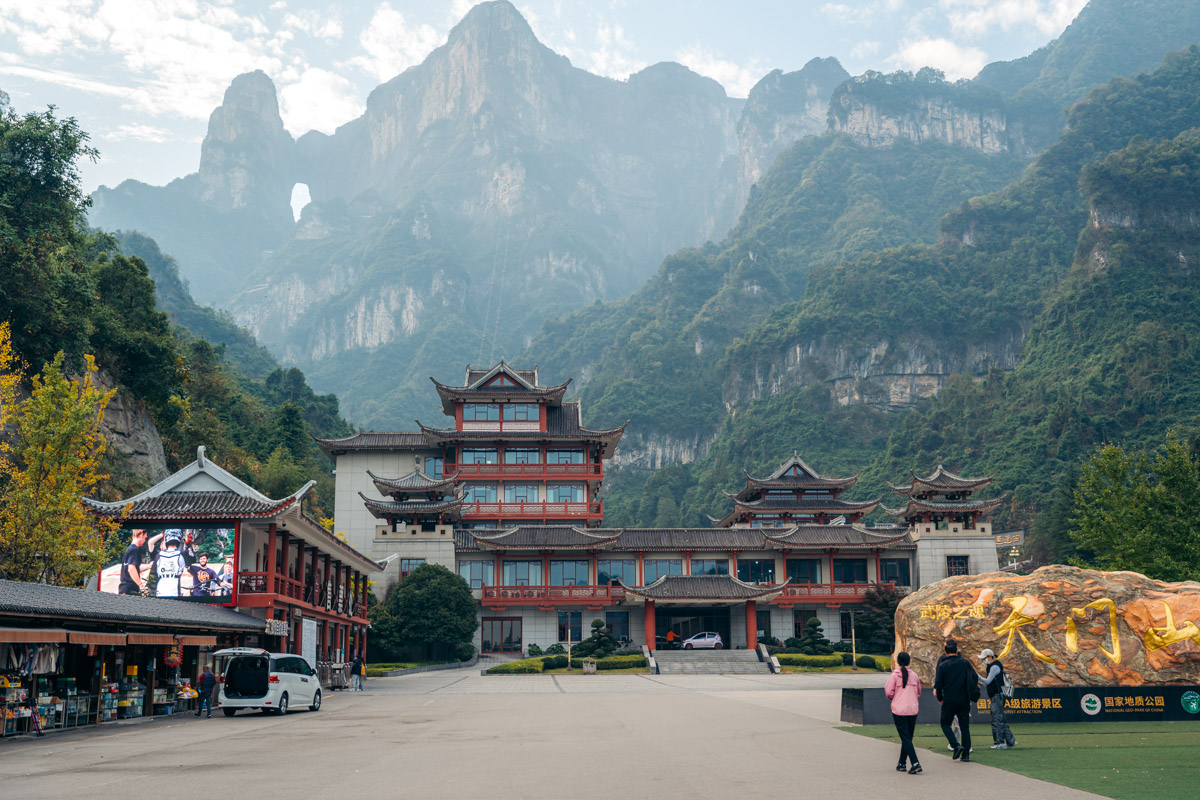
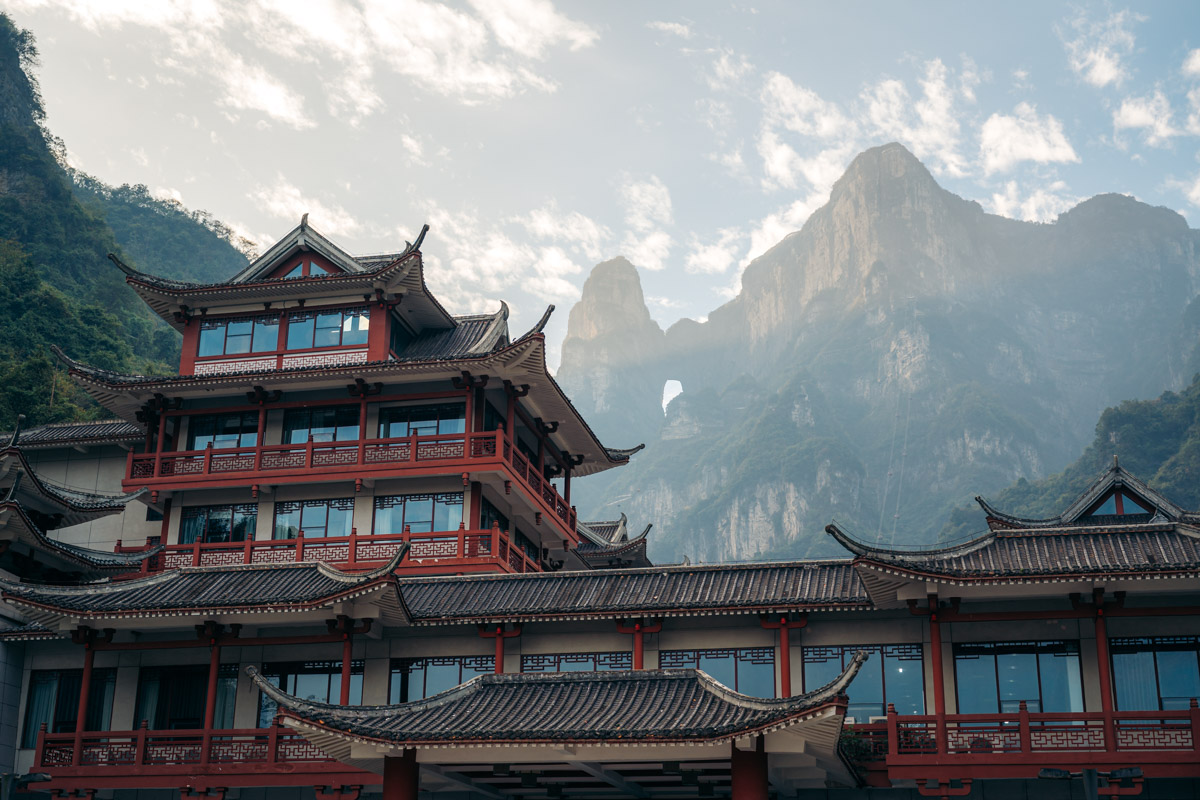
Right from the get-go, you can see the insane mountainous backdrop behind the entrance, and it will get you buzzing with excitement. We could also spot the natural archway of Tianmen so clearly, especially with the clear sky that we got in the morning. In addition to starting the day in quiet solitude without the crowds, the sky conditions and cooler temps were well worth the early wakeup.
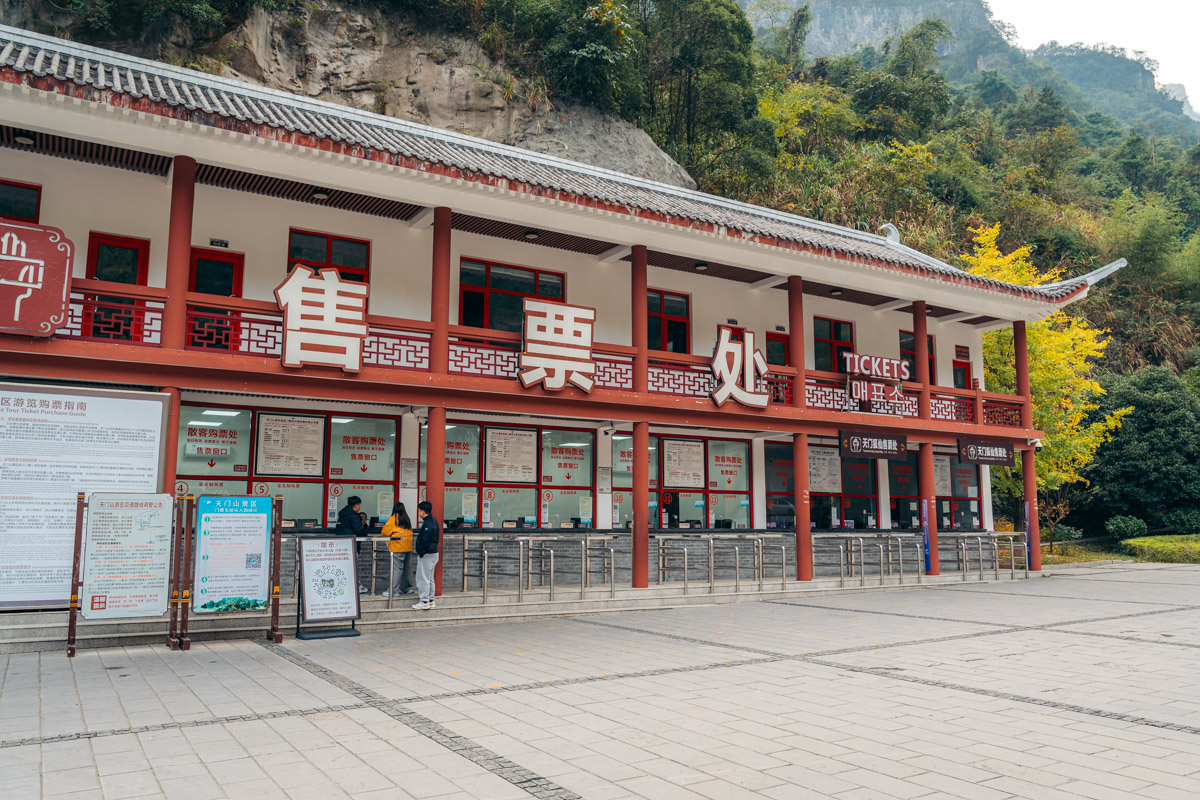
Having bought our tickets on trip.com, we didn’t even need to pop by the ticket office to redeem for physical tickets. They were already linked to our passports, so we just went straight for the gates up the steps, scanned our passports with the attendants and we were on our way.


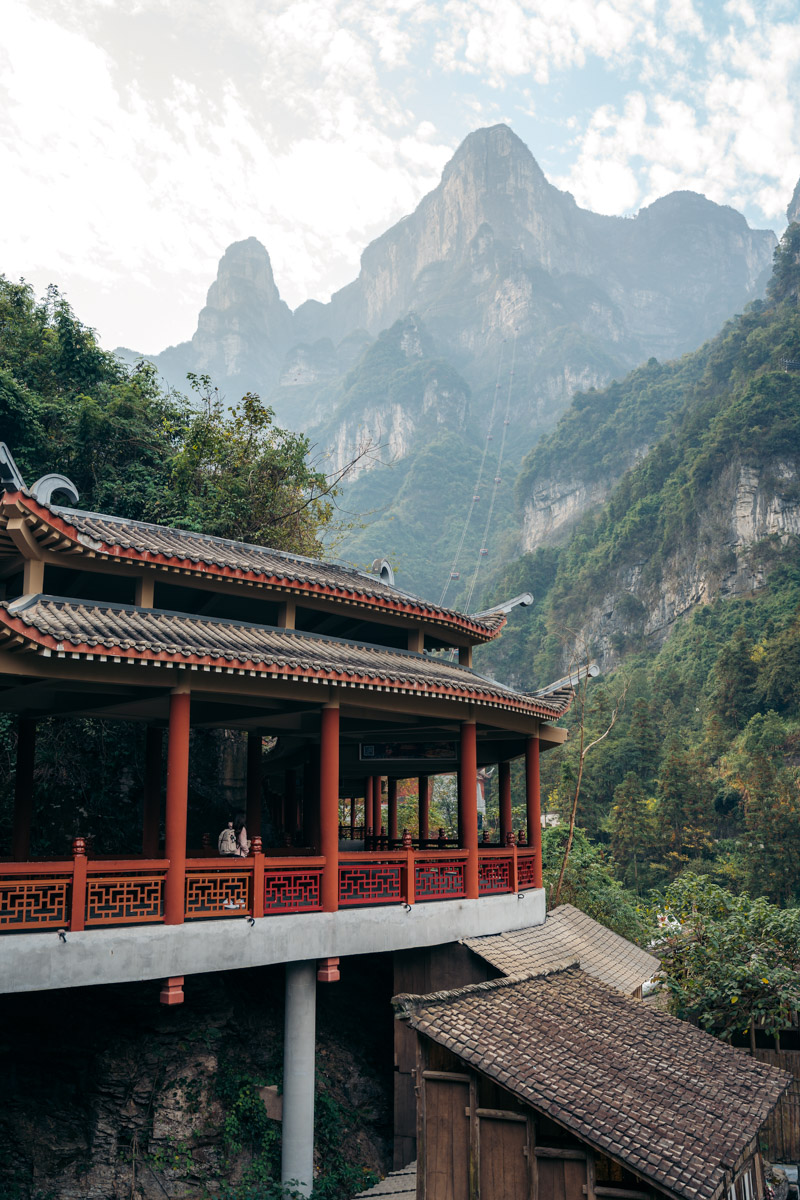
The sheltered walkway was very scenic and we kept peering out to the towering, jagged mountains above us, as well as the amazingly steep express cableway we were about to board. As much as we were rushing to get to the cableway station and get up to the top, we appreciated that the walk got us to slow down and take in our surroundings as much as we could before leaving the base and heading up.
Riding the Express Cableway Up to the Stairway Base
I know everyone wants to flock to the long scenic cableway, but this ride was already so beautiful in its own right. Each gondola has a capacity of up to 26 people and it operates like a large bus moving through the sky.
The windows were floor to ceiling, and we could look out on all sides to the changing scenery as we were transported from bottom to top in just 5-7 minutes. I personally couldn’t move fast enough to snap shots of the climbing angles of the mountain peaks, but it was an unforgettable cablecar ride that rivals many of the ones we took in Switzerland’s Jungfrau region.


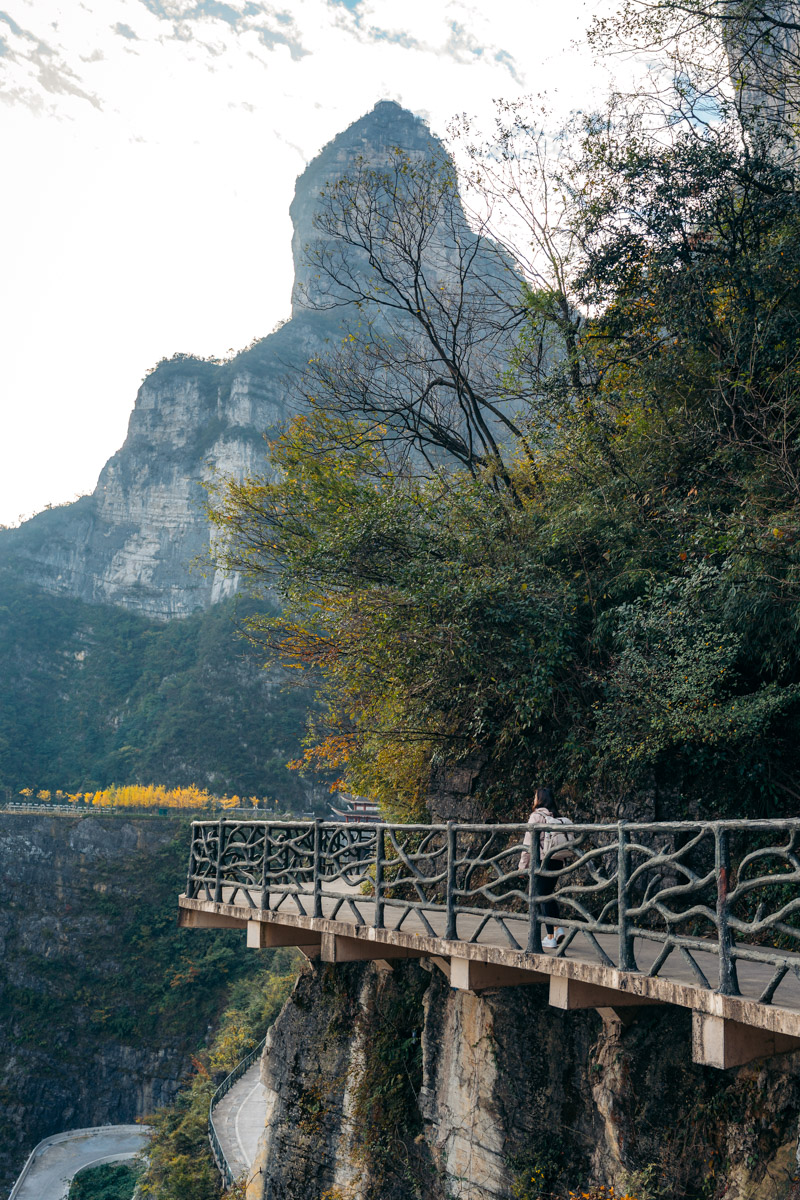
Once we got off at the top, we could see below to the winding mountainous 99-bend road (Tongtian Avenue). There weren’t any vehicles coming up with the road, and honestly, I’m not sure what the road is used for now that the cable cars are in operation, apart from bringing up supplies. Maybe they have car exhibitions on here? That would be quite the event!

There was a stunning cliff walk that curved around the rock walls and led to the base of the “stairway to heaven’s gate”. Seeing the 999 steps up close for the first time was a sight to remember!
The plaza at the base of the stairway was massive, which is probably a necessity for the volume of people who visit Tianmenshan. There are a ton of washroom facilities throughout the mountain, but it’s a good opportunity to use them now before you make the climb and start exploring.
Climbing the 999 Steps of Tianmen Mountain
The climb up the 999 steps of the Stairway to Heaven’s Gate started off fairly easy, as the steps weren’t very steep yet, and there were some platforms in between step segments to give relief. But very quickly, the stairway became steeper and steeper, with four railings placed equidistantly for the steeper sections.
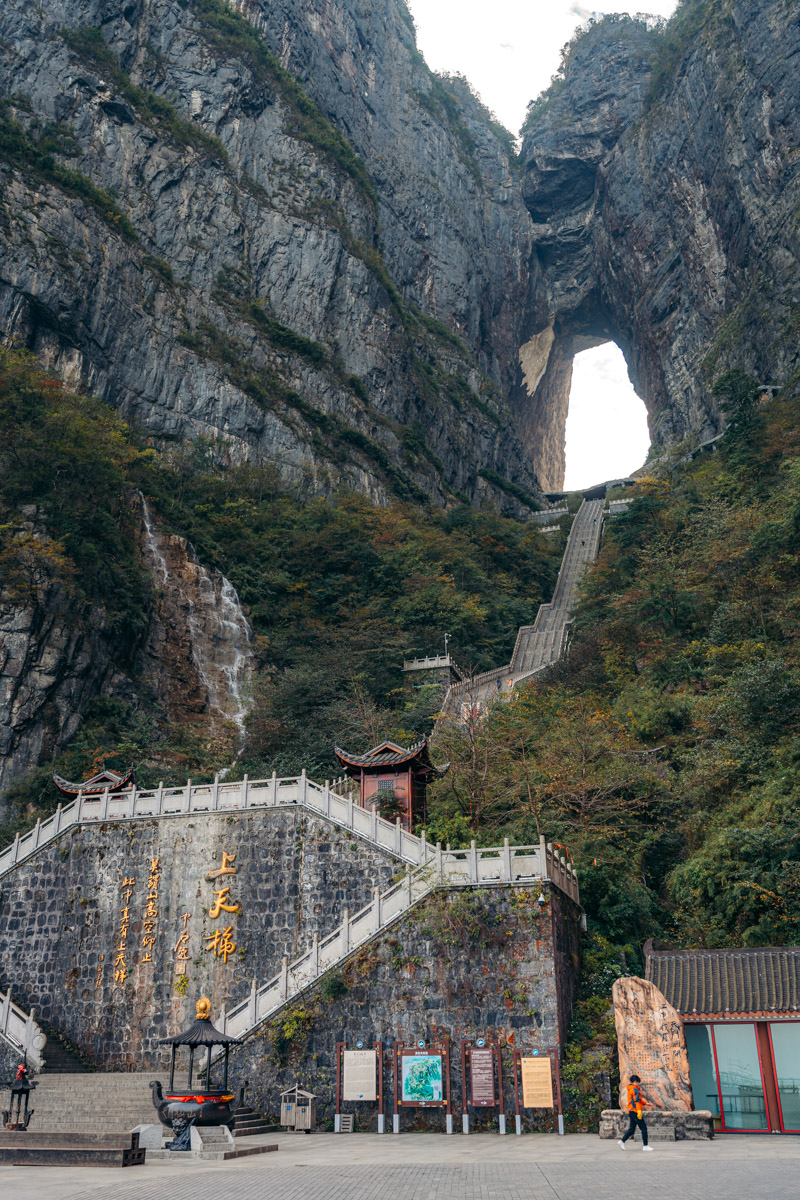


It levels out a little bit with sections of shorter steps in the middle, before you start the final section, where the steps are consistently steeper to follow the sharp angle of the mountain. You’re practically climbing up a vertical at this point, so take your time and use the railings to give your legs a bit of a break.
We took a leisure 40 minutes to climb up the stairway so we could take photos, film, and be humbled by the immensity of the mountain. The stairs looked so fine and small when we first arrived, coming around the bend of the cliff walk. But now that we were in it, we were the ones who felt like the tiny brush strokes on a massive canvas.

If you find that climb will be too daunting, physically or mentally, or you have any mobility impairment, the good news is that there’s the option of taking an escalator all the way up instead. You could always walk up the stairs for a short stretch and come back down to take the escalator if you so choose. It comes with a cost add-on of 32 RMB (as of early 2026), which you can buy onsite.
As we reached the top, I tried not to look down and only looked up with my jaw dropping further than it already was. Entering the mouth of the cave—because that’s what “heaven’s gate” is, a massive cave upon on both sides—it occurred to us how deep the archway really was. It didn’t look like the flat opening we first thought it was, but an extremely high tunnel.

The natural patchwork of the archway, with white stone against the dark grey, and lush greenery that was growing in the crevices of the stone, was incredible. But the hero shot was the window that the archway created, as we looked out to the bottomless sky, the clouds gliding across the frame with the silhouette of mountains in the distance. The wind started tunnelling through, but we caught a bit of reflection on the calm water that pools directly under the archway.

Looking back down to where we came from, to the square at the base of the stairway, was equally as humbling as it was rewarding. But now it was time for us to continue on and venture the entirety of this large mountaintop.
Midday (10am to 1pm)
Taking the Trans-Mountain Escalators to the Summit
From the archway, you’ll be able to walk through to the other side of the mountain, gaining some new views, before entering an ascending tunnel that will take you from the cave level to the summit level of Tianmen Mountain. I may have lost count in the process, but we went up a total of (I believe) 7 crazy long escalators! Each of them spanning across multiple floors.

We came out on the other side and arrived at a very busy landing, where a lot of folks who took Route A had just arrived after their long scenic cablecar ride. For the rest of the day, we’ll be walking all the way around the summit plateau before nearly closing the loop to the Upper Cableway Station.
Update 2026: With the long scenic cableway closed as of October 13, 2026, visitors must use Route C to return to Zhangjiajie City. After completing the entire clockwise loop around the summit plateau, find your way back to the seven-flight in-mountain escalators to head down the mountain.
We used the following map to help us navigate and know what sites we were exploring. Keep note that the north arrow is pointed downwards—we messed up our sense of direction for the first bit of hiking if you figured that out in the video.

The circular hiking system wraps around the cliff edges, with some detours and forks in the path that lead through forested areas or to higher vantage points. It features two main hiking routes that meet in the middle of the plateau, and connect at the Tianmen Mountain Temple and the Tianmen Mountain Upper Cableway Station. Combined, the eastern route and the western route total approximately 7km of hiking, less so if you skip forest trails that cut through the middle of plateau up to Yunmeng Fairy Peak.
Most visitors prioritize doing the western route due to its nature of being more “thrilling”. But if you have the time, we highly recommend exploring both, starting with the eastern route.
Exploring the Eastern Route of the Plateau
We found that taking the eastern route offered a quieter experience, especially by Chinese standards, as most tour groups don’t come this way with the limited amount of time they might have. Perhaps it was because it was a bit longer than the western route, at around 4km in distance.

One part we skipped over that perhaps we shouldn’t have is the segment of the eastern route on the north side, between the top of the Trans-Mountain Escalator and the Upper Cableway Station. Here, you’ll find the Davidia Involucrata Garden and the Coiling Dragon Cliff (Panlongya) Skywalk. This skywalk is the newest and longest skywalk on the mountain, measuring about 100m long. Clinging dramatically to the cliffside with huge vertical drop views, it’s considered to be the most captivating as it sits high above the 99-bend mountain road.
If you don’t want to miss out on the iconic view of the insane Tongtian Avenue directly below your feet, then be sure to make the 30-minute detour heading counterclockwise before embarking on the rest of the eastern path. Just note that it can get very busy, and you might get a little bit of resistance with the crowds going in the opposite direction taking Route A, since it is right between the cableway station and the escalator. You can also tack it on at the end of your walk along the plateau before descending the cableway if you prefer to save it for later!
If you do miss the Coiling Dragon Cliff Skywalk like we did, don’t worry! You can still catch a full view of the 99-hairpin road when you reach from the Yuhu Peak in a quick minute, as pictured below.

Now, back to where we were in the square at the top of the Trans-Mountain Escalator. You’ll start making your way through the less crowded walkway and up to Yuhu Peak, where we got an incredible, unobstructed vantage point of the verdant mountain ridge lines and peaks below, the winding Tongtian Avenue, as well as the insane cliffside of Tianmen itself.
From here, we could see a significant portion of the northern section of the eastern route, including where we just came from, as well as Yunmeng Fair Peak, at the heart of the summit.


From there we made our way around the eastern corner and met our first skywalk, the Eastern Glass Cliffside Path. For 5 RMB, you can rent the mandatory soft shoe coverings that allow you to walk the glass floor and see all the way down the cliff right under your feet.


We loved this skywalk a lot, mostly because it wasn’t busy, but also because we could see the backside of the Tianmen Cave from above.

From hereon out, we were able to mostly keep to the edge of the cliff, walking along concrete paths that wrapped around the vertical drops with absolutely nothing below. I loved it and the way they designed the wooden branch guardrails was so unique.
After just under two hours, we made it to our halfway point, the Tianmen Mountain Temple.

rom here, you could take the Sightseeing Chairlift (which costs about 25-30 RMB per person for a one-way ride) up to the Yunmeng Fairy Peak. As I mentioned above, you can also hike up to it from the upper cableway station, either taking a western trail or eastern trail.


While we were at the Tianmen Mountain Temple area, we grabbed a quick lunch. Surprisingly—especially compared to other scenic destinations in China we’ve visited like Zhangjiajie Forest, Wangxian Valley and Huangshan—there were so few food options here. There was essentially only one restaurant open and some vending machines. No street food stalls whatsoever.
The restaurant we saw open only offered a few simple dishes: either plain rice or noodles with a meaty stew. We got the stir-fried pork and green peppers with rice and noodles, which cost 35 RMB per dish. Expensive for what it was, but we were on the top of a mountain, so we’ll take what we can get.
Afternoon (1pm to 3pm)
We spent the rest of our time on Tianmenshan exploring the western route before heading down the longest cablecar in the world.
Exploring the Western Route of the Plateau
As we made our way around the western corner, we reached the Suspension Bridge, which is not as intimidating as one might think. It’s actually incredibly sturdy and very wide, allowing for large weight capacities and heavy traffic, as opposed to the suspension bridges we’ve walked on in Canada (like in Kitsilano, Vancouver).

After that we made it to the Guigu Cliffside Path, which is the longest continuous stretch of plank walk at 1.6km. The extent to which Chinese labour ingenuity goes is next level. Every time we took a new corner, we would peer out to the adjacent cliff that we were heading to and be completely mind boggled as to how they built this sturdy, wide and smooth concrete path that snaked around the natural vertical wall.

We found the mountain peaks to be equally captivating on the western side of the plateau as well, and there was yet another glass walkway to take before we neared the end of our route. The Western Glass Cliffside Path measures 70m in length, and once again, sits 300-500+ meters above the ground below. These are numbers that are hard to fathom, and you’ll be humbled by them when you step on the glass floor.

You might find it start to get much busier as you start to near the upper cablecar station, as many folks who’ve come later in the day will only do the western route going counterclockwise. So just be prepared for a little squeezing past others and a some shoulder to shoulder action.
Returning Back to Zhangjiajie City by Cableway
Update 2026: Unfortunately, the long scenic cableway is now fully closed for upgrading as of October 13, 2026. During our visit, we were able to take this incredible cable car down from the summit, but it’s currently suspended until further notice.
With only Route C operating, you’ll need to complete the entire clockwise loop around the summit plateau and find your way back to the seven-flight in-mountain escalators. Take the escalators down to Tianmen Cave, descend the 999 steps, and then take the Tianmen Cave Express Cableway and connecting bus back to the Tianmenshan Lower Cableway Station in Zhangjiajie City. This is the same express cableway and bus combination used to reach the mountain at the start of the day. Allow enough time for this return route before the park closes.
I’ve kept our itinerary below to show you guys what the long scenic cableway experience is like for when it’s open again.
You’ve wrapped up a full day of stairs and walking around the summit of a large mountain! But the day isn’t over yet. You can’t forget about the most incredible feat of engineering of Tianmen Mountain: the record-breaking long scenic cable car! As I mentioned earlier, it spans 7,455m and climbs an elevation of 1,279m! No wonder it takes 25-30 minutes to go each way.

Remember how I said that the most popular route is Line A, where people start with this cable car and finish with the express cablecar, instead of the other way around? Well, there were still a ton of people lining up to get on this cablecar down, meaning that even though Line B is not as popular, that’s only by China standards. It is still incredibly busy no matter which way you go. So we stood and line and weaved our way through the snaking queue for about an hour before we finally got through the gates to get on the gondola.
The ride was as gorgeous as they say it is, and now I know why starting with it taking Line A is so sought after, because I could only imagine what it would be like to have these insane mountain views revealed to us at first light instead of departing the mountain views that we had grown used to.

Even so, at least we got to experience all of it nonetheless. As we made our way down, we could spot the express cableway across the valley, showing how we had come full circle. And half an hour later, we arrived back to where we started our day, at the lower cableway station.
Essential Tips for Visiting Tianmen Mountain
Before I wrap up this guide, here’s a review of some essential tips that I briefly mentioned to ensure you’re best prepared for your Tianmenshan visit.
- Entry & documents: make sure to bring your passport if you’re a foreigner, whether you already have pre-purchased tickets or are buying tickets on the spot at the ticket office.
- Tickets: we recommend you book your entrance tickets in advance, especially during peak season, and Line B is our personal favourite route.
- Timing: go early at opening time to avoid the crowds for as long as possible, and steer clear of going over major holidays (mentioned above) and on a cloudy day.
- What to wear: comfortable shoes are a non-negotiable, and wear layers and a light windproof jacket as temperatures can change quite a bit on the mountain.
- Food & water: there are limited options that are actually healthy so pack some snacks. Drinks are never hard to come by but bring water with you.
Tianmen Mountain FAQ
- Do I need to bring my passport?
Yes. For pretty much every scenic attraction in China, whether it is to redeem your e-tickets or to purchase tickets on the spot. - Can I visit Tianmen Mountain with ease even if I don’t speak Chinese?
Absolutely. So long as you’re well prepared, with my travel guide in your repertoire, you shouldn’t run into roadblocks due to language barriers. There is signage in English everywhere, and if you do need to communicate with any park staff, pull out your translator app to do so. - Are the stairs mandatory?
No. You can take the escalator to bypass the 999-step stairway, and there are the seven long escalators to take you from the Tianmen Cave to the actual mountain summit. - Is it scary if you’re afraid of heights?
If you’re taking the stairs up, when you near the top of the stairway and look down, it can be a little freaky due to the steepness. We also encountered some folks along the cliff walks who were hugging the wall because looking over the guardrail triggered their irrational fear of heights. These were rare instances as there are no unsafe ledges to worry about. - How long does it take to visit?
You can use our timeline of 7am to 3pm from start to finish as a good estimate for your visit. Unless you are visiting during a very busy time of year, 8 hours should be a sufficient amount of time to take the stairs and explore both the eastern and western route of the Tianmen Mountain summit. - Is it suitable in bad weather?
Honestly, you’ll need to evaluate how much you’d rather visit than not at all if you happen to be here when the weather is not ideal. We explored Huangshan across two cloudy and rainy days, and it was still magical, even though we couldn’t see much below us. If you can handle rain, wind and moments of poor visibility, Tianmen Mountain can still be breathtaking beautiful with low hanging clouds wisping across adjacent peaks, and you might get some eerie experiences walking the stairs or glass skywalks through the fog. Just make sure to evalute the safety of walking the steps if the rain renders them slippery. - Are there lockers available for luggage storage?
Although we couldn’t confirm for ourselves, the most up-to-date information has shown there to be lockers or a storage service at the lower cableway station near the ticket window. I would suggest confirming that before you go. The cost should range from 10 to 30 RMB per bag, and should be open during the park operating hours, closing at the same time the site closes. Make sure to recuperate your belongings before that time! - Can I fly my drone here?
Unfortunately, no. Many scenic spots that have temples and religiously sacred places don’t allow drones to to take off and land, unless you have a specific permit to do so here. China’s government is cracking down more and more on drone flying now, so even though we managed to fly in other parts of Zhangjiajie in 2024, it’s much harder to do so nowadays. - Is the Zhangjiajie National Forest or the Zhangjiajie Glass Bridge near Tianmen Mountain?
No, it can be confusing given that they have the same name as the city, but only Tianmen Mountain is directly entered through Zhangjiajie City. The Zhangjiajie Forest, home to the famous “Avatar” mountains, is located about an hour away in the Wulingyuan Scenic Area. The Zhangjiajie Glass Bridge is also a separate attraction, located 40 minutes from the forest and roughly 1-1.5 hours from Zhangjiajie city centre.
Thanks for Reading!
I hope this guide gives you everything you need to best prepare for your visit to the Mountain of Heaven’s Gate! If you have any further questions that I didn’t address, make sure to leave them in the comments below.
Now that you’ve discovered the gateway to Zhangjiajie, don’t stop here—make sure to check out my complete guide to visiting Zhangjiajie National Forest Park to start planning the rest of your trip.
And before you go, be sure to check out my must-know tips for visiting China in 2026, along with my other guides to can’t-miss destinations across the country to help you plan the rest of your adventure.