

Ultimate Guide to Visiting China’s Zhangjiajie National Forest
China is truly one of the most jaw-dropping countries I’ve ever explored, and we had the privilege of doing so across 5 weeks last fall. The landscapes here are drastic in diversity and impression. From desert dunes to skyscraping Himalayan mountains, floating village houses hanging on cliffs to tropical beaches… and then there’s Zhangjiajie.
If you’ve ever watched Avatar and felt totally transported to the floating mountains of Pandora, you’re not alone. Those surreal, towering sandstone pillars were inspired by a real life place located at the heart of China: the Zhangjiajie National Forest in Hunan Province. Formed over millions of years through physical erosion and tectonic uplift, these quartz-sandstone formations look like something straight out of a fantasy world. Seeing them in person? Even better than the movies.
Zhangjiajie shot straight to the top of my China bucket list the moment I saw those scenes in theatre. But it’s not just on mine—it’s a dream destination for many of the 1.5 billion people living in China too, not to mention travellers from around the world. Meaning it can get unfathomably busy. Which is why I wrote this guide! To help you avoid the crowds, uncover lesser-known areas of the park, and make the most of your visit without losing your mind.
I’ll be breaking down the five main sections of Zhangjiajie National Forest Park (not including Tianmenshan which we explored separately), sharing a detailed two-day itinerary we fine-tuned with the help of local guides, and pointing out my absolute favourite photo spots along the way. China isn’t the easiest country to navigate, especially if it’s your first time. But with a little planning (and a lot of local insight), it becomes an adventure you’ll never forget.
How to Get to Zhangjiajie
If you look up Zhangjiajie on maps, you might stumble upon a city and not a national park. Although it is not within reach of the jaw-dropping quartz sandstone pillars that you’ll want to see, it is the starting point to your journey of reaching the real life Pandora forest.
As cross-country transportation goes, you’ll most likely be taking a train during your visit to China. Of course, planes are also an option, especially if you’re travelling from further away, but the Chinese high speed railway is an extremely efficient way to get around the provinces.
Regardless of how you get yourself to Zhangjiajie City, whether by plane or train, you will definitely want to book your tickets on trip.com. For foreigners, there is no other way to booking your train tickets online without a residence card and it is extremely user friendly. And as much as I am for booking flights directly with the airline, most domestic Chinese airline websites are highly difficult to navigate, or straight up don’t exist! Trip.com makes life so easy for foreign travellers and acts as a great third-party agency that saved us a number of times.
Once you arrive in Zhangjiajie City, at either the railway station or airport, you’ll want to make your way to the town of Wulingyuan. It’s a small and quaint town, acting as the gateway to the national forest.
We ended up staying in this super affordable homestay in walking distance to the East Entrance of the park. There are many other accommodation options in the town to choose from, ranging from local inns to resorts, yet all incredibly reasonably priced.
Best Time to Visit
Most people will tell you to avoid going to Zhangjiajie during the rainy season, starting from May to August. But there is a unique beauty in watching rain clouds rise above the valley and hug the pillars and mountains of the forest. It’s something we truly missed from our time as we only had clear but hazy blue skies.
As much as our photographer hearts ached for some low clouds and moodiness, I know most of us wouldn’t complain about perfect and unwavering weather. We were in Zhangjiajie at the tail end of October which meant sunny yet cool weather and fewer crowds.
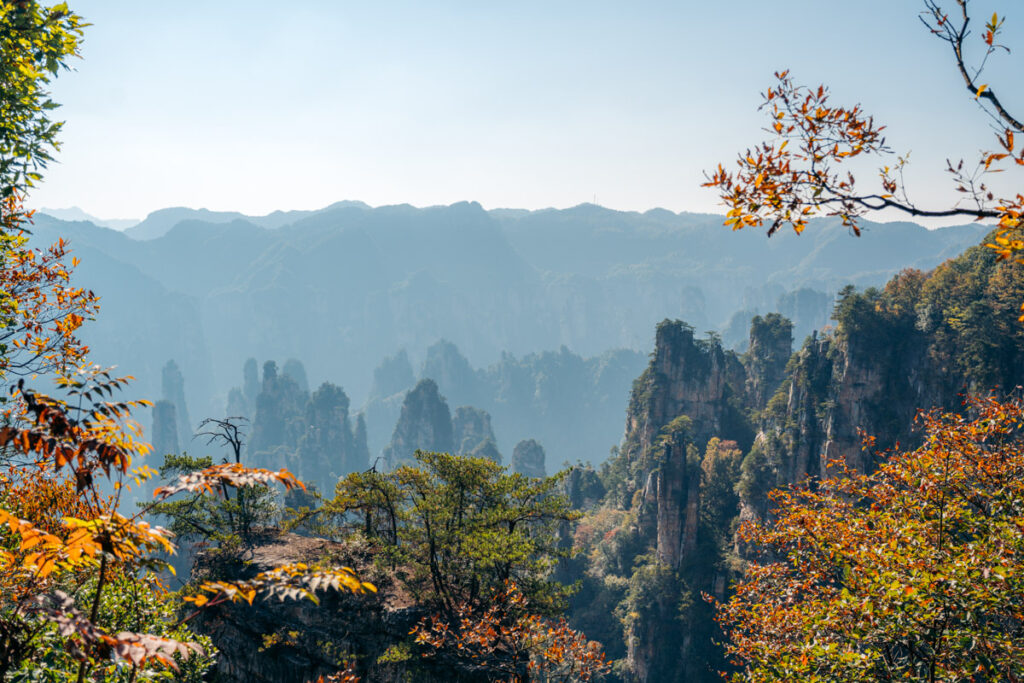
I won’t lie, there’s never really a “non busy” time in Zhangjiajie, but this was honestly the best we could have asked for, the perfect combination that made for an ideal lower season.
Going in mid to late fall and early spring means you also avoid the two major Chinese holidays: Golden Week and Chinese New Year. These two are the absolutely “STAY AWAY” holidays that you must avoid when travelling in China. You haven’t seen chaos and crowds until you travel through the country during those times!
Itinerary Breakdown
Now that we’ve covered the where and when, it’s time I give you a lay of the land for this large national forest.
Zhangjiajie National Forest can be visited with a 4-day pass. This is actually the standard ticket you will need to enter and roam the park. That also means that it can take four days to explore all the main nooks and crannies that the park has to offer.
But in truth, you only really need two days to see the best and greatest viewpoints in the park, thanks to its reliable bus shuttle system and extensive cableways.
There are five main sections of the park and one bonus area:
- Yuanjiajie: the main attraction, home to the Avatar Hallelujah Mountains
- Yangjiajie: a much less visited hiking trail area with hidden gem viewpoints
- Tianzi Mountain: home to the Monarch of the Peak Forest
- Huangshi Village: not actually a village but a large natural viewing deck high up offering views of the Five Fingers Peak
- Golden Whip Stream: a valley walk along a beautiful stream at the base of the stunning pillars
- Ten Mile Gallery: a bonus trail at the base of Three Sisters Peaks with handcrafting and cultural goodies at the end
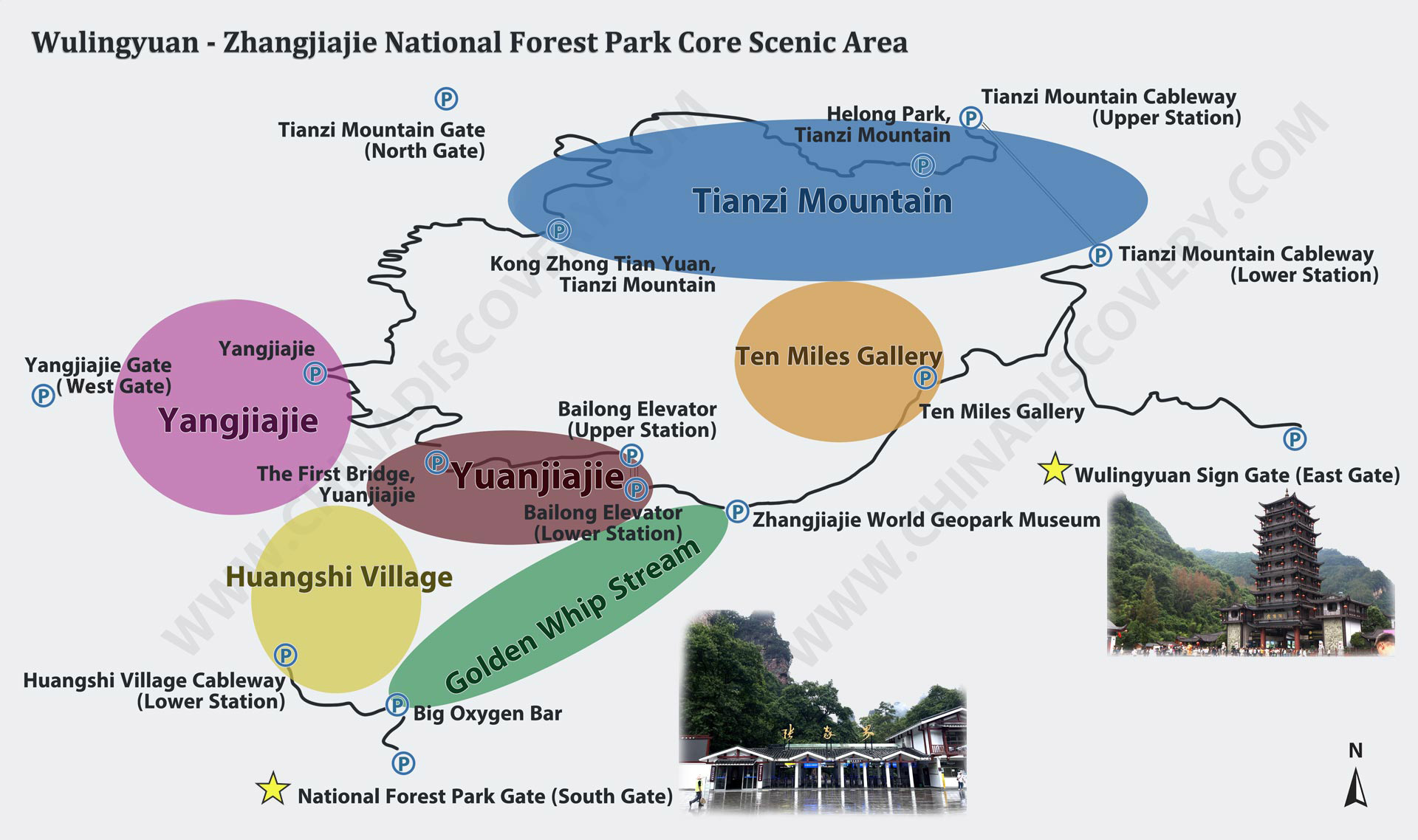
It may seem like a lot but it’s all easily doable to visit within two days with time to spare. The six sections can be split down the middle, with three of them on one day and the other three on the next day. With this itinerary, vetted by local regulars who frequent the park, you’ll be able to see the best of what Zhangjiajie National Forest has to offer.
On the first day, you would start your journey at the main east entrance, and explore the world up top at Yuanjiajie, Yangjiajie and Tianzi Mountain. On the second day, you would head off to the south entrance and explore on high from a new perspective at Huangshi Village, followed by roaming the valley below at Golden Whip Stream and Ten Mile Gallery.
All of this is shown in our Zhangjiajie video guide below, but don’t worry, I’ll be explaining in further detail what you’ll see along the way!
Yuanjiajie Avatar Hallelujah Mountains (Day 1)
We aren’t wasting any time and are going straight for the hero postcard views of Zhangjiajie right off the bat. As I mentioned above, Yuanjiajie is home to the most iconic sights in the whole park. But to get there, it does take a couple of steps.
After entering through the east entrance, you’ll need to catch the free park shuttle bus heading for the Bailong Elevator. There are different routes you can take so make sure you get on the right one! When in doubt, you can quickly ask the attendants for which bus takes you to the Bailong Elevator.
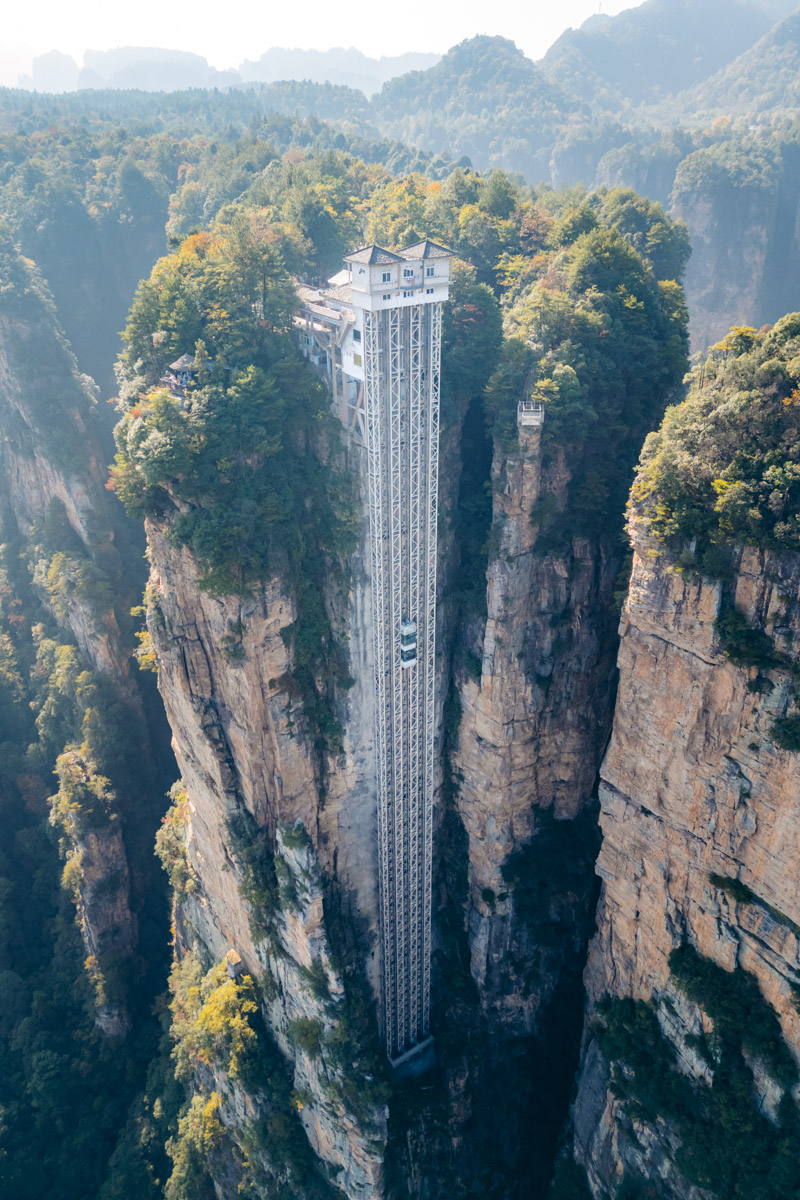
This is the coolest engineering feat in the whole park. It’s actually kind of insane that they built an elevator there in the first place. I mean, that’s a first for us to see in a nature destination!
The Bailong Elevator has smashed a number of world records:
- it is the the tallest outdoor elevator at a height of 326m
- as well as the tallest double-deck sightseeing elevator (yes, there are actually two decks to each of the three elevators)
- it is the fastest passenger elevator with a time of only 1 minute and 32 seconds
- and has the largest loading capacity at 46 people per trip
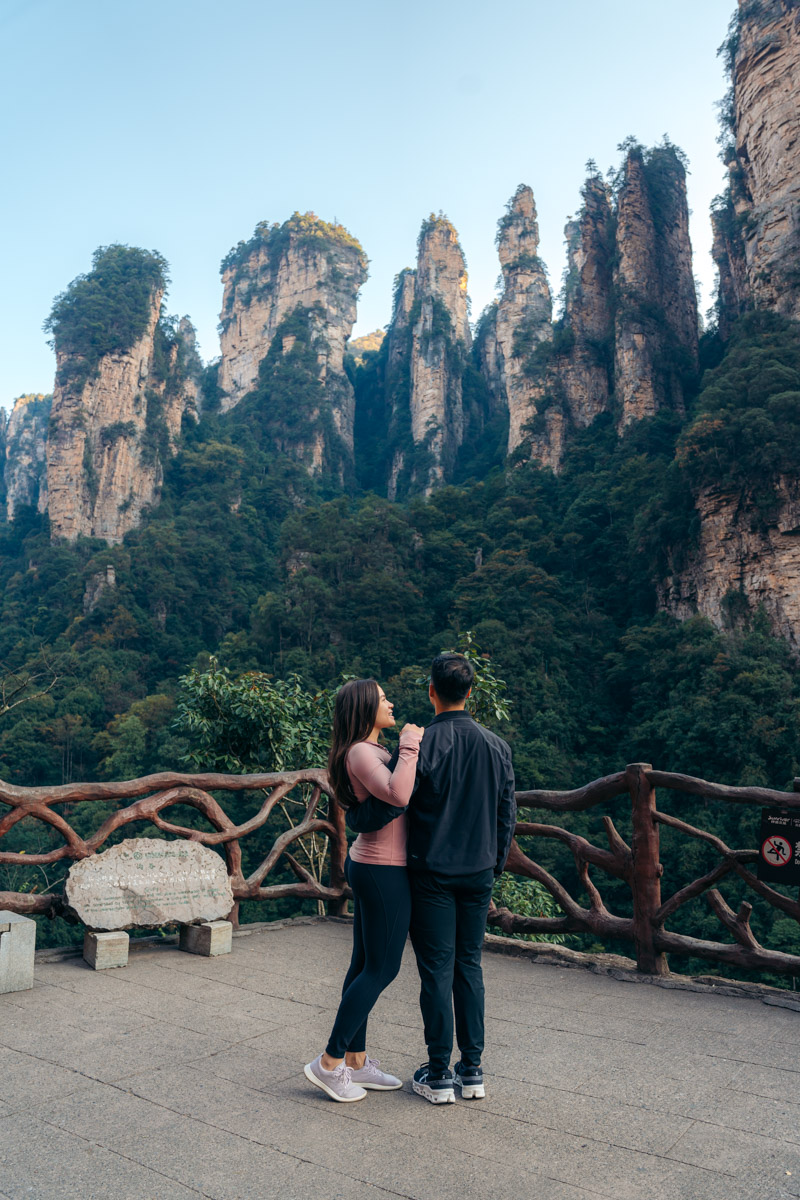
When the shuttle bus drops you off at this stop, you’ll want to make your way passed the ticket counter (if you’ve already purchased your elevator tickets) and around to either the outdoor stairs or initial elevator taking you up to the lower platform, a gathering area before the entry gates to the Bailong Elevator. From here you can enjoy your first viewpoint in Yuanjiajie, facing the non-uniform towering pillars.
Once you’re ready to go through the Bailong entry gate, you’ll walk down a long hall and reach the end where a line may form leading to either the first or second level of the elevator. Each of the three elevators are double-deckers, both decks offering the same space and view.
When you’ve made it onto the elevator, try to face out to the glass and get your cameras ready! It’s a short record-breaking ride, so it’ll be over before you know it! But enjoy your first view climbing up above the mountains with the morning light spilling in through the valley.
Once you’ve made it to the upper platform, you can walk the path leading to another bus station. There are some restaurants and restrooms here if you need them—particularly to grab a hot coconut latte from KFC!—before you climb onto your second bus taking you the Hallelujah Mountains.
Getting off at what they call the Enchanting Stop, this is where you walking journey through Yuanjiajie really starts. You’ll be coming across different viewpoints left and right, some paths leading you right along the edges of the walkways, others leading you up to terraces with different vantage points. They all conjoin back together so you’ve got the freedom to wander and circle back to walk the routes you might have missed.
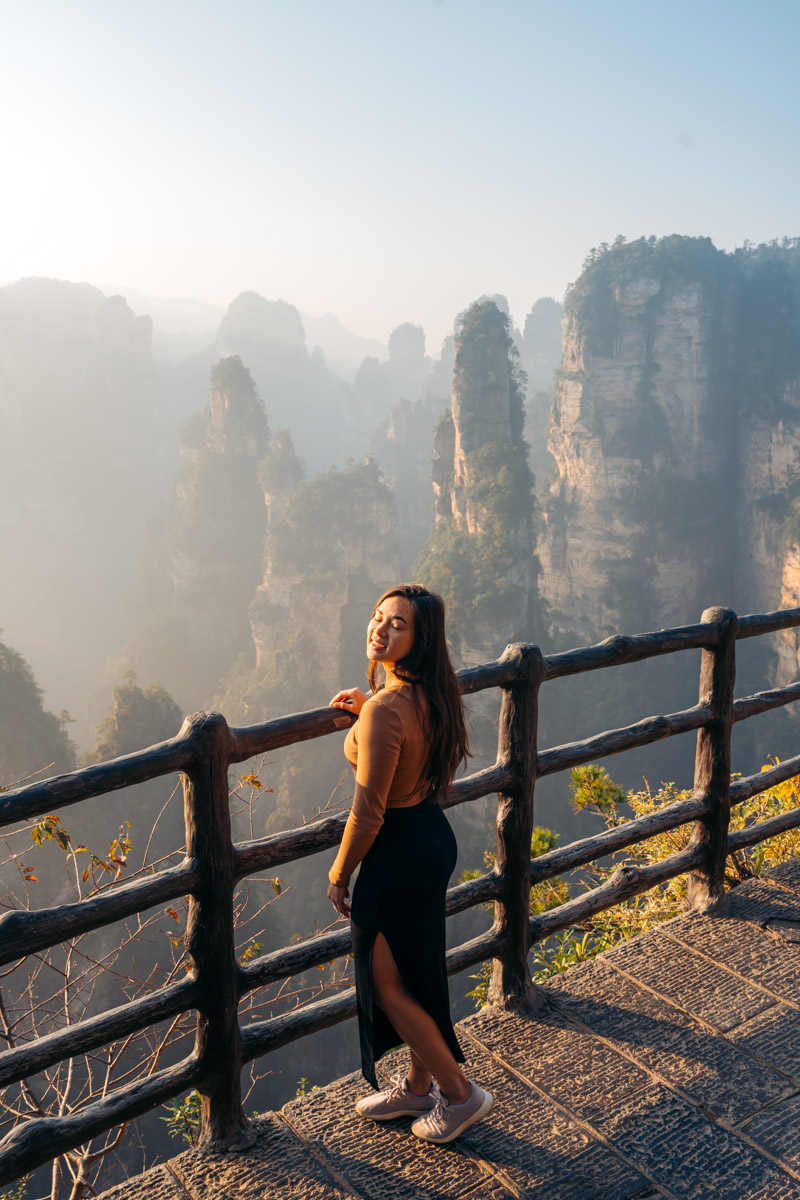
The views really open up once you reach the viewing deck that leads you to see the Heavenly Pillar. It is where it gets most crowded as people stop to gape out to the mountains and then slowly start to make their way, stopping ever few steps.
The Heavenly Pillar is the hero shot, in my opinion. It’s a majestic tower that looks to be standing its weight on the smallest surface and progressively enlarging towards the top. There are quite a few spots where I loved snapping photos of the pillar, particularly sections where there’s a higher viewing terrace just behind a lower deck. Keep your eyes peeled for stairs leading up if you want your Instagram husband to capture you in frame along with the pillar just beyond the guardrail!
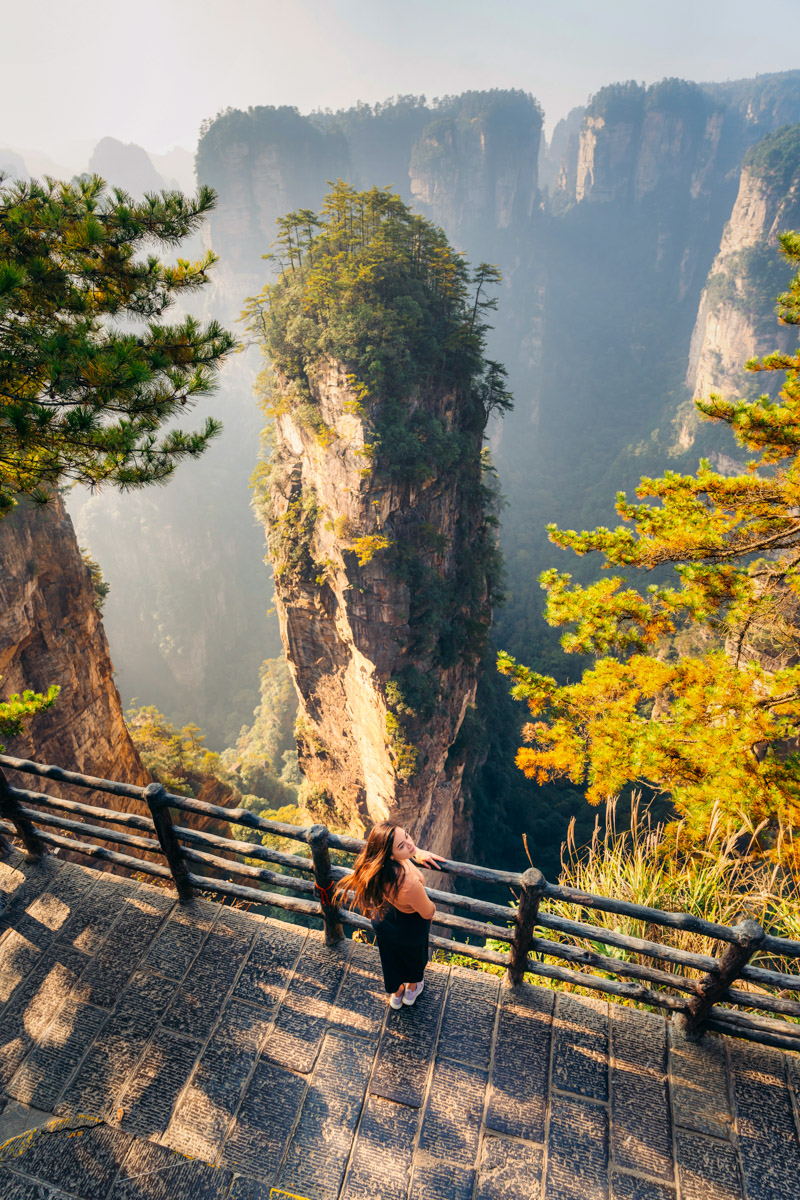
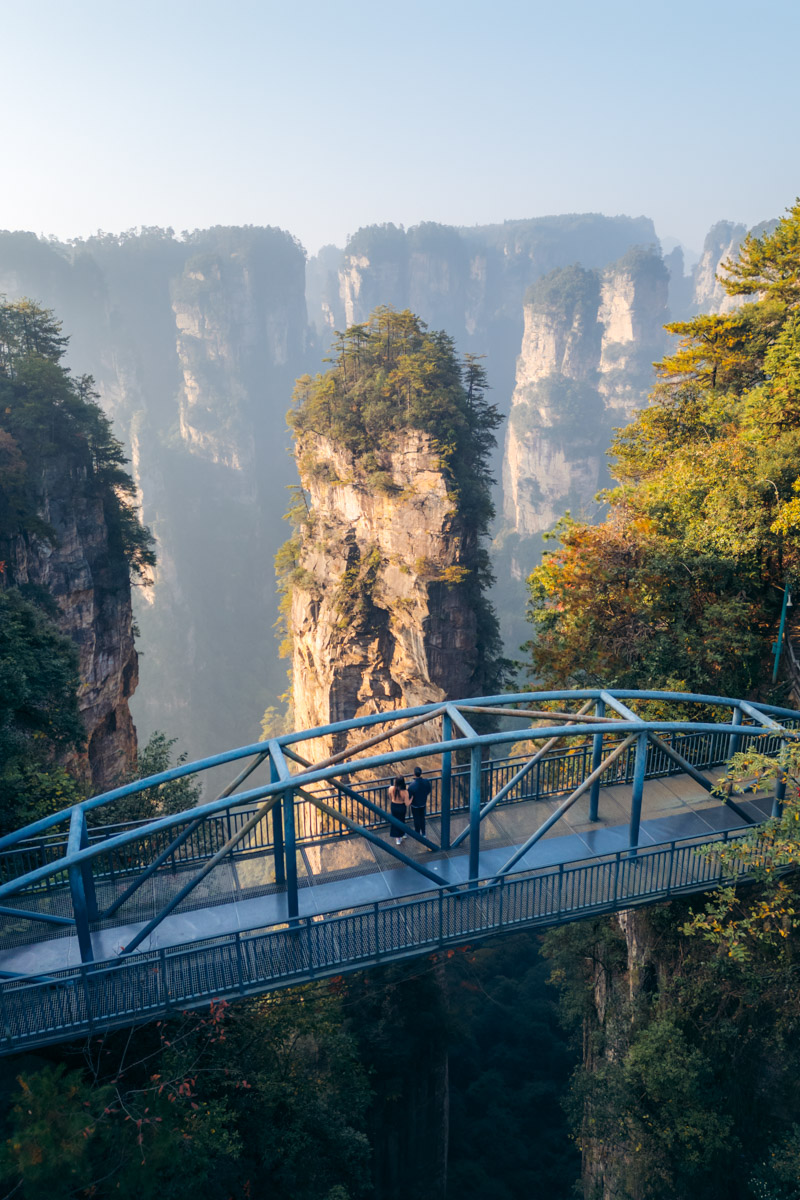
Another favourite spot of ours is the blue painted metal bridge that crosses from one cliff to the other. There’s a completely unobstructed view of the Heavenly Pillar here and we popped the drone up to capture us on the bridge overlooking the natural landmark!
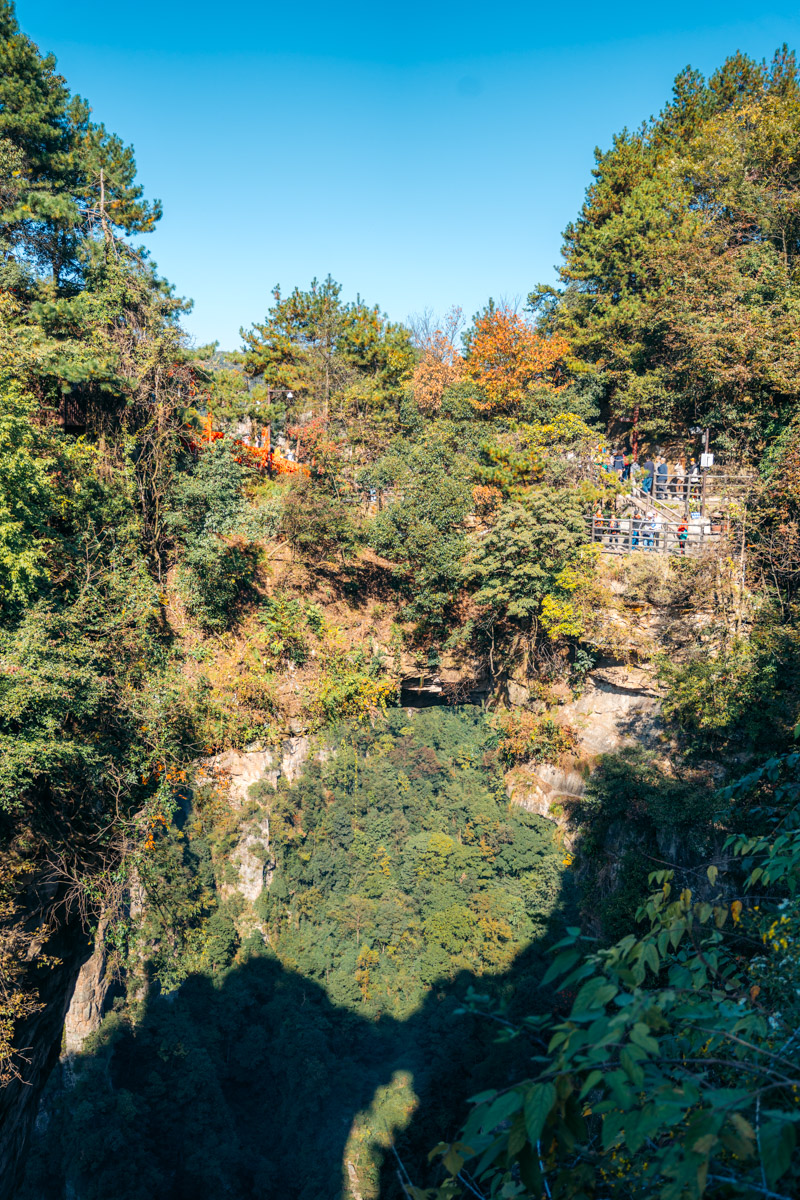
This is about the halfway point and after that, the next highlight is the Greatest Natural Bridge, a natural archway connecting one cliff to another that hovers 350m above the ground. Besides this fact, it’s not the most fascinating area, but you can head across the natural bridge and do a loop around the forested pillar that is covered with red fortune ribbons. It’s the first culturally sacred area that you’ll walk through in Zhangjiajie.
Yangjiajie (Day 1)
After wrapping up at the most popular areas of the forest, it’s time to explore the least visited section. The shuttle bus will drop you off at Yangjiajie and you just need to walk around the bus station to reach the main foot path lined with shops for light bites and drinks. Continue walking down and you’ll reach a cross road that will lead up to the cable car station or further down to where the hiking trails start.
You’ll notice how the crowds thin out here which we certainly didn’t complain about. The trail goes from paved to dirt, heading into the woods. The signage isn’t the best here but there should be workers or even tour guides from whom you could potentially ask for directions. Pull up those translation apps I mention in my visiting China guide here and point to the One Step to the Heavens spot on your Zhangjiajie map!
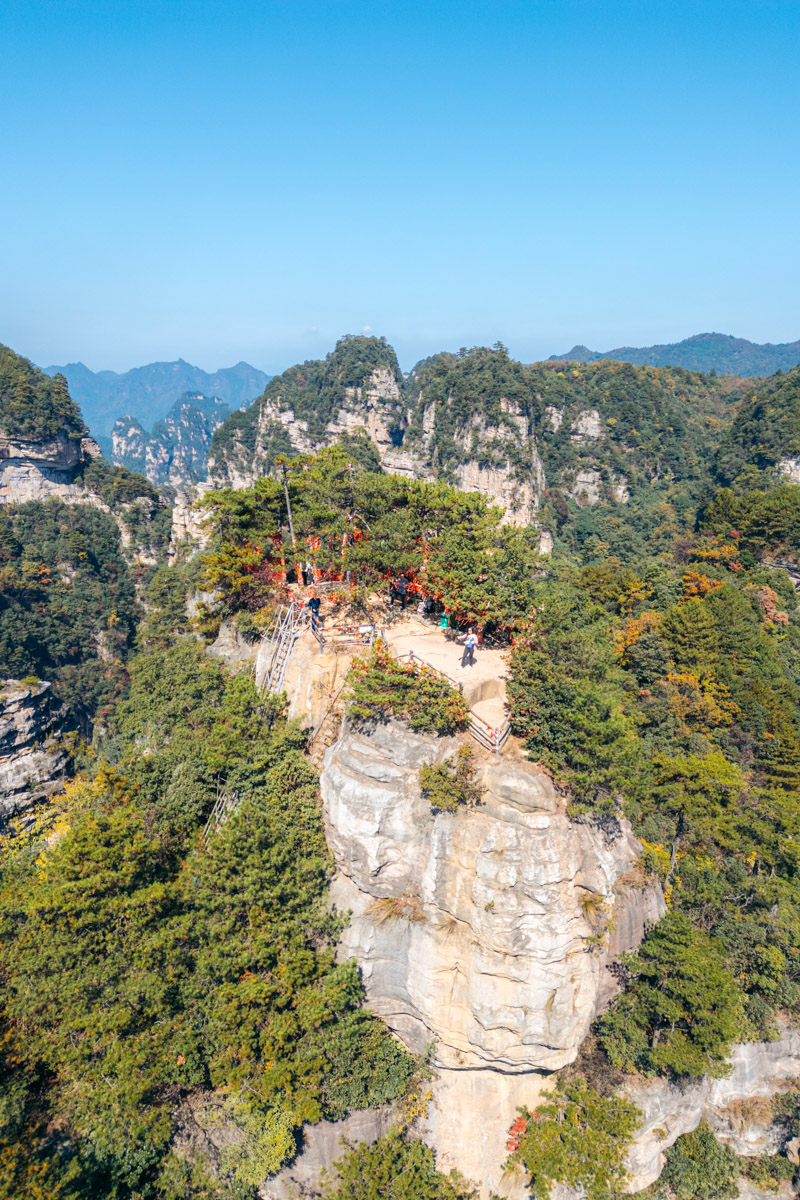
That’s where we headed as it was our homestay’s owner’s favourite place in the whole park!
It was a peaceful and comfortable trail, with a few sections where they had added tiled stone walkways and stairs. Fairly short too at only about 20-30 minutes to reach the viewpoint. It’s only once you get there that you need to climb a whole vertical ladder to get up top! Super fun, but can be daunting with people with a fear of heights or falling. Take your time when going up and down the opposite ladder.
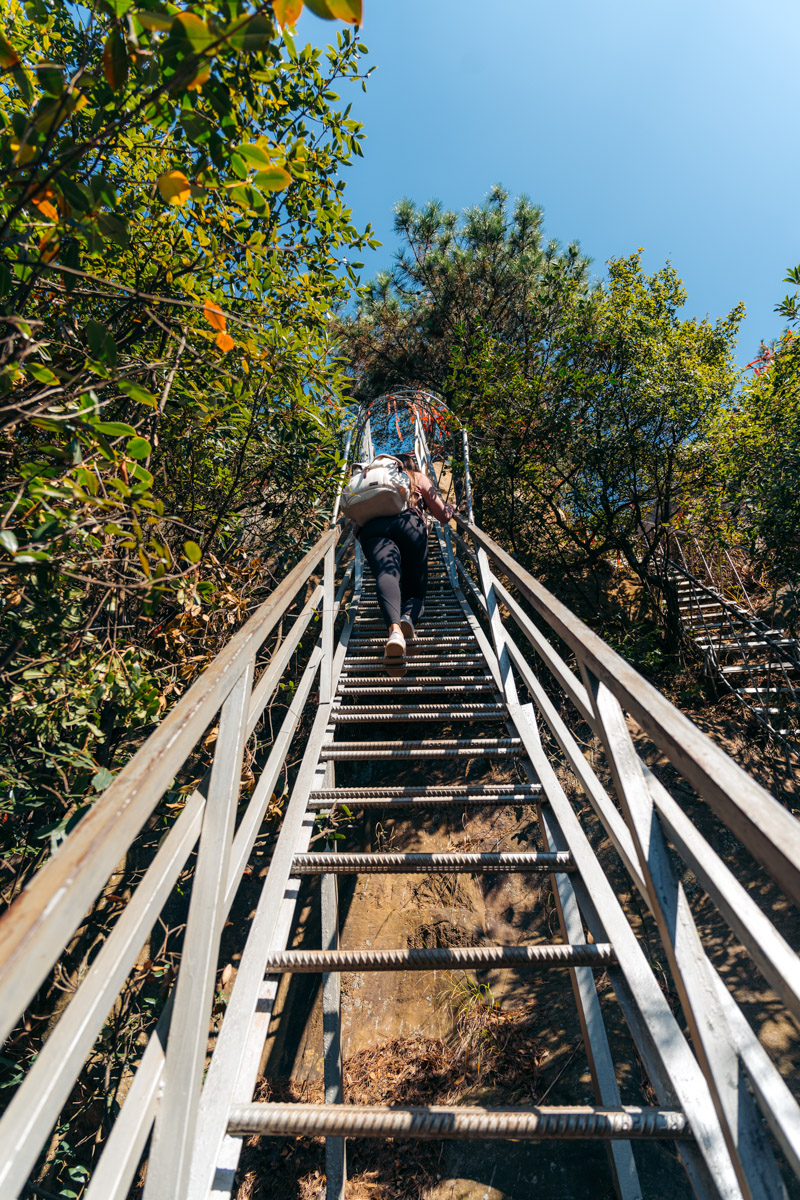
The view is certainly worth it though. You can also see out to differing scenes at the back and the front side of the natural viewing area. There are some red fortune ribbons tied on the trees here which added to the beauty and tranquility as they swayed in the breeze.
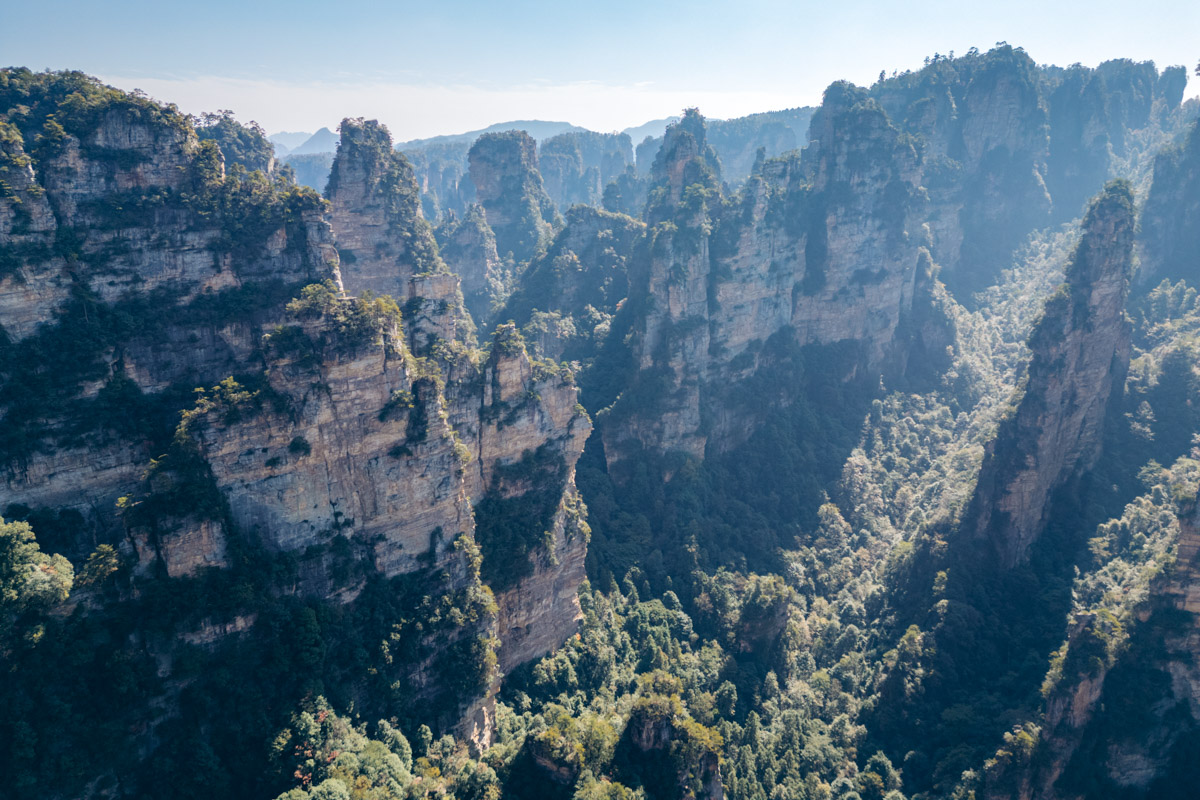
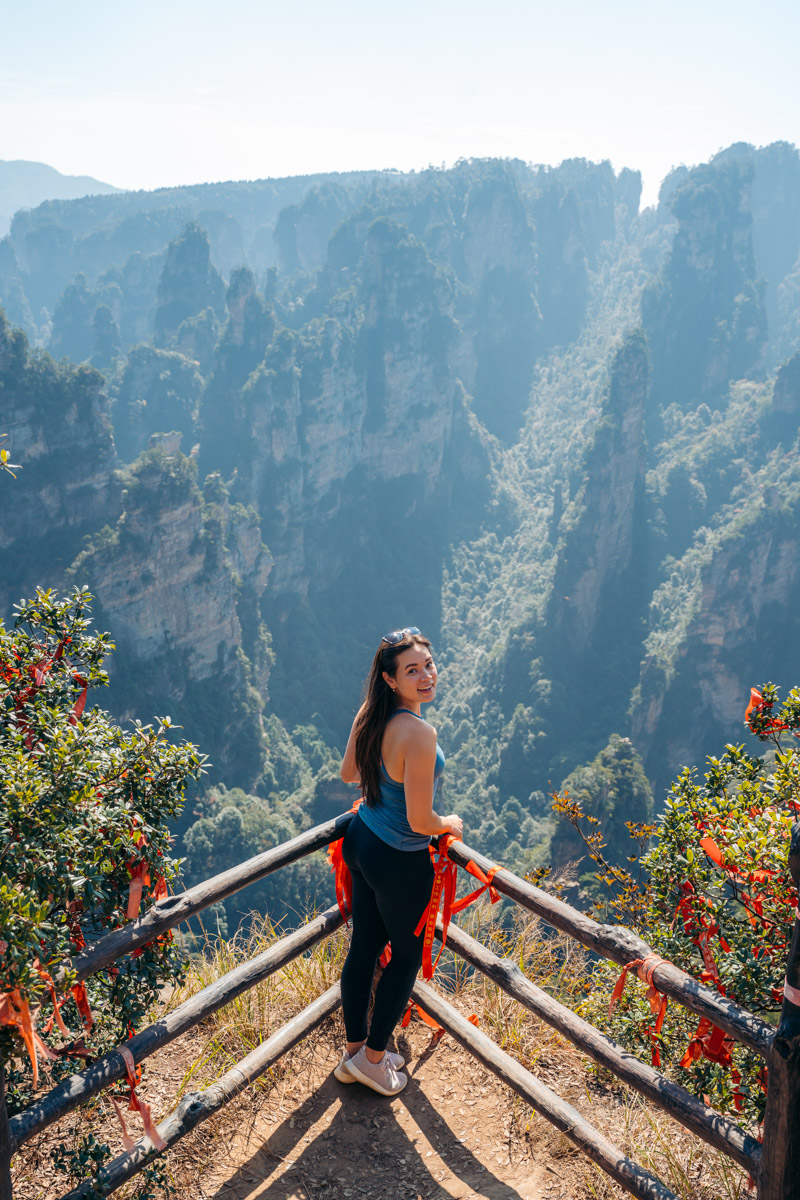
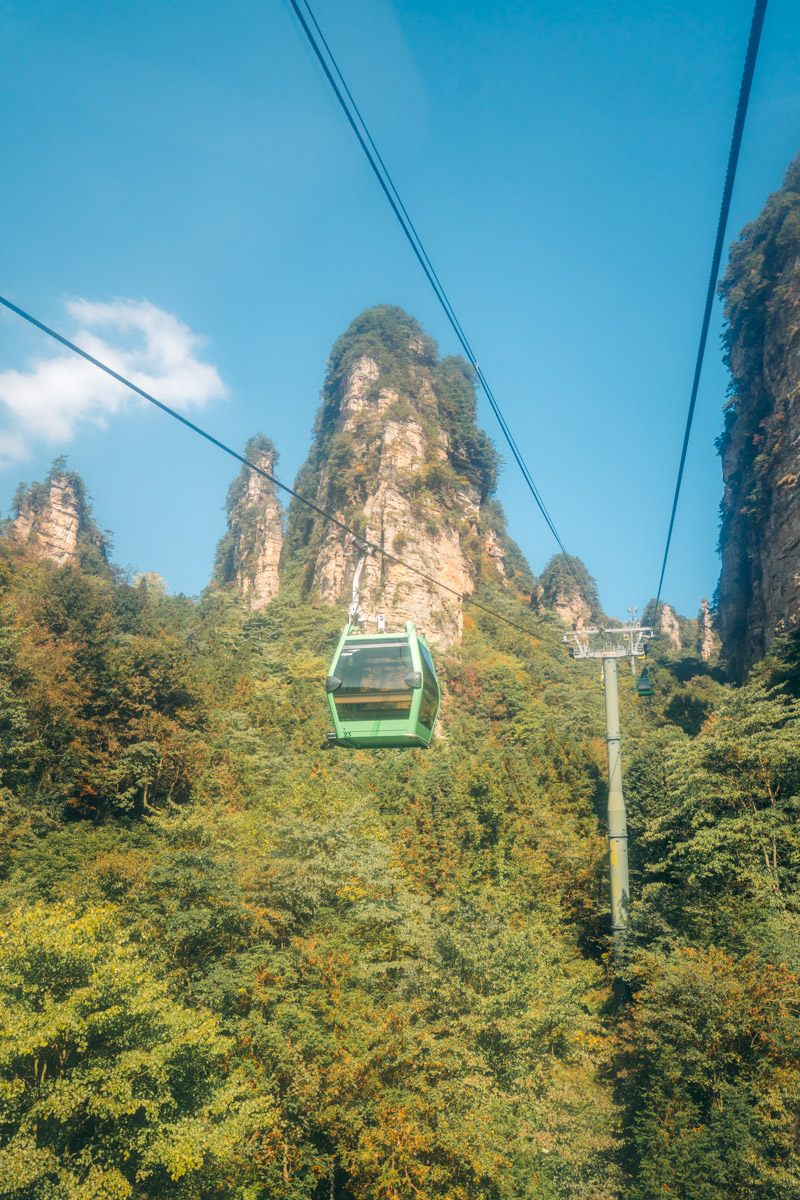
Once you’re all done at the One Step to Heaven viewpoint and trail, make your way back to the Yangjiajie cableway station for an optional round trip scenic cable car ride with barely anyone else in line! This is a bonus and I would only do it if you’ve purchased the unlimited cableway pass, which I’ll get into how to purchase at the end of this blog post.
It was a nice midday treat as we took a cable car with just the two us and went right around to head back up! There isn’t anything to do at the bottom as it’s just the Yangjiajie west entrance and parking area so you don’t need to stick around. Plus you’ll want to spend your spare time at the next major section of day 1!
Tianzi Mountain (Day 1)
When you get off the shuttle bus in Tianzi Mountain, you’ll first walk through an entire alley of street food stalls ready to take your order. Once you’ve gotten a bite or drink, you can keep making your way through and start walking through the largest section of Zhangjiajie National Forest.
Tianzi Mountain is probably my favourite area of the park. Although it is busy, being that it is the second most popular section, it has quite a few nooks and enclaves where you can escape the crowds and take in the panoramic views of the sandstone pillars.
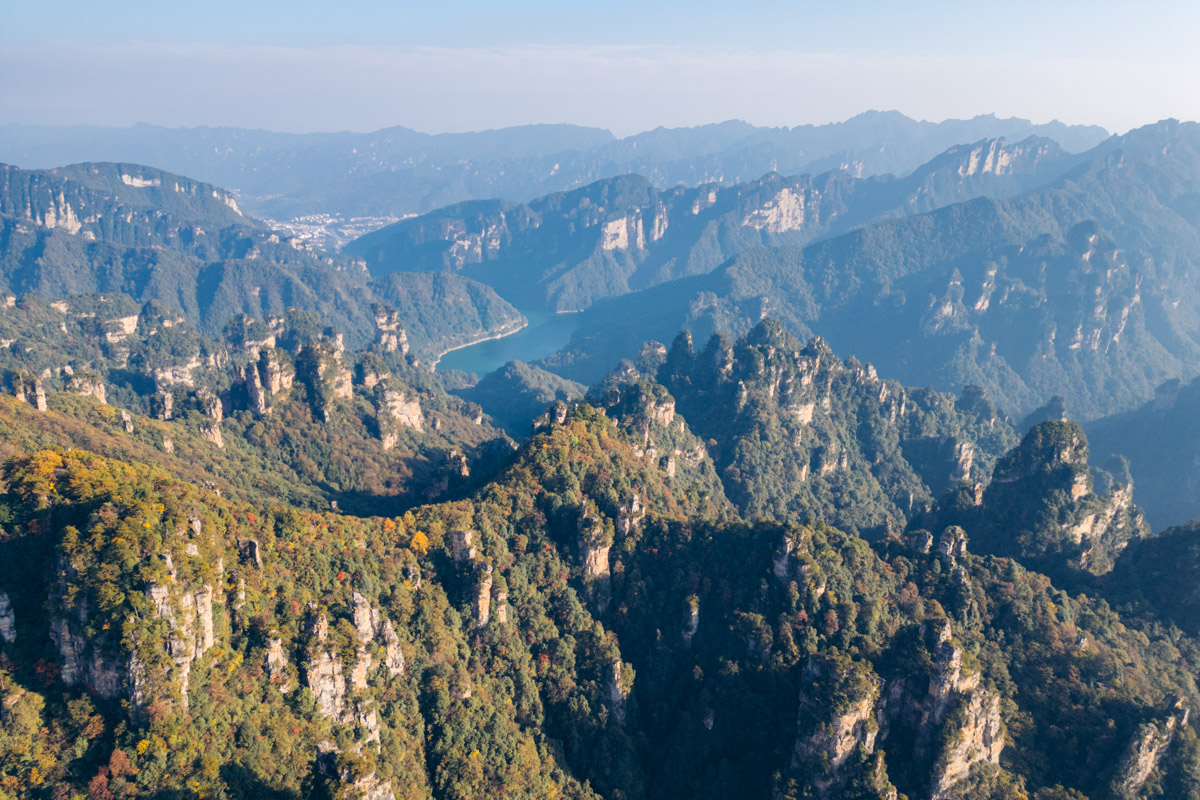
It’s within this area that you’ll find the tallest peak in the scenic park, Kunlu Peak. Being up high, you’ll mostly look down towards the view of pillars versus having it at eye level.
In Tianzi Mountain, the pillars and surrounding mountains appear to be further away and below. They look to be narrower and more conjoined in clusters, dissimilar to what our eyes captured in Yuanjiajie. And coming here in the afternoon on a sunny and cloudless day, the images you see appear more mystical and glazed over like a mirage.
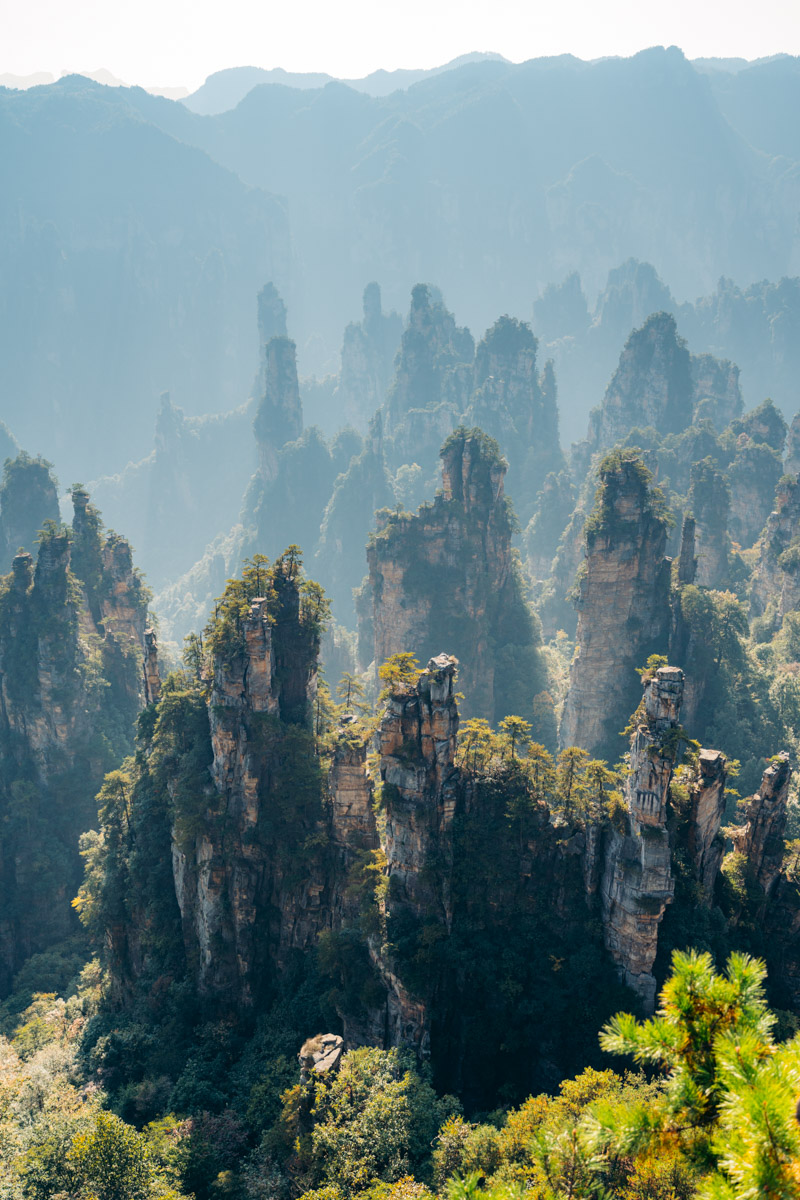
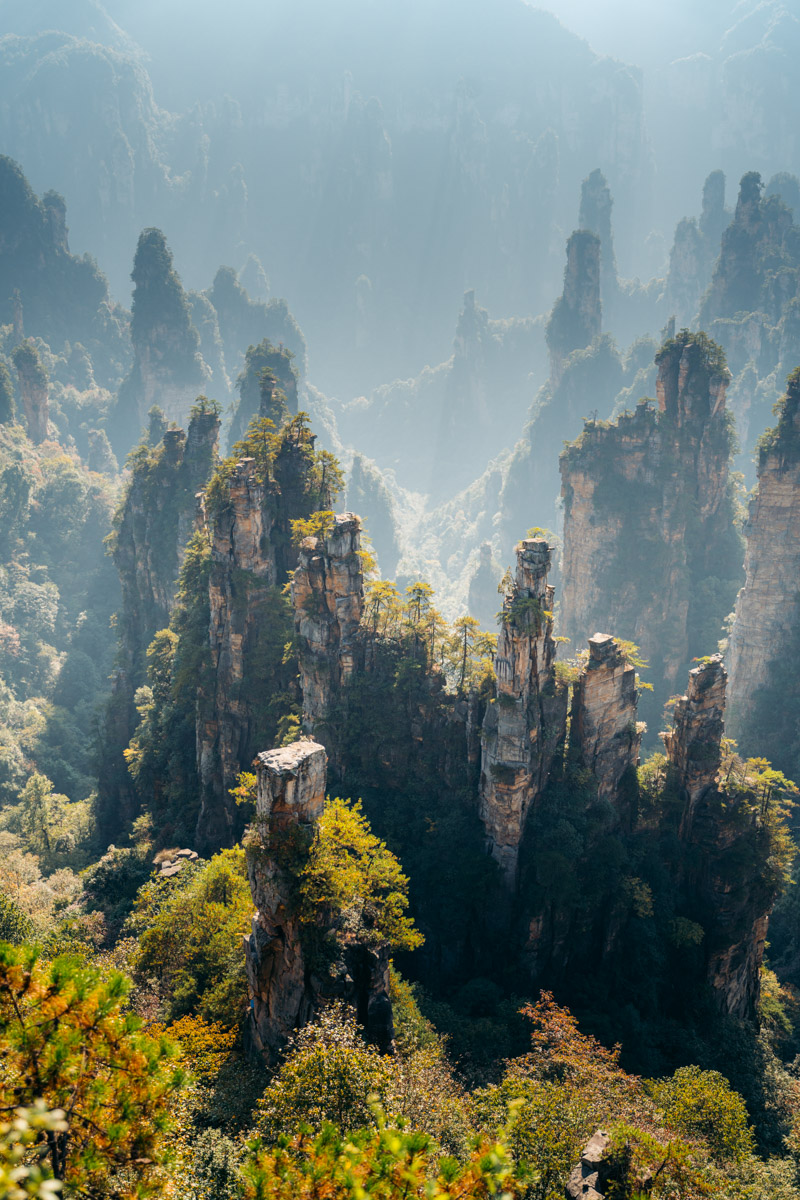
The best viewpoints in this third section, in my opinion, lie behind the Helong Park. If you walk past the tall Helong statue, and take the stairway on the right heading down, you’ll find the various viewing enclaves along the stone path that make for some of the best photo spots in the area, framed by the tree leaves.
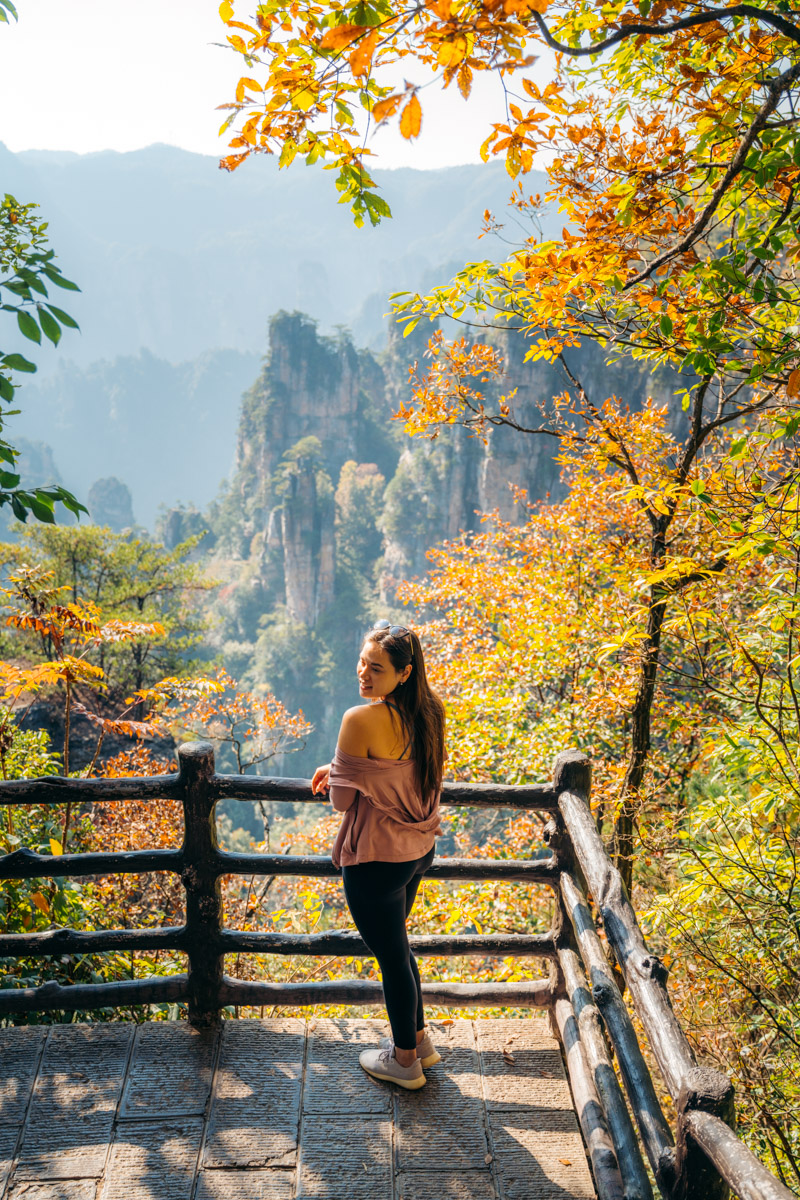
Continue along the downhill path heading east to reach Yunqing Rock and Yubi Peak. If you come later in the afternoon or earlier in the morning, you might be able to squeeze in a few shots alone here! Yubi Peak does get busy, but if you time it right between the tour groups, you’ll have a little space at the edge all to yourself.
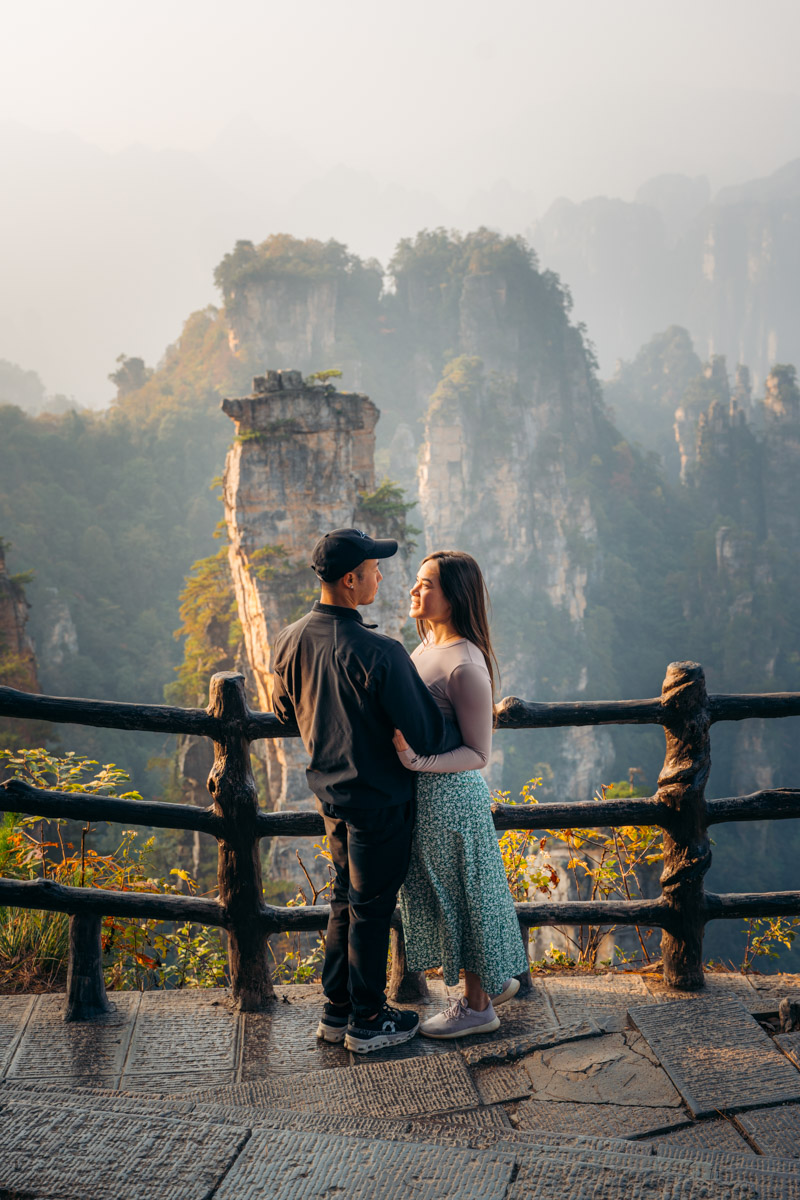
Disclaimer: though we spent two full days exploring all six sections of the park, we took advantage of the four-day pass and came back for another two consecutive mornings to revisit our favourite photo spots! That’s why you might see some outfit and lighting changes ;).
Once you’ve taken in the gorgeous pillars of Tianzi Mountain, that are similar yet still distinct from the other sections of Zhangjiajie, make your way to the beautiful Tianzi Tower, a gorgeous five-storey pagoda at the edge of the Tianzi Mountain scenic area.
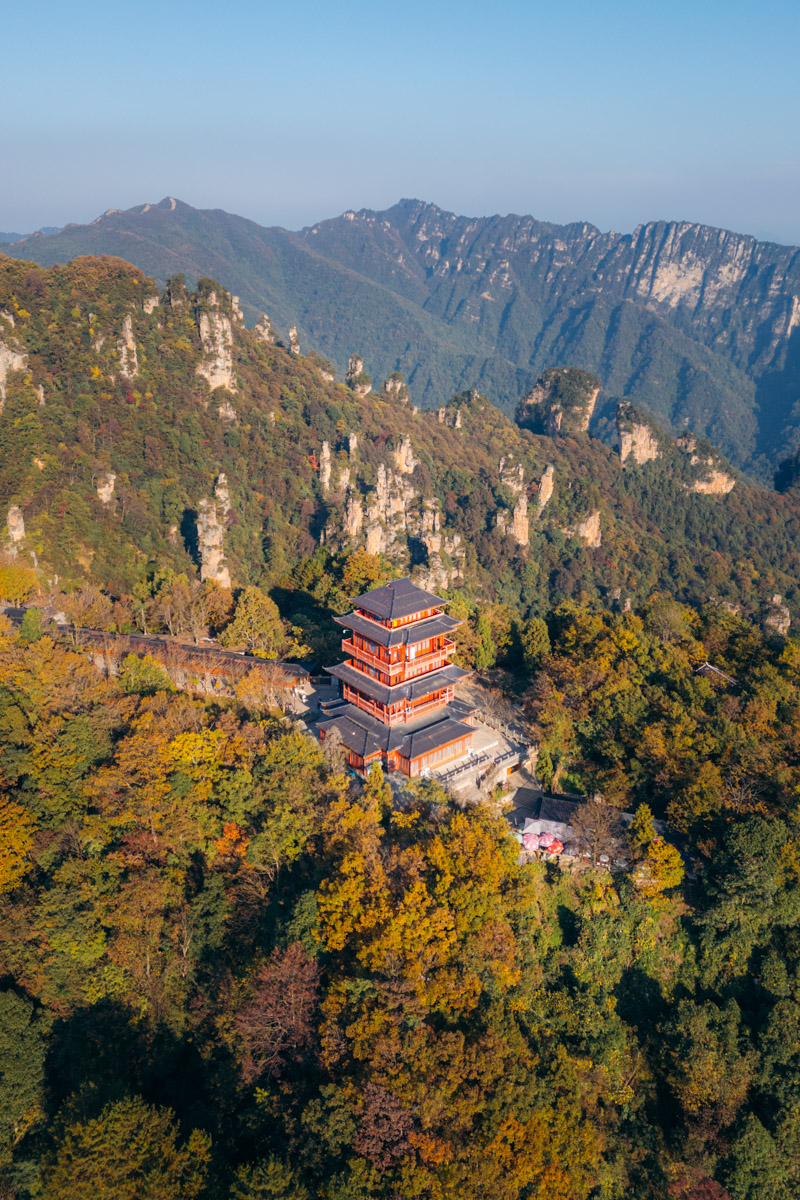
The views aren’t finished yet! As you take the cablecar down, you’ll be met with some of the best cableway views in the entire national forest. Especially with the evening light being cast, it looks incredibly picturesque and begs you to come back to explore the mountains once again the next day.
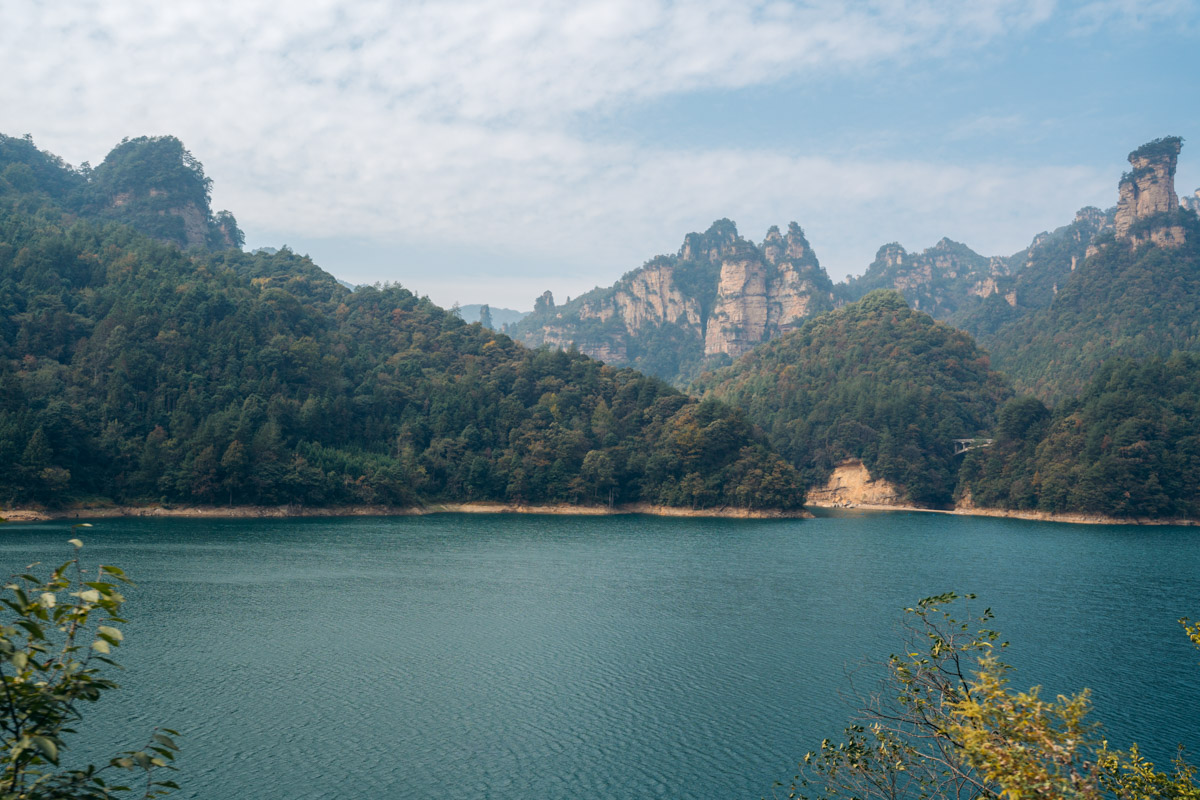
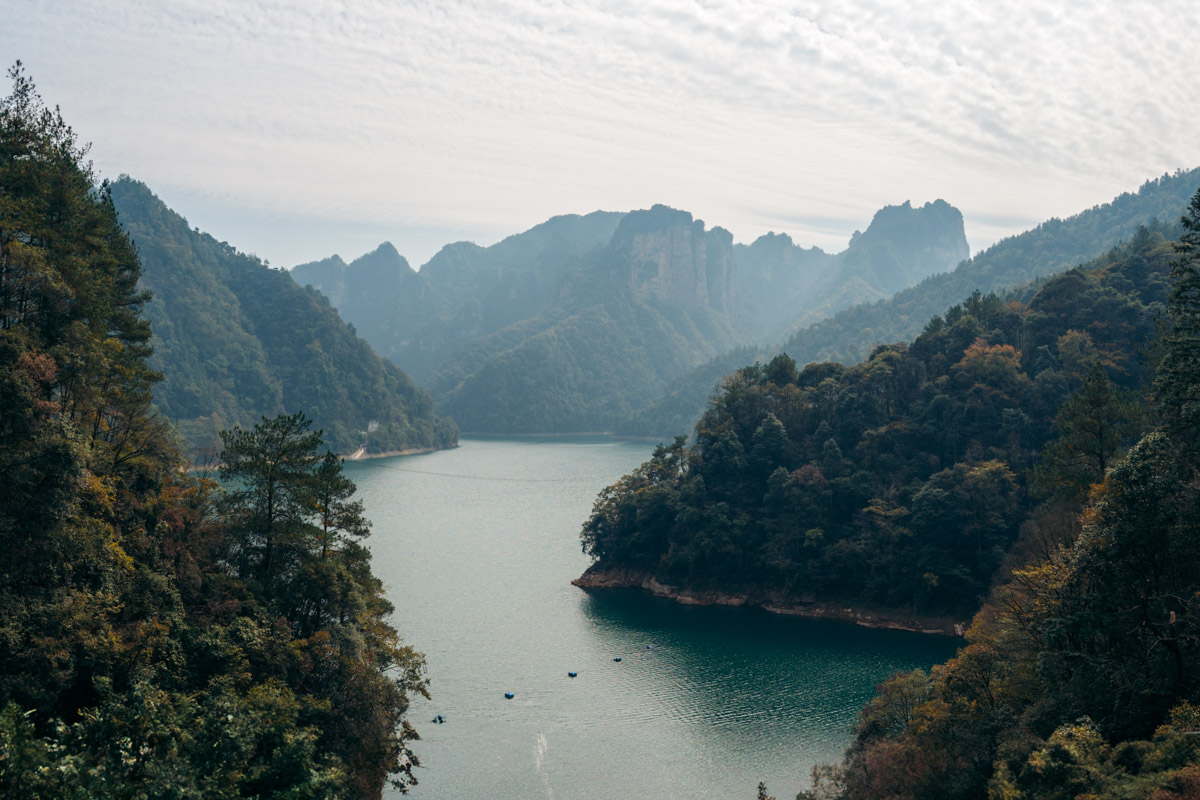
There’s a long slew of zigzagging stairs awaiting you at the bottom, but once you reach the bus station, you can relax (hopefully not waiting long in line) and enjoy the gorgeous lake and mountain views on the bus ride back to the east gate entrance.
Huangshi Village (Day 2)
On the second day, you’ll need to find your way to the south entrance to Zhangjiajie National Forest. There’s a minibus that starts from the Wulingyuan Bus Station, located at the southeast corner of Jundi Lu and Guihua Road. It’s pinpointed on the Zhangjiajie tourist map below!
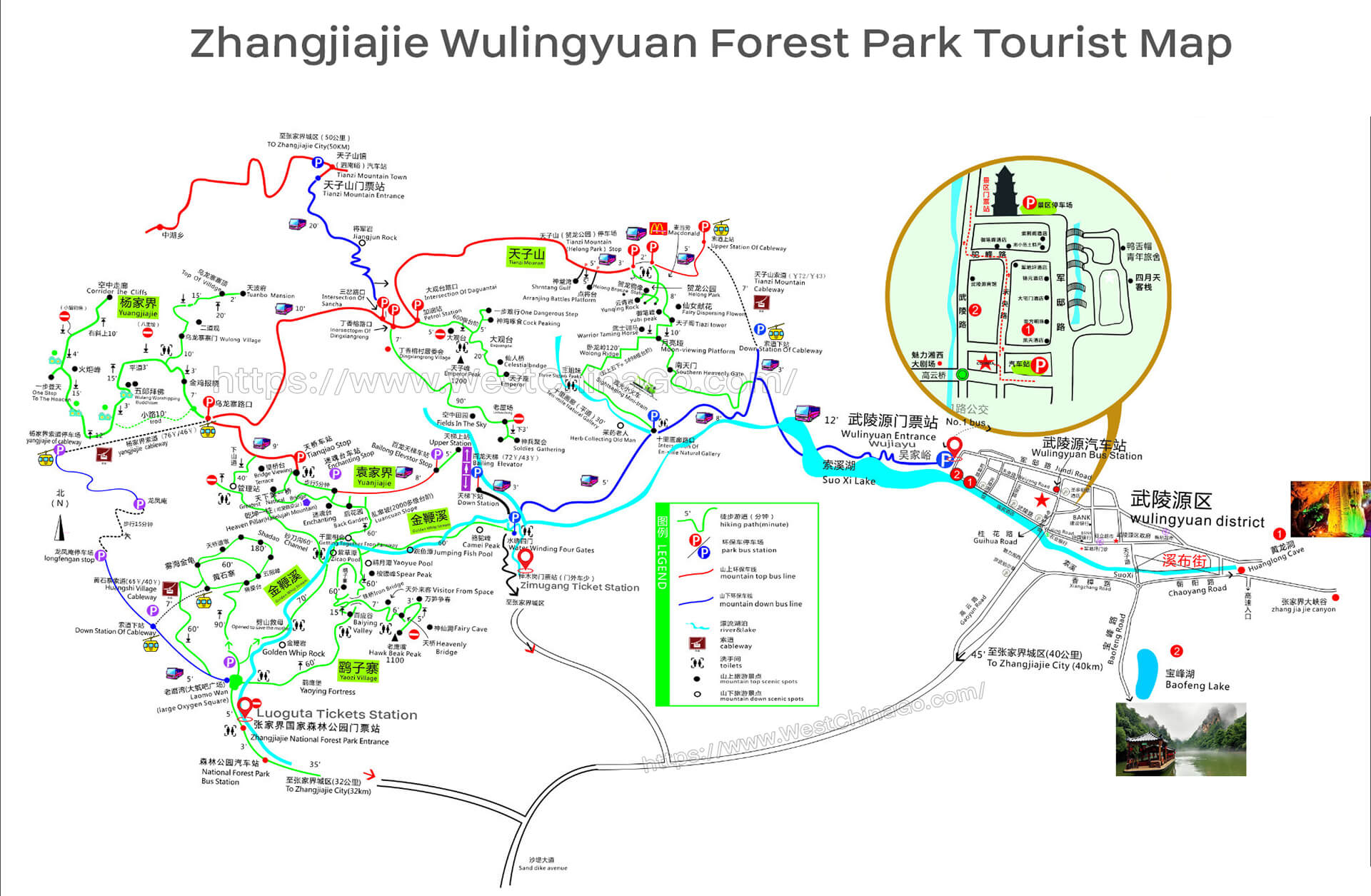
The bus ride costs 10 RMB per person, a cheap fare for the 30-minute ride. But truth be told, we wish we had just taken a Didi (China’s rideshare app) because the bus doesn’t leave until it’s full, so even though we were at the station for 7am, we had to wait a good 20 minutes before leaving.
Didi would’ve cost the same as it did for the two of us, that’s how cheap rideshare transportation is in China!
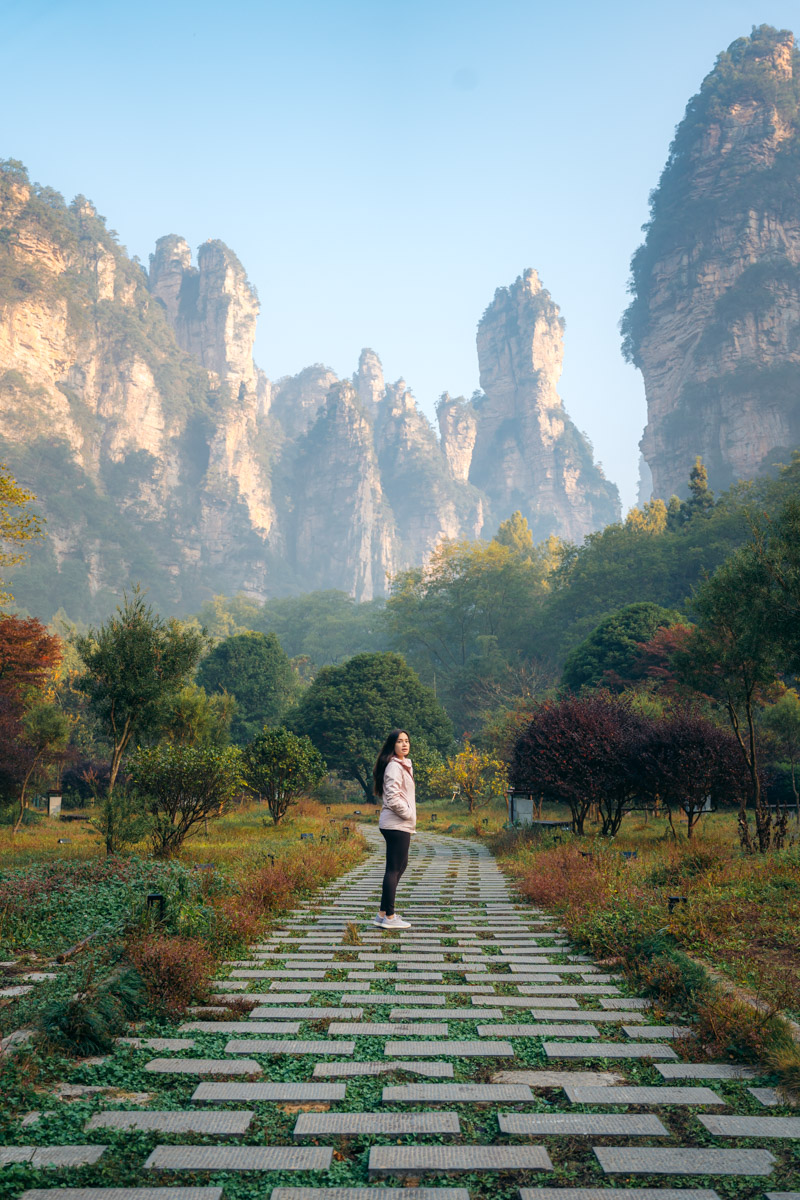
The south gate is significantly less busy than the east gate, which makes sense. The lack of crowds made us feel less rushed and we took our time as we walked our way through this section of the park. A few minutes into the path, an opening reveals a stone path amidst a garden with the gorgeous sandstone peaks in view, mystified behind a layer of haze.
After further walking, you’ll come upon the Laomo Wan square where you’ll catch the five-minute bus ride to reach the cable car station for Huangshi Village. It’s not actually a village, but another renowned scenic area located high up in the sky with stone paths to roam and gaze from.
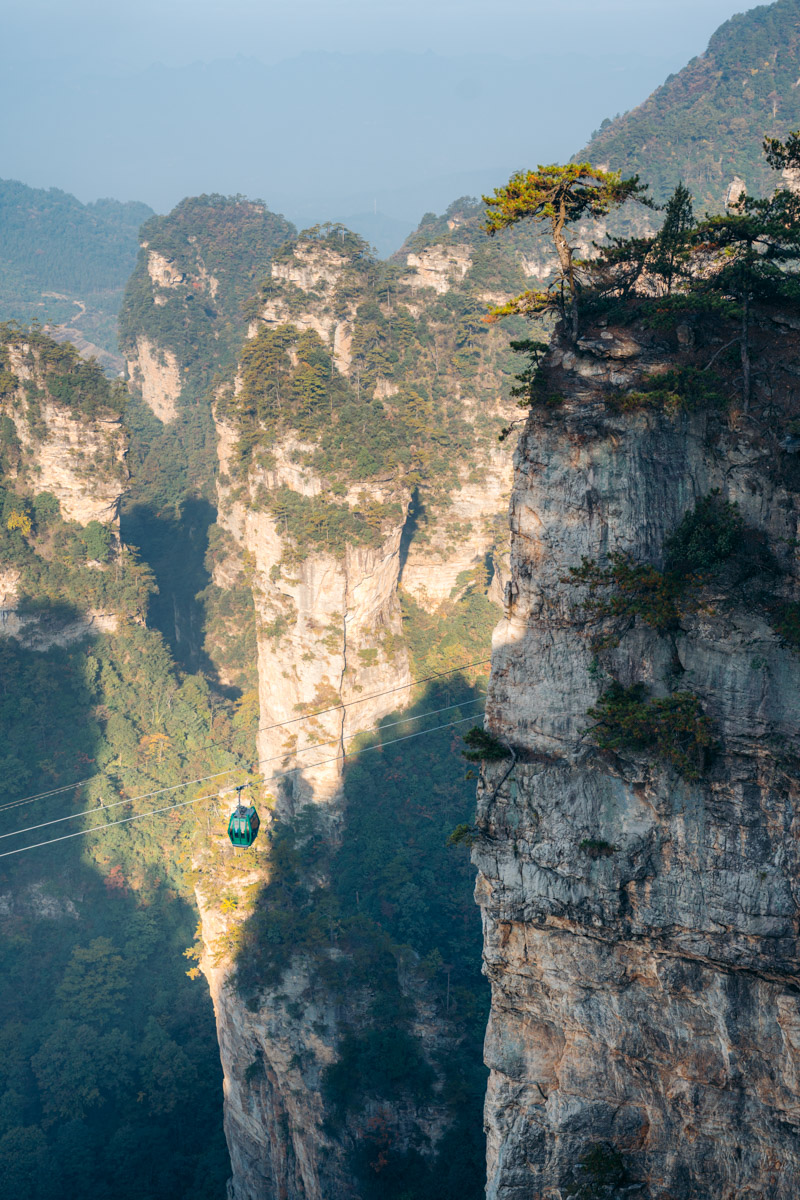
Huangshi, meaning yellow stone, refers to the golden colour of the surrounding rock formations. They differ ever so slightly from the other pillars we see in the forest, but are still blanketed with verdant flora.
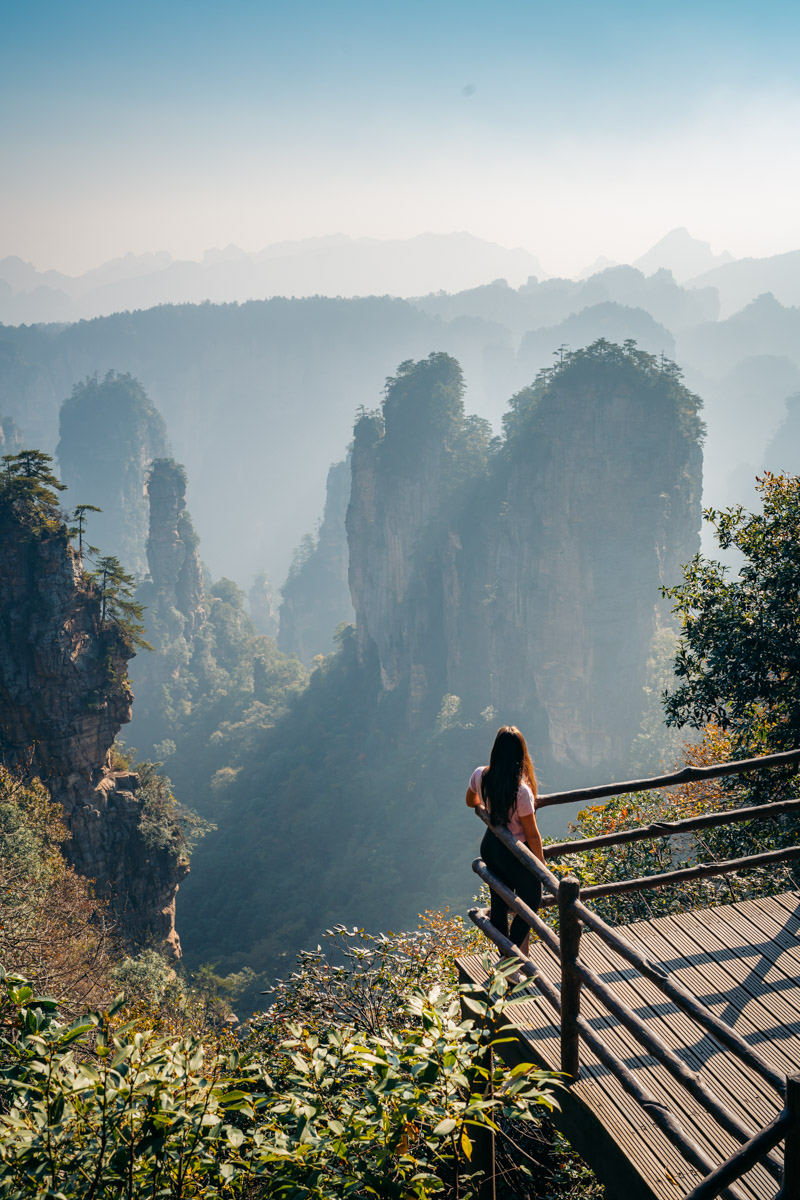
It’s also much less crowded in this section, but instead of hoards of people, you’ll see monkey troops left and right! They are absolutely everywhere, adorable yet menaces.
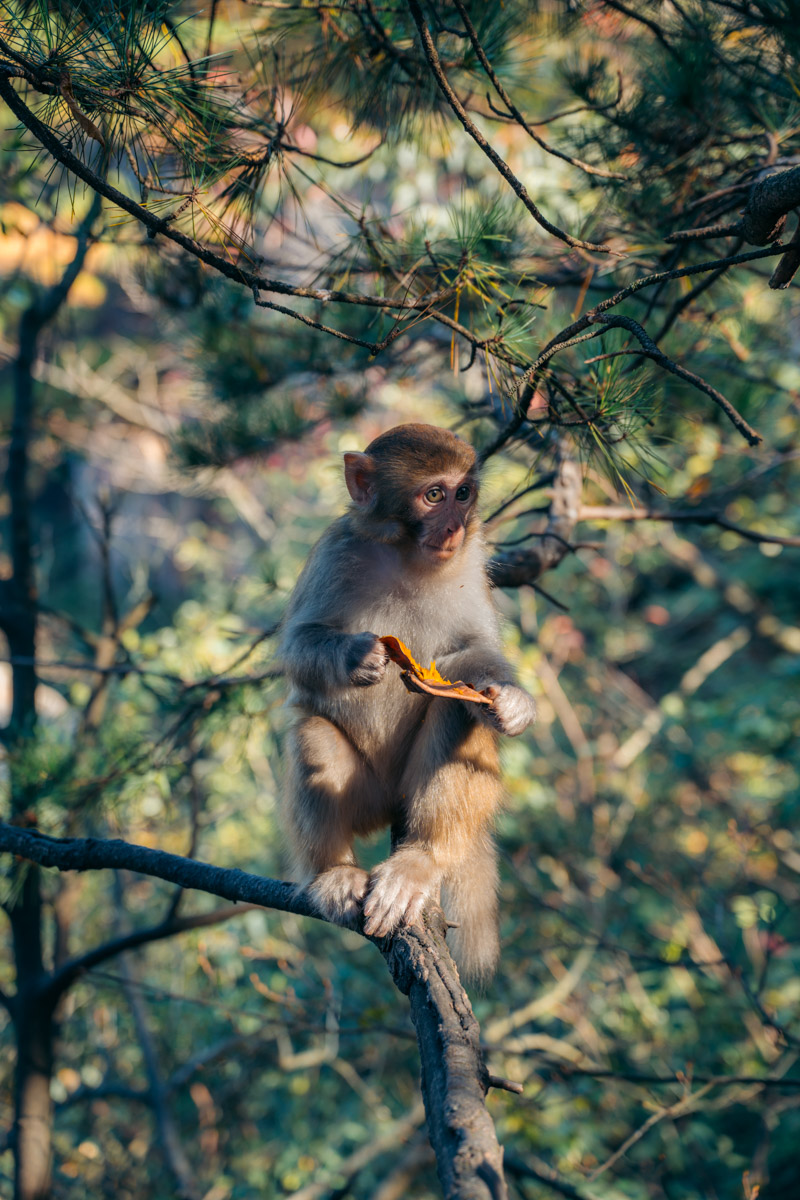
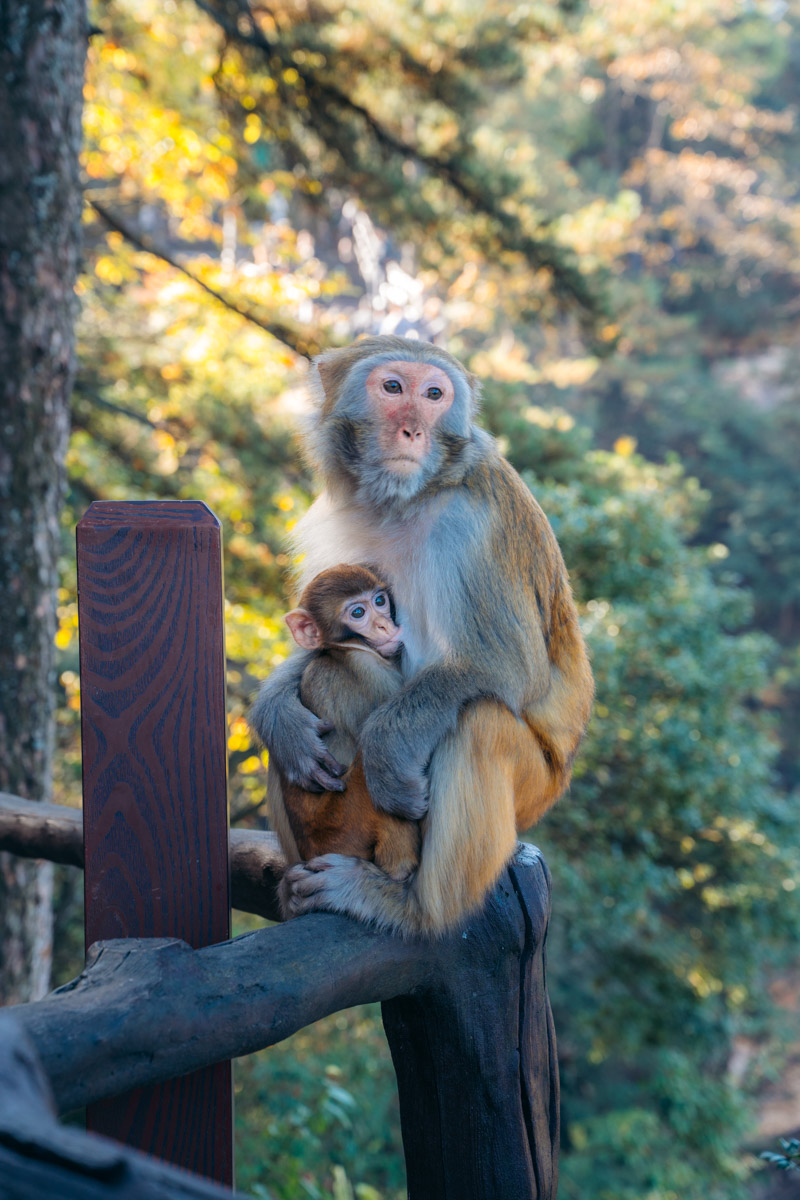
There are a few routes and loops you can take to wander the veins of Huangshi Village’s viewing platforms. They grant you views 360-degrees all around.
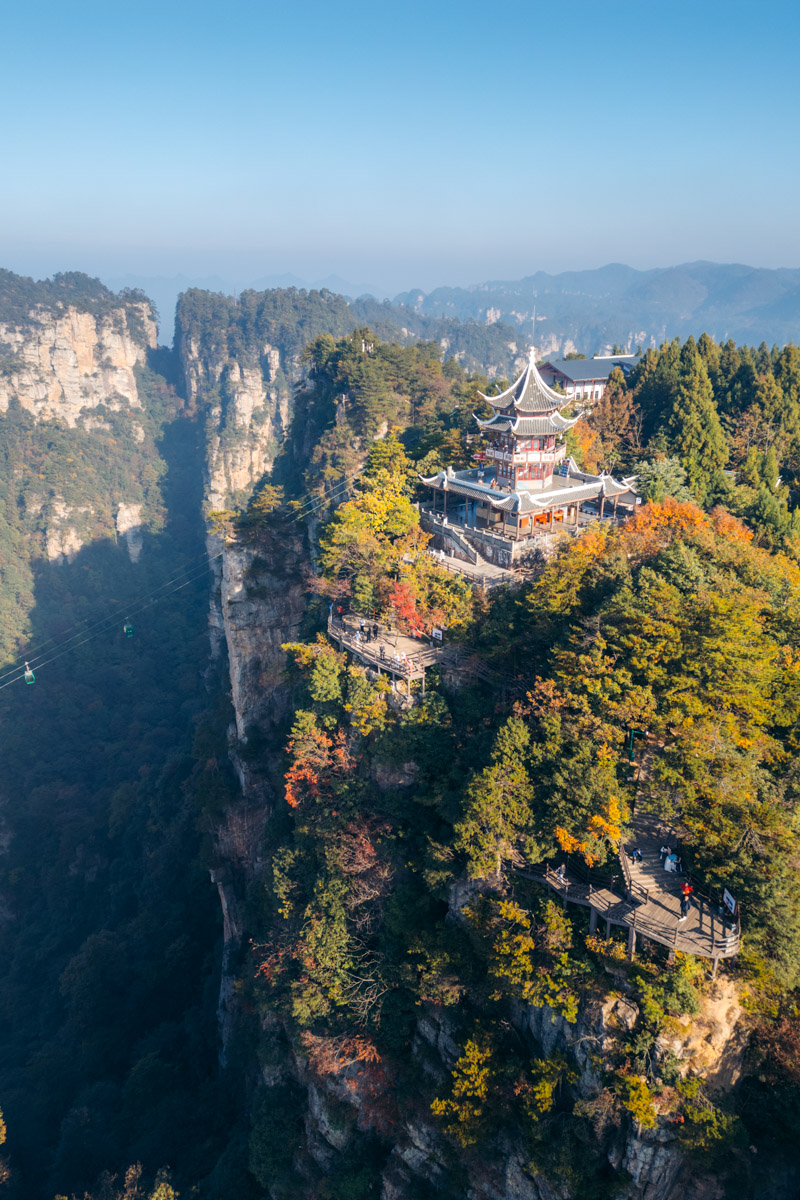
The most memorable view to me was that of the Five Fingers Peak. It’s really the first time you can actually visualize where the ground originally stood all those millions of years ago before the sandstone collapsed.
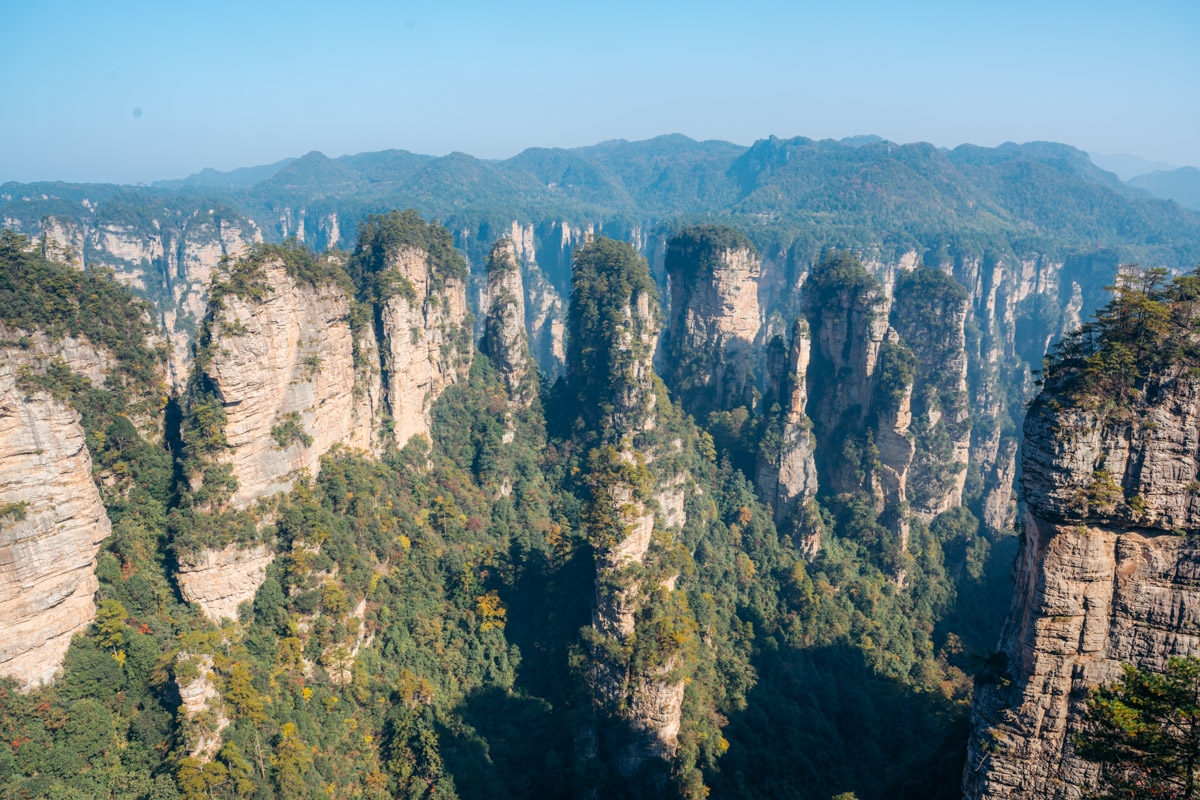
Where we stood was the original surface of the earth in Zhangjiajie but now we can look down into verdant valleys or across to jutting peaks. It’s crazy to see the timeline of geological transformation layered before your eyes.
Golden Whip Stream (Day 2)
After coming back down the cableway from Huangshi Village, you’ll get to take the one and only valley walk in the park. The Golden Whip Stream is a one-way walk along a stone tiled path through the base of Zhangjiajie’s pillars.
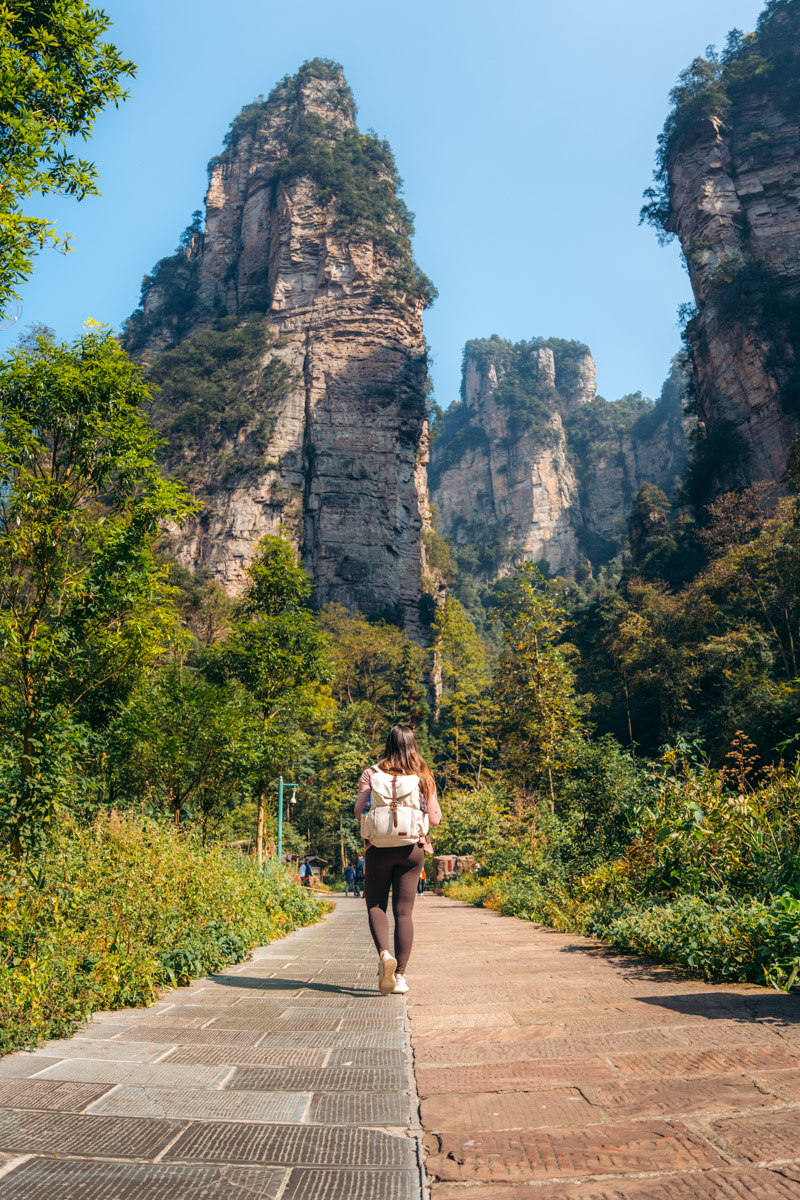
It runs alongside a stream, and with the shade of the mountains and tall trees, it feels super cooling to walk here, even in the afternoon heat.
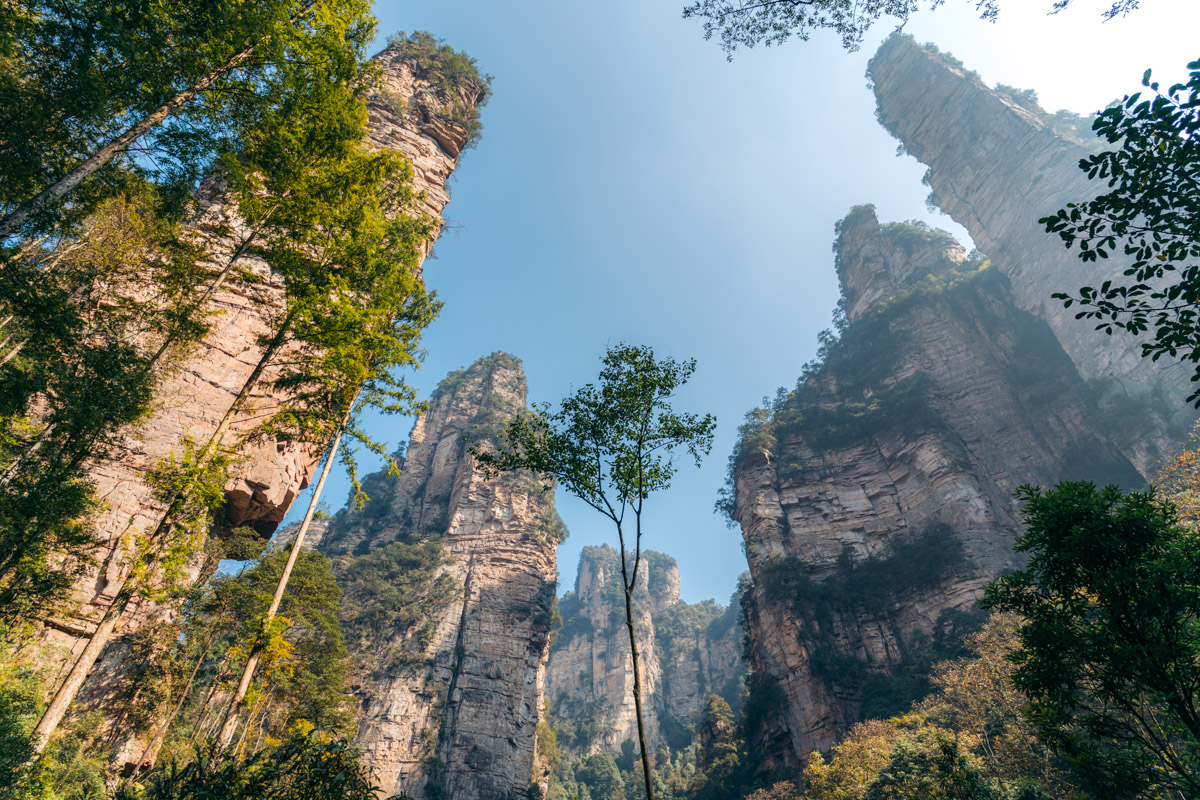
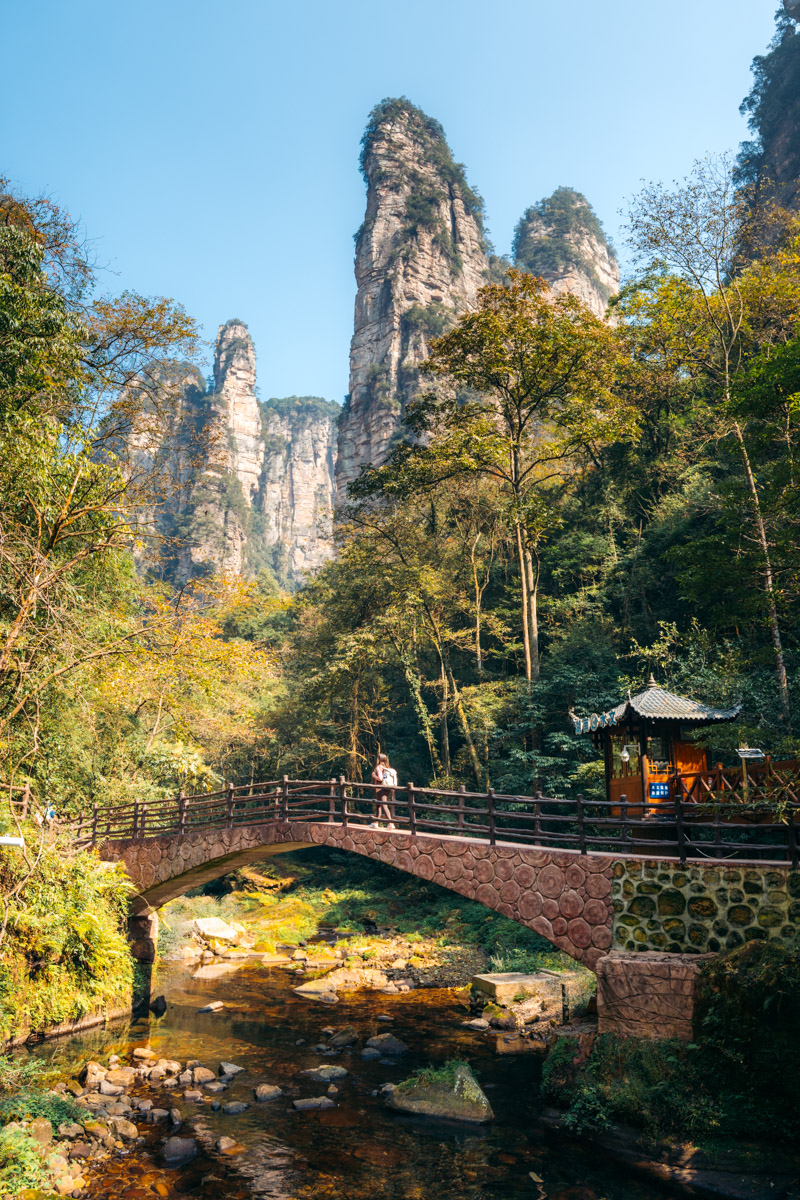
It takes a couple of hours to make your way from one end to the other, and the views are worth every step. It’s an impressive perspective to look up into the towering pillars, and it makes them way more grand from this vantage point. The trail itself is just beautiful too, with arced stone bridges crossing the stream here and there.
There’s a little street food hut area partway through selling some easy eats, like Chinese pancakes, fried potatoes and meat skewers. A perfect stop to break up your walk and enjoy a light lunch before carrying on.
I would suggest only eating here and immediately throwing away any food wrappers, bags and leftovers! The monkeys are the peskiest along the Golden Whip Stream and they certainly aren’t ashamed to snatch any food bag you have right out of your hands. They will legitimately fight you for it, no matter what’s in the bag!
Once you arrive at the crowded opening and meet a mid-size square and stretch of road, the valley walk has reached its end. You can then head towards the shuttle bus station on the left to catch your transportation to the next area.
Ten Mile Gallery (Day 2)
Last, and in fact most certainly least, is the Ten Mile Gallery. It’s a common name seen across China that refers to any stretch of scenic walk or drive. But in our opinion, this section didn’t have nearly as much appeal as the other five.
Good thing it is a short one at only half an hour each way. You can also take the fun slow train, decked out in cartoonish characters to appease young families, if you so chose to give your feet a break. The slow train does come at an extra cost on top of the national forest pass and cable car tickets, but you can buy your tickets onsite at the Ten Mile Gallery starting point. It’s either 38 RMB one way or 76 RMB round trip for the train ride.
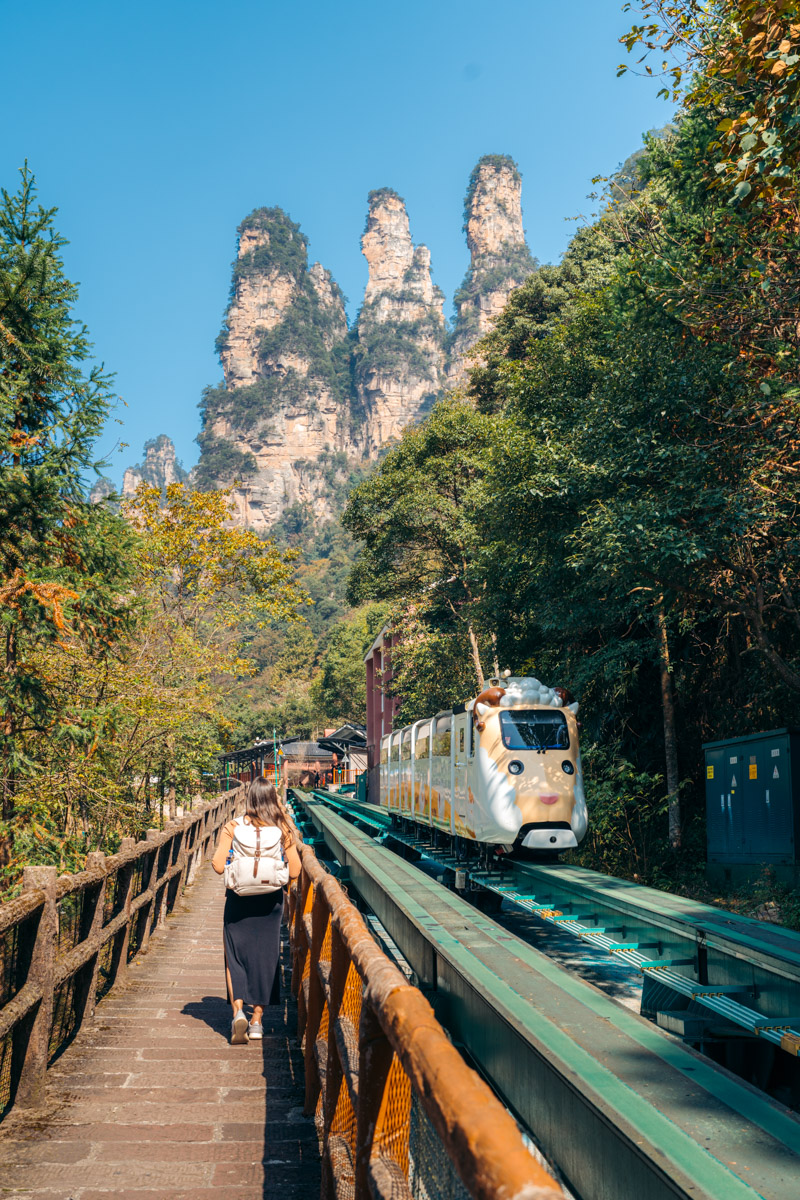
We walked the path instead, which ran alongside the train tracks, with some sections of shade but mostly exposed to the sun. The hero shot along the walk is most definitely that of the Three Sisters Peaks, which are framed in view as you approach the end of the trail.
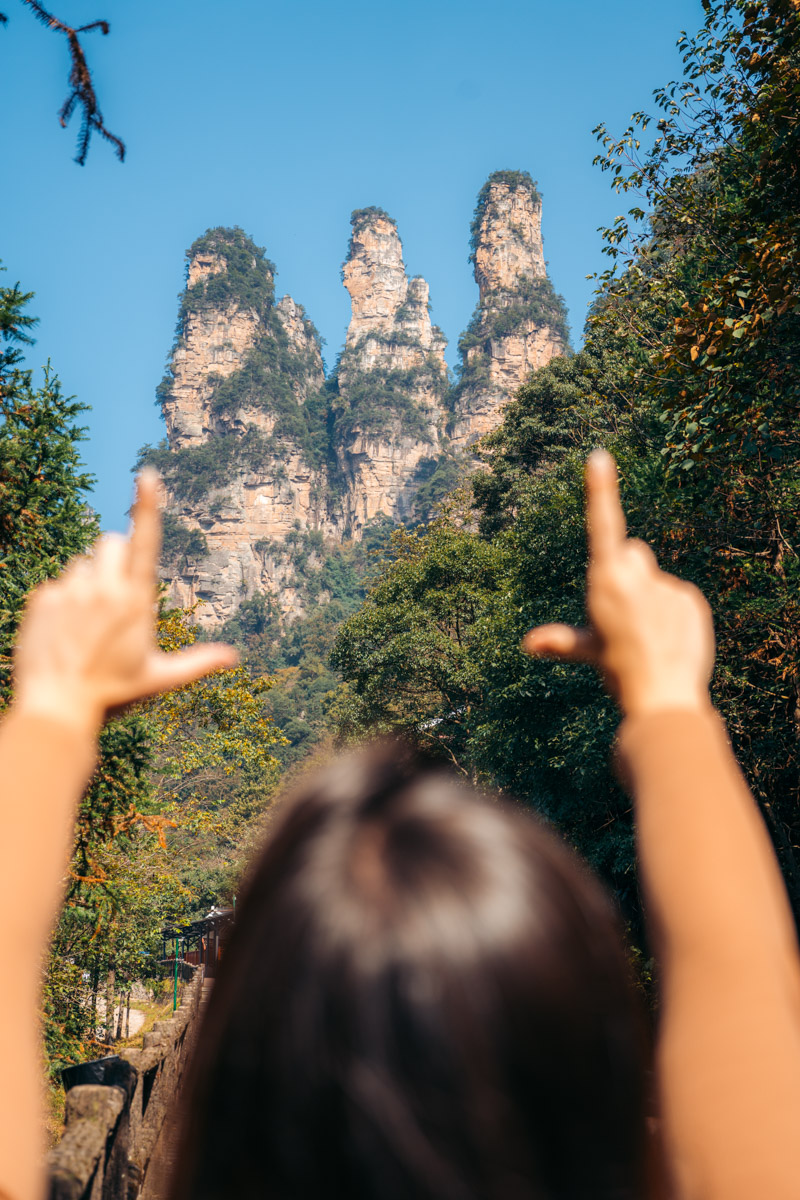
Once you reach the end, there are some other forest trails you can wander. It’s also the trailhead for hikes up the mountains and into the upper sections of Zhangjiajie, foregoing the cablecars completely—though they do seem like a long way up.
At the end point, there’s also a whole handcrafting area and shop, where locals make incredible art pieces, mostly sculptures and wood carvings. There are also some traditional sweet delicacies that you can watch the shop owners make with their own ands and tools, in a ritualistic performance as well, much like the making of mochi in Japan.
Even though Ten Mile Gallery might be underwhelming after seeing the giants of Zhangjiajie, it’s also a great way to end your time in the national forest. With unique handmade souvenirs and delicious sweets to take home, it’s a great way to collect some final memories in a tangible way.
Food and Dining
One thing you’ll never have to worry about when touring major destinations in China is the access to food. The entire national forest of Zhangjiajie has food stalls and drink shops, with a few fast food joints as well, namely KFC.
At every major starting point of each section, near the shuttle bus stops and occasionally halfway through the sections, you’ll find your Chinese version of concession stands. They sell all kinds of foods, from fresh fruits to grilled meats and tofu, jianbing (a delicious Chinese savoury crepe) to thick meaty flatbreads, and juices, milk teas and much more.
There were a couple of major Chinese eateries if you wanted more than a street food selection. At the main shuttle bus terminal near the upper deck of the Bailong Elevator, you can find a KFC, which we loved to pick up a hot coconut latte from. Once you take the bus over to the start of the Yuanjiajie area, you’ll walk the few steps down and find the first of the street stalls. There’s some sheltered seating behind the front-of-house, where we enjoyed some noodles one of the mornings.
Over at Yangjiajie, heading towards the cablecar and the quiet forest trails, you’ll pass an actual Chinese restaurant with indoor seating, as well as a few bubble tea shops. And, in my opinion, the best place to enjoy food is at the alleyway at the beginning of Tianzi Mountain nearest the bus stop. There is a whole variety of delicious Chinese eats, from squid skewers to roasted corn, dumplings to fried noodles and rice, and even delicious stinky tofu!
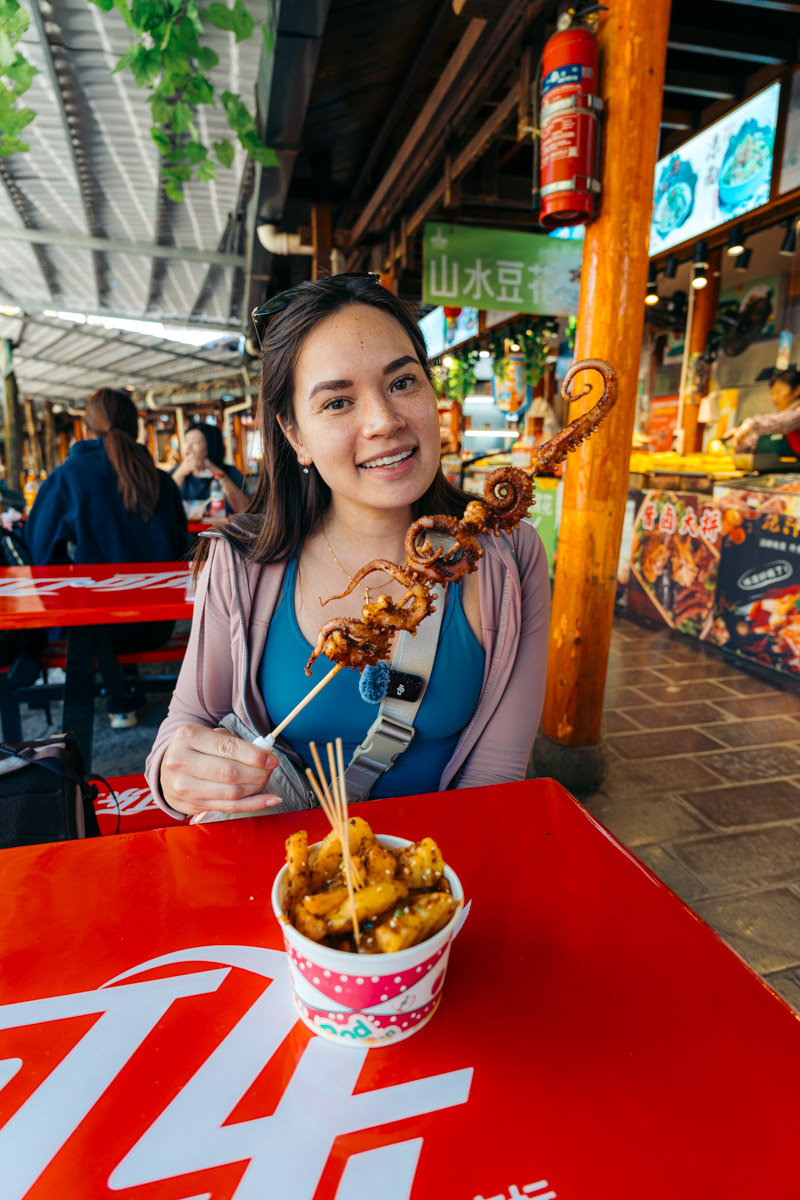
At the end of Tianzi Mountain, near the cablecar station, lies a large square where you’ll find a Luckin Coffee and McDonald’s. They really don’t leave you hungry in China, and you can fill up on burgers and ice cream before you even leave the park!
How to Purchase Your Zhangjiajie Tickets
I’ve spent a long time talking about what you see in Zhangjiajie, all the details about the sections, how to get there and even what kind of food you’ll find in the park. But I haven’t yet explained how to secure park entry tickets and cableway passes.
First off, the Zhangjiajie entry tickets come in the form of a four-day pass. This includes entry at any of the gates into the national forest and unlimited access to the inner park shuttle bus. All other modes of transportation, namely the cableway system and the Bailong Elevator, need to be purchased separately at an additional cost.
If you’re purchasing your four-day pass ahead of time, particularly online or through a third party, you’ll need to head to the ticket office on your first day of entry in order to validate it using your passport and ensure you can access the gates without issue. This is why I recommend you visit the east gate on your first day because it’s the largest, and the ticket office is right on the left side of the square before you reach the entrance and security.
Once you have your pass validated, you’ll be able to go through all the entry gates freely, by either scanning your passport or simply using your face! The gates have facial recognition, for the next four days, you can pass through just by looking at the screen. But make sure to carry your passport with you in case any issues arise during your daily visits to the park.
If you have time to spare before your visit, and are willing to converse with your hotel hosts and reception managers (in spite of potential language roadblocks), you’ll have a great chance of getting a local discount to your Zhangjiajie pass.
Not only that, but they can also give you a discount on an unlimited cableway ticket coinciding with your pass! Foreigners don’t get access to the unlimited cablecar ticket on their own, so this is such an advantage if you want to ride them multiple times and would like to revisit the park for more than two days.
If you don’t think you’ll get much use of the unlimited pass, there is a great bundle package for the Zhangjiajie four-day pass + 3 cableway tickets + 1 elevator ride. This is enough to do the entire two-day circuit of my itinerary, including the roundtrip ride to Huangshi Village, and the ride down from Tianzi Mountain. It’s a perfect combo, and you can find it on trip.com.
Thanks for Reading!
And with that, I hope I could address all your info needs for planning your visit to Zhangjiajie National Forest! If you’ve got any questions, make sure to leave them in the comments below!
And if you’re currently planning your trip to China, there’s a lot that has changed in the last few years, and I’ve compiled the most important 10 tips you need to know before visiting China.
I know you’ll love exploring Zhangjiajie, an icon of a destination for decades. But you won’t want to miss China’s cliffside fairyland village, Wangxian Valley. It’s a much newer destination and is not a place rooted in history, but in legend, natural beauty and it comes to life during the night.
And Guilin is an icon of the ages, one of China’s oldest and most beautiful regions that is always inviting folks to explore! Be sure to check out my other China content before you set off and explore this unparalleled country!


Comments (27)
Christina N
July 26, 2025 at 6:31 pm
HI! Not sure if you’ll be able to see this but I am going to make this trip in a couple weeks and wanted to make sure I was getting the right train ticket! I will be traveling from Shanghai– will I be looking for tickets to the Zhangjiajie WEST railway station? Hopefully you know the answer! And I’m assuming just get a DiDi to whatever hotel I end up booking? Thank you!
laurenslighthouse
August 3, 2025 at 8:09 pm
Hi Christina, hope you get this response in time for booking your trip! You can make your way to Zhangjiajie West station if you’d like. It’s a slightly closer station to the Wulingyuan district, where the Zhangjiajie National Forest main entrance gate is located (about 30 minutes drive, instead of 45 minutes). Zhangjiajie main station is an advantageous place to get off if you plan on visiting the Tianmenshan area first, as the cable car station for Tianmenshan is a very short drive from Zhangjiajie’s main railway station.
Alexandra
August 11, 2025 at 4:53 am
Just writing to let you know I absolutely love all your content! Your Pictures, Videos, tips… EVERYTHING IS GORGEOUS!!! You gave me a lot of useful information to plan my trip to China. Thank you so much.
laurenslighthouse
August 18, 2025 at 7:29 pm
Thank you so much, Alexandra! That made my week! If you have any questions regarding your trip planning for China, feel free to drop them here.
nicolas
September 8, 2025 at 11:18 am
thanks a lot for the comprehensive guide and beautiful photos Lauren, this is great work and super useful ! A few questions:
– at what time does the park open in the morning and close in the evening ?
– are there many steps like huangshan ?
– is it possible to bring a drone there ?
thanks and keep up the good work !
laurenslighthouse
September 10, 2025 at 12:44 pm
Hi Nicolas, to answer your questions:
– At the time we visited, which was the extended summer season, the park would open at 7am and close at 6pm. These times may be different during the winter and spring seasons, so I would check upon your arrival to Wulingyuan.
– There aren’t as many steps as Huangshan, luckily! I felt there were more stairways in Huangshan than in Zhangjiajie, but that depends on if you take the cable cars or not. If you follow my itinerary, the paths to walk are flatter since the cable cars cover the elevation or you. Lots of observation decks and very few stairways.
– It may still be possible to bring your drone there but bylaws may be changing. At the time (last fall), it was completely okay to fly our drone. We even asked the police officers stationed at the Bailong Elevator and they were very much like, “yes, of course, just be cautious.” Mind you, we registered our drone in China, which you definitely should do (you’ll need a Chinese phone number to do so). But now, things might be different as I’ve been reading that drones may be prohibited in the park as of a few months ago.
Voytek
September 30, 2025 at 8:09 am
Hi
Thank you for all info!!
I have question , is possible to hire profesional guide in Zhangjinjie??
laurenslighthouse
October 2, 2025 at 10:37 am
Yes, absolutely. We don’t have any experience in hiring guides in China, but there are professional guides for Zhangjiajie. I would suggest booking on in advance, especially if you need one for a specific language other than Chinese or English.
Cecilia
October 3, 2025 at 8:23 am
Hola! Gracias, ha sido muy útil toda la información brindada. Estaremos llegando en tren al mediodía… dices que ese día se podría aprovechar para visitar algo por la tarde o se debe comenzar bien temprano? Los tickets tienen un horario y el último es a las 12 por lo que no llegaríamos si debemos presentarnos puntuales…
laurenslighthouse
October 5, 2025 at 1:26 am
Hola Cecilia, pienso que yo entendí tu pregunta pero voy a responder en inglés ya que mi español no es muy bueno. I’m not too sure I’ve read anywhere that you cannot enter the Zhangjiajie National Forest after 12pm. Nowhere online does it mention a last entrance time, though the park is only open from 7am to 6pm (times may differ depending on the season). It wouldn’t hurt to try entering on the day you arrive, especially if you are only staying for a few days, as the park pass lasts 4 days. I would suggest going to the ticket office on the day you arrive and try to validate your entrance passes to see if you can enter the park.
Lucy
October 5, 2025 at 10:51 pm
Thank you for the guide!
I have a question: I’ll be arriving at Zhangjiajie West Station on Friday, Nov 14 ~10 AM, with 3 days (Nov 14, 15, 16) in the area. I want to follow your Day 1 and Day 2 itinerary and then also visit Tianmenshan. I’m debating whether to do Tianmenshan first (Nov 14) or the two days at Wulingyuan first. My concern is that visiting the Wulingyuan area on the weekends (especially Yuanjiajie) will be very busy. However, I don’t know if I have enough time to fit Day 1 (maybe without Yangjiajie) on the Friday if I enter the park around 12-12:30 (1 hr drive to hotel from station, drop off, get to park, buy tickets). Can you give me some suggestions?
Thank you so much!
laurenslighthouse
October 12, 2025 at 1:19 am
Hi Lucy, I would suggest maybe buying your Zhangjiajie national forest four-day pass in advance, either through your hotel or through trip.com. That might save you some time at the ticket office, but I’m not too sure as you might still need to validate your ticket on your first day, depending on how you purchased it. But honestly, if you’re arriving at Zhangjiajie West Station, it might be better to head straight to Tianmenshan and do that on your first day since you’ll be much closer and therefore have more time. Instead of cutting yourself short by going to the Wulingyuan area on Day 1. The Tianmenshan cableway station should have luggage storage in the tourist service centre, but do some research into that to see if you can actually ensure you can stow your luggage there. Good luck and have a great time!
Paulo M
October 10, 2025 at 8:11 pm
Great tips! It helped a lot. I read that you took the elevator and stopped first on the base platform, then took the elevator again and went to the upper platform. Did you only use one elevator ticket, or did you need two?
laurenslighthouse
October 12, 2025 at 1:33 am
Hi Paulo, thanks so much! Sorry, let me clarify. Once the in-park eco bus drops you off at the Bailong Elevator location, you walk around the bend of the bus stop (past the Bailong Elevator ticket office if you have either already purchased tickets or have some sort of combo package/unlimited rides pass that I mention in a later section), and you will either see outdoor stairs or a set of initial elevators. These are completely free and just get you up to the main viewing platform, the same spot where I have that picture of me and Jason looking out to the view of multiple narrow pillars. This large viewing platform is where people gather before going through the gates to access the Bailong Elevator. That’s where you’ll need your elevator ticket or your passport with facial ID recognition to go through the gates. Once through, you walk the very long indoor corridor leading to the Bailong Elevator entrance, and you can either take the stairs up to the next level or stay on the same level, as each of the three elevator capsules has two levels. Hope that explains it a little better! You’ll understand when you get there, but you only need one ticket or unlimited pass to ride the Bailong.
Liz
October 12, 2025 at 12:38 pm
Hi! Thanks so much for all this information. I wanted to ask what time you’ll recommend entering the National Park in order to avoid the biggest crowds? 🙂
laurenslighthouse
October 13, 2025 at 4:58 am
Hi Liz, I would say as early as possible! Unless there’s been a change, during the autumn season, it should be 7am entry time. That’s the time we entered on our days in Zhangjiajie National Forest. Be aware that you might need to validate your park entry pass on your first day, depending on how you purchased it. We booked ours through our homestay owner, and the park needed to manually validate our tickets and match them to our passports. So we waited a good 20 minutes or so for the ticket office to open on our first day. The advantage was that we only needed facial recognition to enter the park and use the cablecars and Bailong Elevator from then on, since we went through the validation process. Just a thing to note!
Mavi
November 15, 2025 at 6:04 am
Hello Lauren, I love your blog! Im dreaming of a trip to China, Can you tell me ale prices of ticket to the park etc?
laurenslighthouse
November 18, 2025 at 8:09 am
Hi Mavi, thank you so much! You should be able to find up-to-date pricing for the entrance tickets and different combos (including the 3 cablecar rides + Bailong Elevator that I mentioned in the blog) using this trip.com link. But some hotels/guesthouses can book your entrance tickets on your behalf at a discounted price that only locals can get. To give you additional context, in October 2024, we purchased our 4-day entrance pass and unlimited cable car rides pass for 458 CNY per person. This was booked through the owner of the guesthouse we were staying at.
SE
November 28, 2025 at 3:20 am
Hi, thank you much for your article! It was super helpful. I saw on your video that you have tons of drone footage. Is it possible to fly drones in Zhangjiajie? (sub 250 grams) Online it looked like it wasn’t.
laurenslighthouse
December 9, 2025 at 2:51 pm
Hi! Thanks for reading, I’m glad it was helpful and that you enjoyed the video as well! We did manage to fly our drone at the time, back in 2024. We applied for a Chinese permit and had the QR code stuck on our drone, and when we flew it at the Bailong Elevator, there were police officers present with whom we made sure to get a thumbs up before taking off (as there were a lot of people there so we just wanted to make sure we got a green light). But this year, we’ve noticed more information being released that drones are not permitted within Zhangjiajie National Forest anymore. I can’t say so for certain, but we’ve had multiple people ask us so far, and it seems like the park administration are making rules now to disallow drone flying, unfortunately. I would recommend asking any park admin in person, but you’ll still want to make sure you get the drone permit for China!
Ayank
December 18, 2025 at 2:22 am
Hi, your article is super helpful! I’d like to ask a few questions if you don’t mind
1. Do you think it’s better to book the Zhangjiajie National Park before the trip or just buy it through the owner of my accommodation since you said that we can (potentially) get an unlimited pass for cable car and bailong elevator?
I will be go to Tianmen Mountain on day 1 so I think I can search for Zhangjiajie National Park from the local if you recommend this option
2. Trip.com give the option for East gate-Line A and East gate-Line B, which one that you recommend? My accommodation is in Wulingyuan. If I want to go there for 4 days, do I have to always take East gate or once I registered for face recognition I can just enter through all of the gates?
laurenslighthouse
December 30, 2025 at 2:50 pm
Hi, thanks so much for the feedback! I hope I can answer your questions in time for your trip.
1. It really depends on when you plan on going, as during the lower season, it should be much more plausible to purchase your park admission through your accommodation. I would recommend sending your accommodation a message via the platform you booked with, they might be able to get you an answer on whether they can even provide a discount to you. If you are travelling there during a higher season, I would strongly recommend securing your admission in advance in case of high demand, but again, try to contact your accommodation first. The unlimited pass is really great if you plan on visiting the park for multiple days, but if you follow our itinerary, you will only need the 3 cable car rides and Bailong Elevator (one to go down Tianzi Mountain and two for Huangshi Village), which is a combo they sell on trip.com.
Doing Tianmen Mountain on the first day is exactly what we did. We stayed one night in Zhangjiajie City right beside the cable car station for Tianmenshan, then relocated to Wulingyuan to explore the Zhangjiajie Forest. We took a Didi ride to get to Wulingyuan.
2. I’m not sure I see the East Gate Line A or B options on the trip.com interface. I do see the “4-Day Ticket + 3 Cableways and 1 Elevator Transportation Ticket (Adult ticket)” option, which is what I would book if you follow our itinerary to a T. Once you register on your first day entering the park (and you might only be able to do so at the main East Gate), you are able to enter at any gate for the remainder of your time there. On Day 2, we took the shuttle bus from Wulingyuan (you can take a Didi instead if you wish) to the South Gate to explore Huangshi Village and Golden Whip Stream. Have a read over our Day 2 section of the blog for more info if you need.
Lari
December 30, 2025 at 10:04 pm
Hi! Thank you for such a great guide! We are going at the end of March and are super excited. Would you mind telling me a general breakdown of the timing? Starting from 7am, how long each section took and what time you ended day 1 and 2? Thanks so much!
laurenslighthouse
January 2, 2026 at 3:19 pm
Hi Lari, thanks for the feedback, I’m happy to see it’s been useful for your trip planning! It’s honestly hard to give a general breakdown of timing as we are not “normal” visitors. We take a lot more time to capture and create the content that you see in this post, including our YouTube video and reels, and spend more time than anyone else visiting the park to do that. We’ve also traced our steps back in order to revisit some spots we thought were better photo spots after walking through the different paths. So even though we would enter the gates around 7-7:30am and leave around 4pm, it’s not to say that you would too.
Based on some timestamps of my photos and videos, on Day 1, we went up the Bailong Elevator around 8:15am, reached the viewpoint of the One Step to the Heavens walk in Yangjiajie at 12pm, and came down the cable car from Tianzi Mountain at 4:30pm. On Day 2, we entered the South Gate before 8am, came down the cable car from Huangshi Village at 11:15am, finished our Golden Whip Stream walk around 2pm and then Ten Mile Gallery lasted about 1.5 hours after that.
Zhangjiajie National Park – JOSEPHINE'S TRAVELS
January 12, 2026 at 9:37 pm
[…] national park entrances are actually in (not Zhangjiajie). For those who want to visit, we followed this itinerary pretty closely and it worked out really […]
Kate
January 25, 2026 at 3:07 pm
I don’t have any question, I just wanted to thank you. That guide is really helpful and detailed.
laurenslighthouse
January 30, 2026 at 6:33 pm
Thank you so much! I’m glad it’s been of use for you!