Huashan (Mount Hua) Guide: The Best Hiking Route & One-Day Itinerary
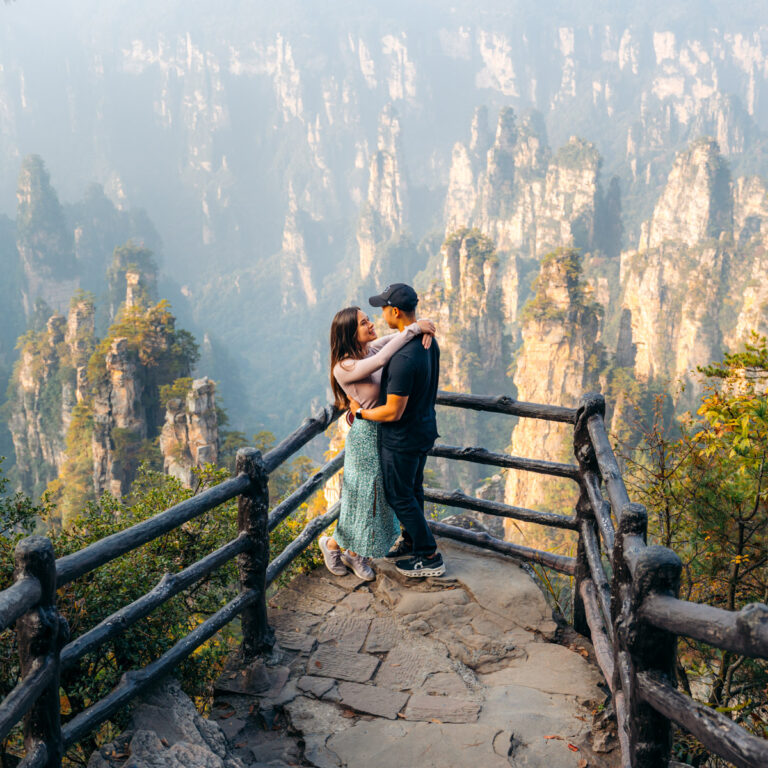
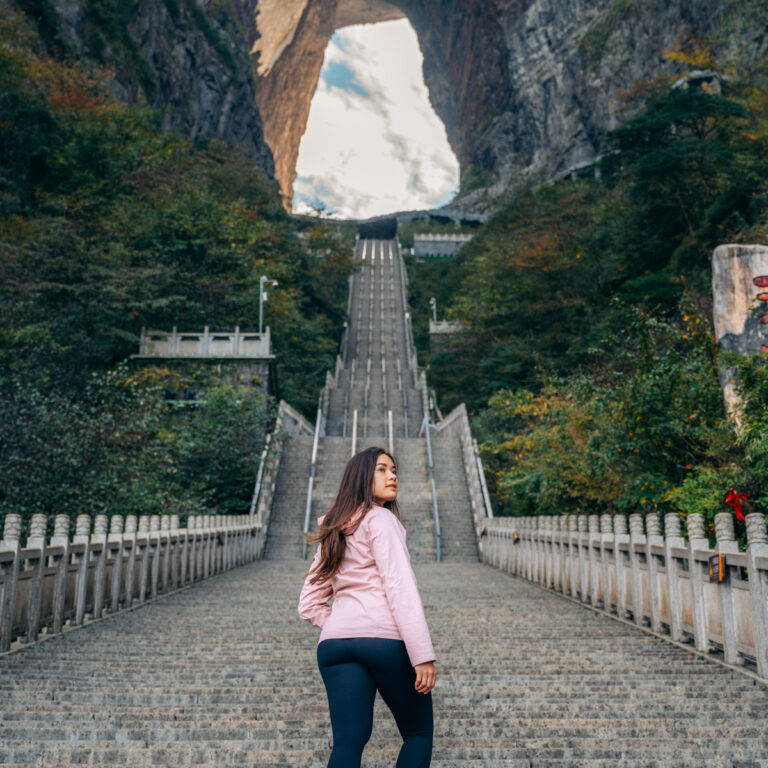
China has zero shortage of outstanding mountain landscapes. From the Avatar-esque quartz sandstone towers of Zhangjiajie, to the steep-sided karst mountains rising from the green plains of Guilin, to the vast desert sand dunes of Dunhuang, we’ve managed to explore more than our fair share of iconic natural landscapes in China. But even so, very few of them left us in awe like Huashan (Mount Hua).
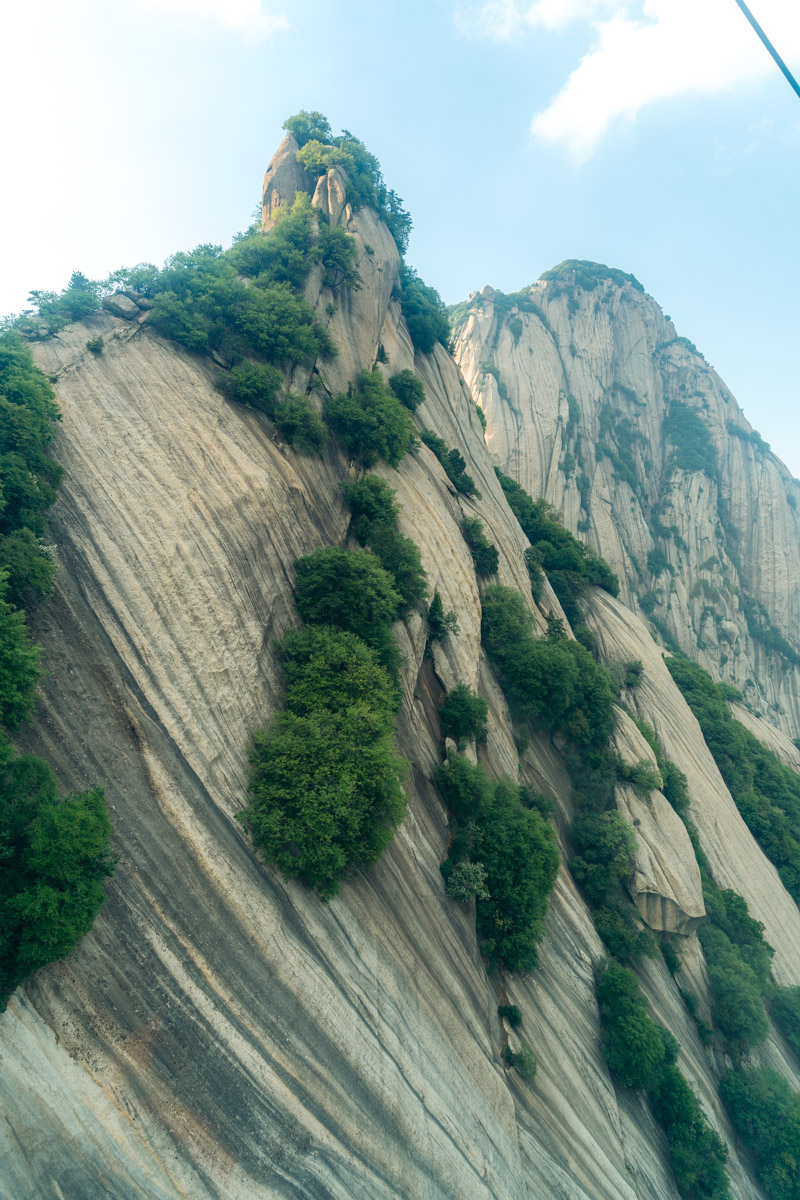
Towering over the Shaanxi Province with its dramatic granite cliffs, narrow ridgelines and breathtaking views, Huashan (Mount Hua) is one of China’s Five Great Mountains for good reason. It’s long been a place of cultural and religious significance, attracting pilgrims for centuries. Today, it’s also one of China’s most unforgettable hiking destinations, offering everything from challenging all-day climbs to scenic cablecar rides that make its incredible peaks accessible to almost anyone.
Planning a visit to Huashan can feel surprisingly overwhelming. There are multiple entrances, two different cablecars, five peaks to explore, and several routes to choose from depending on how much hiking you want to do. It can be difficult to figure out which itinerary makes the most sense, especially if you’re visiting as a day trip from Xi’an.
In this guide, I’ll walk you through everything you need to know before visiting Huashan, including how to get there, where to stay, the different hiking and cablecar options, and how to choose the route that’s right for you. I’ll also share our one-day itinerary, where we rode the West Peak cablecar up, explored all five peaks on foot, and descended via the North Peak cablecar, a route that gave us the best balance of incredible scenery without tackling the mountain’s most demanding climb.
Huashan at a Glance
Here’s a quick rundown of what to expect for Huashan, and some quick need-to-know details before we get into the nitty gritty.
Location: Huayin, Shaanxi Province, China (about half an hour from Xi’an by high-speed train)
Time Needed: 8–10 hours for most day trips (or 2 days if staying overnight for sunrise)
Difficulty: Moderate to Very Challenging (depending on your chosen route)
Cablecars: Two available (West Peak and North Peak)
Highest Elevation: 2,155 m (7,070 ft) at South Peak
Famous For: Dramatic granite cliffs, narrow ridge walks, breathtaking viewpoints, and the infamous Plank Walk in the Sky
Tickets Required: Entrance ticket plus separate shuttle bus and cablecar tickets
Best Time to Visit: April–June and September–October for comfortable hiking temperatures and clearer skies
Can You Visit in One Day? Yes! Most visitors explore Huashan as a day trip from Xi’an.
Budget: Expect to spend approximately ¥500–¥800 per person, depending on your transportation and cablecar choices.
Where Is Huashan?
Huashan is located in the Shaanxi Province (not to be confused with the Shanxi Province, which is right next door to the east), home to the ancient city of Xi’an. Xi’an was a the capital of China for parts of 13 different dynasties, spanning over a thousand years. It’s most known for its food culture and the 2,000 some terracotta warriors that were uncovered by archeologists in 1974.
Huashan itself is situated 120 km east of Xi’an in the Huashan Scenic Area. It’s a single mountain made up of five distinct peaks, which you’ll soon discover in detail, but it’s also part of a much larger mountain range called the Qin Mountains (Qinling), which divides northern from southern China.
How to Get to Huashan
The best way to get to Huashan is from Xi’an, either by driving—1.5-2.5 hours depending on traffic and your starting location in the city—, by tour, or by high-speed train. You also have the option of booking one of these Huashan packages that includes a roundtrip shuttle bus from Xi’an!
The train is by far the most efficient way to get to Huashan if you’re coming from Xi’an, and it only takes 25-35 minutes! Even if you’re not coming directly from Xi’an, you’ll likely still have to transfer through the city. We were coming all the way from Zhangye in the Gansu Province, and transferred via the Xi’an North Railway Station.
If you’re flying in, the closest airport is also in, you guessed it, Xi’an, at the Xi’an Xianyang International Airport (XIY). From there, you’ll most likely head to the Xi’an North Railway Station and take the same high-speed rail we did.
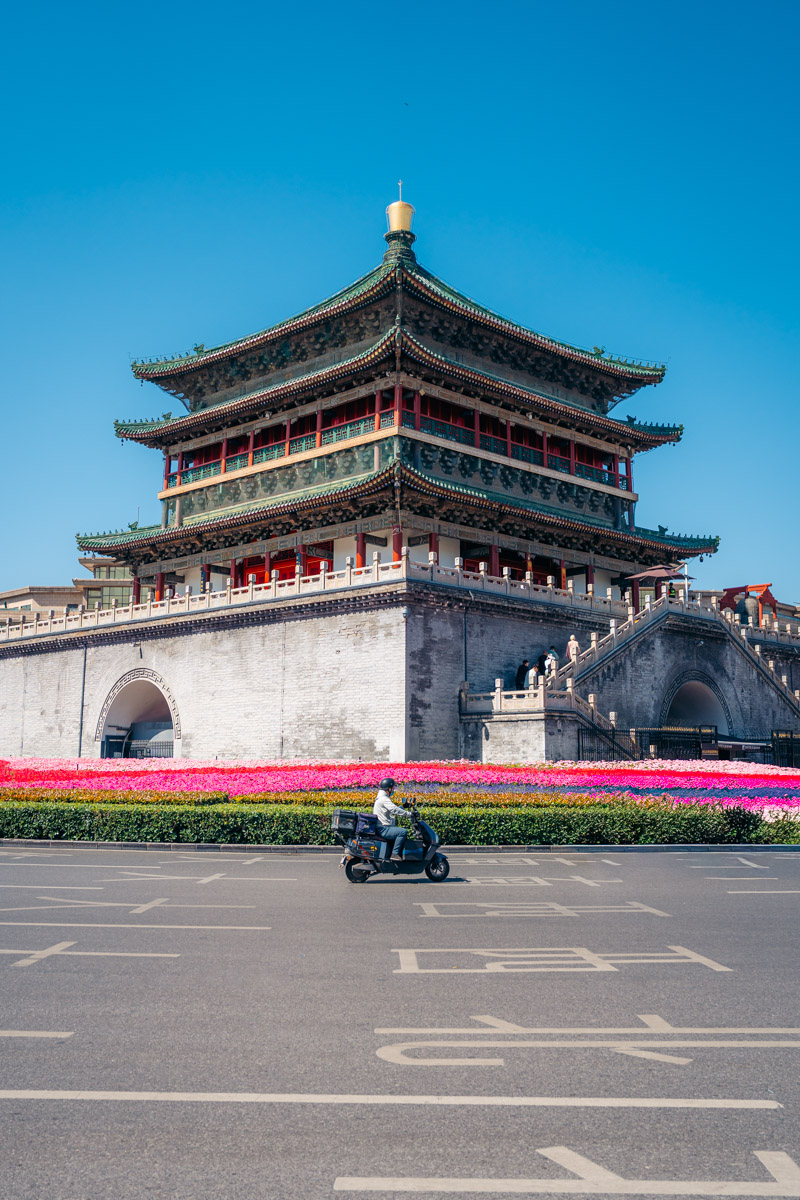
Once you arrive at the Huashan North Railway Station, you can either take a taxi or a Didi (China’s main rideshare app) for about 20-30 RMB for a 10-20 minute ride. There’s also a free shuttle bus that departs from the station and takes you to the Huashan visitor centre in about 30 minutes, departing every 30 minutes or so, from 7:10am to 7:10pm, depending on the season. Check out this page on China Travel Guide for more info.
But my favourite way to get there from the railway station is by complimentary private pickup, which we got with the hotel we were staying with!
Where to Stay
Stay in Xi’an
Since the high-speed train ride only takes about half an hour from Xi’an, you can consider staying in the city of Xi’an itself. The advantage of that is that there are way more hotel options, better restaurants (the Huashan area was seriously lacking and more expensive) and it’s actually an easy day trip to make. One of the main ticket options for Huashan actually includes a roundtrip shuttle us from Xi’an, so it’s quite a common experience.
You would need to take into account that extra hurdle to jump over, which means an earlier wakeup call, potential heavy traffic in Xi’an depending on where you stay, or you could stay close to the railway station that night to eliminate that risk. After you spend the day at Huashan, you can easily get on an evening train back to Xi’an, but I would still pre-book your train tickets in advance.
We stayed at the JW Marriott in the Weiyang District, as well as the Elong Etang Hotel near the Bell Tower. Both were fantastic for very different reasons: the former offering a luxury experience in the quieter, administrative centre of the city, while the latter is a budget-friendly alternative, situated near all the action, in the heart of the ancient city walls, and a walk away from the Muslim Quarter. Out of the two, the JW Marriott Xi’an is the closest to the Xi’an North Railway Station, albeit still 15-20 minutes away.
Stay in Huayin
Yes, it’s doable to come in and out of Huashan from Xi’an on a day trip, we highly recommend spending at least one night in the town of Huayin that lies at the foot of Huashan. Personally, we spent two nights here, giving us the opportunity to get a good sleep, enjoy a quick complimentary breakfast and a complimentary ride to Huashan’s visitor centre.
Especially if you are planning on hiking up the mountain, or taking one of the more difficult route options (which I’ll talk about later), you’ll want to eliminate any additional journeying and time on the road you’ll need before and after your time spent on the mountain.
You’ll be minutes away from the gate, you’ll feel way less rushed on the mountain, and if you are hiking up the mountain, it’ll be much easier for you to get a head start.
The downsides are that there are fewer hotel and food options in the area, but it’s a small sacrifice over the span of two nights worth making to save you the headache for the main attraction.
We honestly loved our affordable stay at the Yuanshan Hotel in Huayin. It was a cozy, clean and new room with a mountain view right from our window. I also mentioned before that we got a complimentary pickup and dropoff from/at the Huashan train station, a drive to take us and pick us up from the Huashan visitor centre on the day of, and the service was top notch at the reception. For less than U$30 a night, it honestly doesn’t get any better than this.


Best Time to Visit Huashan
Much like the majority of China, the best times to visit Huashan are during the spring (from April to early June) and autumn (from September to October). The summer months are actually really hot with chances of thunderstorms in the afternoon, and are a very busy time with long queues for the cablecars, but the rain can create some stunning seas of clouds in the mornings.
The shoulder months of spring and autumn usually bring much more pleasant weather and temperatures and often offer better visibility, though autumn is better in that department. This is pretty much what we got when we visited at the very end of April: clear blue skies with some overcast, very comfortable temperatures both at the foot and at the summits of the mountain, and some haze due to the seasonal spring dust and altitude fog of the incoming cloudier season.
I say spring and autumn are the best, but the times you absolutely must avoid any tourist destination travel in China are:
- Chinese New Year (usually falls betwee January 21st and February 20th)
- Labour Week (usually May 1st-5th)
- Golden Week (October 1st-7th)
Avoid them like the plague or you’ll end up queuing all day, shoulder to shoulder with every other human on the mountain!
Huashan Entrance Areas Explained
Before I get into it, let me explain that you have the choice of either hiking up to the top of the mountain or taking one of two cablecars. If you choose to hike, the most sought out trail is the Traditional Hiking Route, but there is also another way which doesn’t get talked about much, and for good reason.
It’s called the Soldier’s Path, and it’s a steep staircase made up of 4,000 steps that was built in 1949 for eight PLA soldiers to scale the mountain, with 2.6 km in distance and about 750-800 m in elevation gain. It’s essentially just a direct staircase with no views that follows a similar alignment to the north cablecar. It might be faster to climb—still at a lengthy 2-3 hours—than the traditional trail, but very few people choose to do it because of the steepness and lack of scenery.
Now for the entrances, there are three key starting points to reach the top of Huashan that all branch off from the Visitor Centre: the West Cableway Station, the North Cableway Station (both for cablecar access), and the Jade Spring Temple/Yuquanyuan (for the hike trailhead).
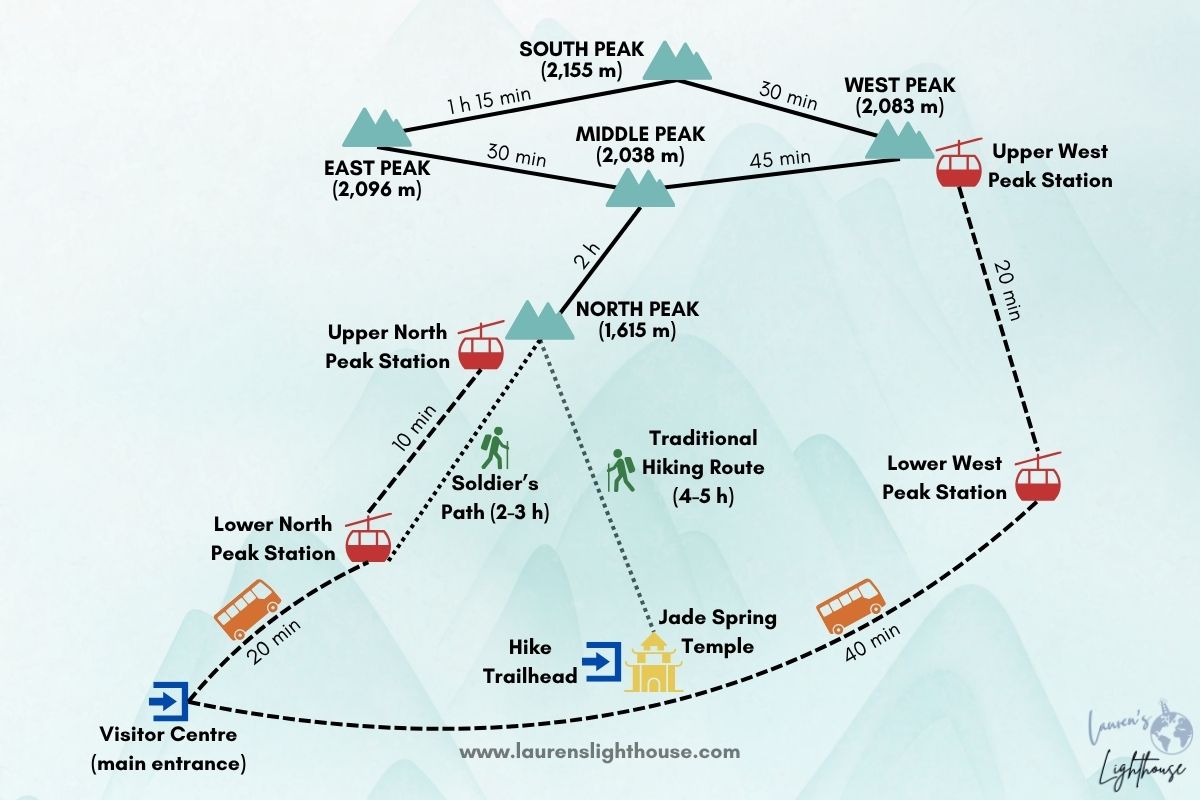
You can also access the Jade Spring Temple/Yuquanyuan separately from the Visitor Centre, which allows for early hikers to make their ascent before the Visitor Centre is even open. You would need a Didi or taxi to get you there, but the ride takes less than 10 minutes from the Visitor Centre (or about 15 minutes from Huashan North Railway Station), costs only around 10–20 RMB, and saves you the extra shuttle transfer.
Now, going back to the West and North lower cableway stations are the access points to reach the West Peak and North Peak, respectively. The Traditional Hiking Route, which I’ll get into detail soon, also leads you up to the North Peak. Let me break down the different peaks that make up Huashan.
Understanding the Five Peaks
Before we get into the different route options, here’s a quick overview on the five peaks that make up Huashan:
- West Peak: sitting at 2,083 m (6,834 ft), it’s known for it’s giant split rock that and dramatic cliffs. It’s considered to be the most beautiful peak by many, due to the towering granite monolith that’s roughly 30 m high.
- South Peak: sitting at 2,155 m (7,070 ft), it’s the highest peak of the mountain and home to the famous Plank Walk in the Sky. It’s our favourite peak because the view of the jagged profile of Mount Hua is insane from here, especially from the Plank Walk.
- East Peak: sitting at 2,096 m (6,877 ft), it’s known for the best spot to watch sunrise, and also sits above the picturesque Chess Pavilion.
- Middle Peak: sitting at 2,038 m (6,686 ft), it’s not truly its own summit but an extension of East Peak, and the junction point between the North Peak and the other peaks.
- North Peak: sitting at 1,615 m (5,298 ft), it’s the lowest summit of the mountain and the first peak reached from the classic hike. As it’s at a lower elevation, you can see much of the steep faces and cliffs of Mount Hua from here.
Huashan Route Options
One of the most confusing parts of planning a visit to Huashan is deciding which route to take. Unlike many hiking destinations, there isn’t just one trail to the summit. As I mentioned above, you can choose to hike the mountain from the base, take one of two cablecars, or combine hiking and cablecars to create an itinerary that suits your fitness level and the amount of time you have.
While many visitors choose the West Peak cablecar up and the North Peak cablecar down, there are several ways to explore the mountain. And. nomatter which route you take from the selection below, you’ll be able to visit all five peaks.
Options 1 & 2: Cablecars Ascent & Descent
To maximize your time (and energy) spent on top of the mountain itself, you can choose to go up one cablecar and down the other. It is possible to go up and down the same cablecar, but it’s not a common choice, mostly due to the extra effort of doubling back on the long stretch between the North Peak and Middle Peak. If you look at my map sketch above again, the trail at the top looks more like a lollipop than a loop.
You’re not missing much—and you’re still seeing all five peaks and much more in between—when you take the opposite cablecar, and ultimately are just missing the stretch between the Middle Peak and the West Peak, which to our knowledge doesn’t offer much that is unique.
Taking the West Peak cablecar up and the North Peak cablecar down is the most popular and our recommended to most visitors. This is the route we chose in the end, to eliminate the most elevation gain, and to reach the Plank Walk in the Sky ahead of the majority while not rushing our time at the beginning. But it also offers the best opening you can imagine, when you ride the 20-minute long scenic cablecar that goes up, down and all the way up amidst the most jaw-dropping valley in China we might have ever seen.
The downside of this route being the most popular… is that it’s the most popular. So during peak seasons, the lineups for the cablecars are absolutely insane, lasting hours. To avoid the crowds and not go with the grain, you can go in the opposite direction: take the North Peak cablecar up and the West Peak cablecar down. You’ll go through the exact same path, with varying detours or one-way courses, just in reverse.
I’ve put together the stats, pros and cons for each route option to help you form your own decision. Just note that the hiking distances and elevation changes are estimated totals, as your actual total depends on any detours, the plank walk or varying courses you might take. The time needed does not include transportation within the park or wait times in line.
West Peak Up, North Peak Down
STATS
- Hiking Distance: 8 km
- Elevation Gain: 630 m
- Elevation Loss: 1,050 m
- Time Needed: 4-6 hours
- Difficulty: moderate
PROS
- Incredible views from the moment you arrive
- Avoids the most strenuous climb
- Reaches the Plank Walk first for day visitors
- Ideal for a one-day visit from Xi’an
CONS
- Most expensive option due to two cablecars
- Can have very long wait times during peak travel periods
North Peak Up, West Peak Down
STATS
- Hiking Distance: 8 km
- Elevation Gain: 1,030 m
- Elevation Loss: 610 m
- Time Needed: 5-7 hours
- Difficulty: moderately challenging
PROS
- Avoids the most popular route and crowds accumulated at the cablecar stations
- Gives you the option of climbing up the knife edge Blue Dragon (Canglong) ridge from the North Peak to Middle Peak
CONS
- More uphill hiking
- Slightly more physically demanding
Options 3, 4 & 5: Hike Up Only OR All Hiking
Some of you might be wondering, why on earth would I think that hiking up the mountain is a good idea? Wouldn’t hiking down be the better alternative? Well in that case, this option isn’t for you. This is for all the hiking addicts who love to undertake a challenge, but who also want the option of starting your day on the mountain bright and early.
The advantage of taking the traditional hiking path up is that there are many points of interest along the way that the rest of us would not experience. Take a look at the map below to see all the spots I mean. You can also start your day as early as you want since you can access the Jade Spring Temple (Yuquanyuan) with your own private transportation without having to wait for the park bus system to start operating.
This historic pilgrimage has been used for centuries, but the trail does climb over 1,200 m via thousands of stone steps before reaching North Peak, where you can continue to explore the remaining peaks. A shorter alternative is the Soldier’s Path that I mentioned before. It climbs a total of roughly 4,000 steps over a short distance, but the elevation gain is max 800 m.
The downside of hiking either is that you spend all your energy making the climb instead of focusing it at the time. If you choose to do the Plank Walk, you might also be delayed in getting yourself there compared to other visitors. But if I were to forego a cablecar ride, it would be the North Peak one. The West Peak cablecar is the hero for views, so try not to miss out on it if you can.
Now, if you are crazy crazy, there’s always the option of hiking up and down the mountain. It’s a level of insane that I can’t comprehend, but if you are going to do it, you could hike up the classic route and hike down the Soldier’s Path. You’d be adding another 4+ hours, give or take, to your day to include the trail from West Peak all the way back to North Peak, but the option is there. This is best suited for very experienced hikers with excellent fitness and endurance.
Traditional Up, West Peak Down
STATS
- Hiking Distance: 15.2 km
- Elevation Gain: 2,180 m
- Elevation Loss: 1,020 m
- Time Needed: 7-9 hours
- Difficulty: challenging
PROS
- Experience Huashan’s historic hiking route
- Most rewarding climb with start time flexibility
CONS
- Very strenuous
- Requires an early start
- Long day with significant elevation gain
Soldier’s Path Up, West Peak Down
STATS
- Hiking Distance: 10.7 km
- Elevation Gain: 1,610 m
- Elevation Loss: 610 m
- Time Needed: 6-8 hours
- Difficulty: challenging
PROS
- Shorter than the traditional hike
- Challenging without being an all-day climb
CONS
- Very steep
- Less scenic than the traditional route
- Still requires to wait for Visitor Centre opening time to buy bus tickets to the North Peak Lower Cableway Station
Hike Up & Down
STATS
- Hiking Distance: 20 km
- Elevation Gain: 2,500 m
- Elevation Loss: 2,500 m
- Time Needed: 11-14 hours
- Difficulty: extremely challenging
PROS
- No cablecar costs
- Complete hiking experience
- Very rewarding
CONS
- You are crazy
- Seriously, because this is insane for one day
- You’d have to do an out-and-back along the middle-north peaks section and miss out on the best cablecar ride
Option 6: Stay Overnight on the Mountain
Huashan has several simple yet pricey hotels located near the peaks, allowing you to experience both sunset and sunrise without rushing your visit. It also allows you to be one of the first to get to the Plank Walk in the morning for the first available time slot.
Most visitors hike or take a cablecar to the mountain in the afternoon, spend the night, then watch the sunrise from East Peak before exploring the remaining trails the following morning. There are hotels at the North Peak (Yuntai Villa), near the Middle Peak (Five Cloud Peak Hotel), at the East Peak (East Peak Hotel) and at the West Peak (West Peak Hotel).

While the accommodation is fairly basic for the price, and you’ll need to pack some overnight items, spending a night on the mountain offers a completely different experience and lets you enjoy the scenery after the daytime crowds have disappeared. The blue hour and golden hour opportunities are also such a haven for photographers, so I can certainly see the appeal.
Even though we opted not to stay overnight on Huashan, we actually did an overnight stay on Huangshan in the Anhui province, and it was so worth it!
Our Huashan One-Day Itinerary
Okay, after that whole rundown, it’s time I breakdown the day’s itinerary, using the route we took—i.e. taking the cablecars up and down, going up West Peak and down North Peak.
Arriving at the Huashan Visitor Centre
As I mentioned above, we stayed in Huayin for two nights during our visit, and the Yuanshan Hotel kindly provided a complimentary shuttle to the Huashan Visitor Centre. Arriving around 7:10am (which could’ve been earlier but we wanted to get some breakfast at the hotel first), we joined the short queue for the West Peak shuttle bus and this is where our passports were scanned for ticket entry. Whether you’re buying your admission online or through your hotel, you’ll absolutely need to bring your passport as your admission is directly linked to it.

Despite the somewhat growing crowd, there were plenty of green shuttle buses waiting, and we were onboard and ready to depart within minutes.
The scenic 40-minute drive winds through a beautiful valley surrounded by lush forests and towering granite cliffs, giving you a small taste of what’s to come. Once we arrived at the West Peak Lower Cableway station, we still had one final climb before reaching the terminal. A broad stone staircase takes about 10-15 minutes to walk, although if you’d rather save your energy, there’s also a fun mountain coaster that carries visitors partway to the top for an additional fee.

Riding the West Peak Cablecar
The West Peak Cablecar was worth every penny and ended up being one of our favourite parts of the day. Stretching 4,211 m (13,816 ft) in length, it’s the longest cablecar on Huashan and climbs an impressive 894 m (2,933 ft) vertically. What surprised us most, though, was that it doesn’t simply travel uphill. Instead, the cablecar first ascents to a mountain peak in the middle before descending into a deep river-flowing valley before soaring up again to the top of Huashan, making the actual elevation change even greater than the published vertical rise.
As we floated above dense forests, a rocky riverbed that carved the valley and sheer granite cliffs, the views became more spectacular with every passing minute. Near the end of the journey, the cablecar glides directly into a tunnel carved through the mountainside before arriving at the upper station. Quite a dramatic entrance that immediately sets the tone for the rest of your visit.


By the time we stepped off the cablecar, it was already 8:45am.
Exploring West Peak
Our first stop was the peaceful West Peak Cuiyun Palace, a small Taoist temple tucked quietly into the mountainside just at the outlet of the cablecar station. It’s a serene introduction to Huashan before the crowds and dramatic viewpoints begin.

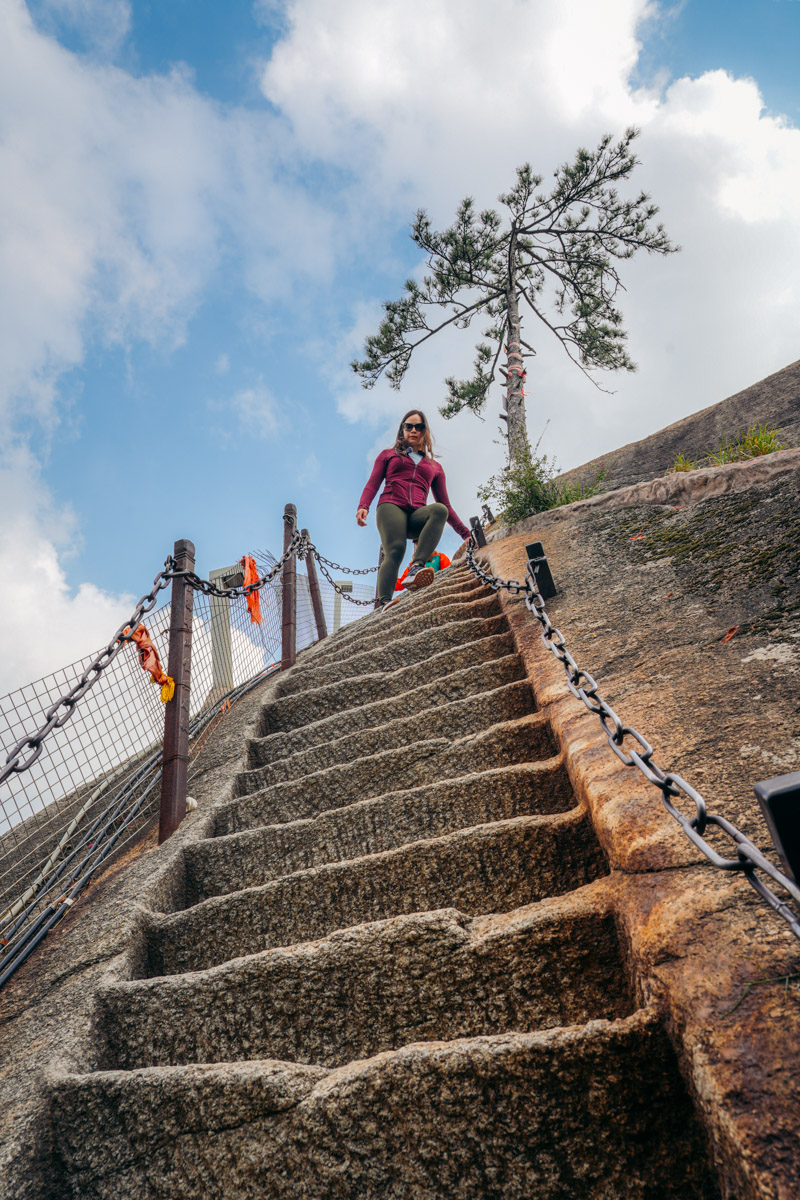
From there, we followed the stone pathways toward West Peak. One of the things that impressed me most throughout the day was the incredible engineering. Staircases have been carved directly into the rounded granite ridges, with sturdy railings and chains helping visitors navigate sections that would otherwise be inaccessible. It’s an impressive feat of infrastructure that allows hikers, young and old, to experience one of China’s most rugged mountains.
The summit of West Peak (2,083 m / 6,834 ft) is marked by a massive granite boulder. If you’re feeling adventurous, you can climb a short set of steep, chain-assisted steps carved directly into the rock to stand atop it. It looks intimidating from below but only takes a minute or two, and if you’d rather skip it, there’s an easier path that loops around and up the rock to the same viewpoint.
The views from West Peak were our first real taste of what Huashan had in store. Looking out across the surrounding valleys and rugged cliffs, we were ready to undertake the rest of our circuit for even more jaw-dropping views.
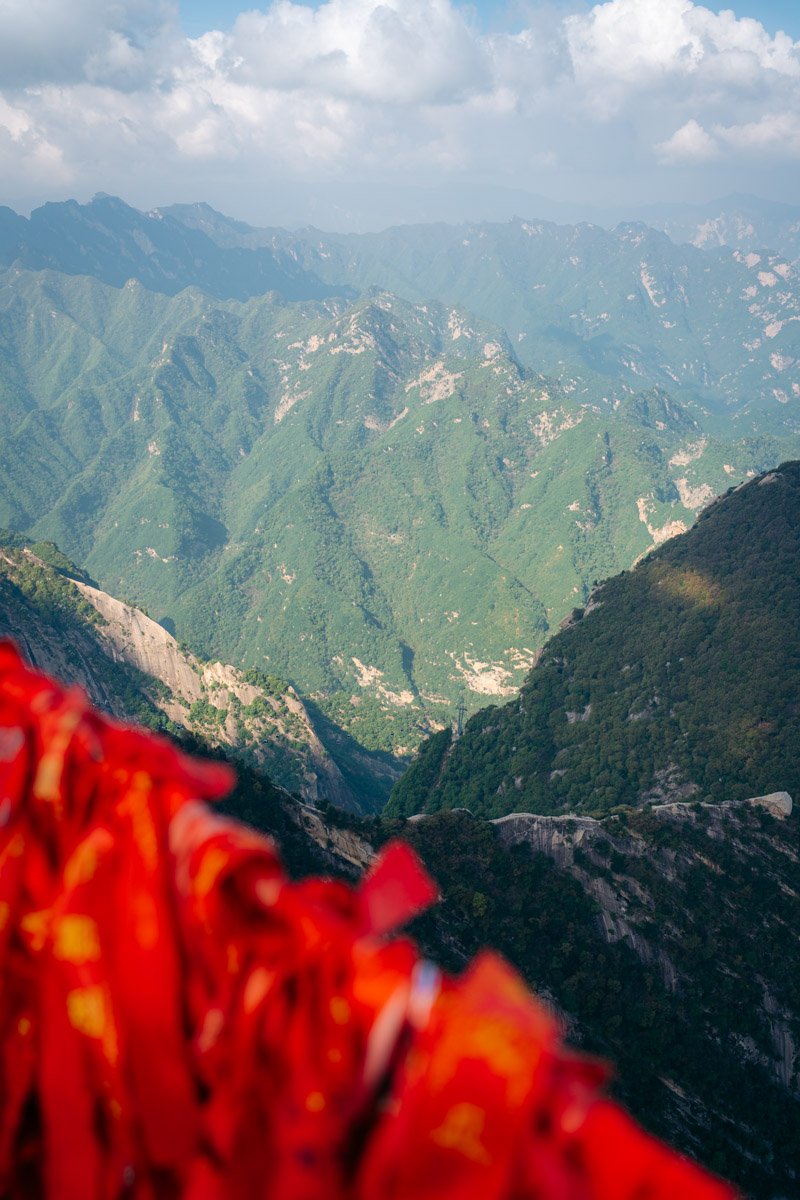
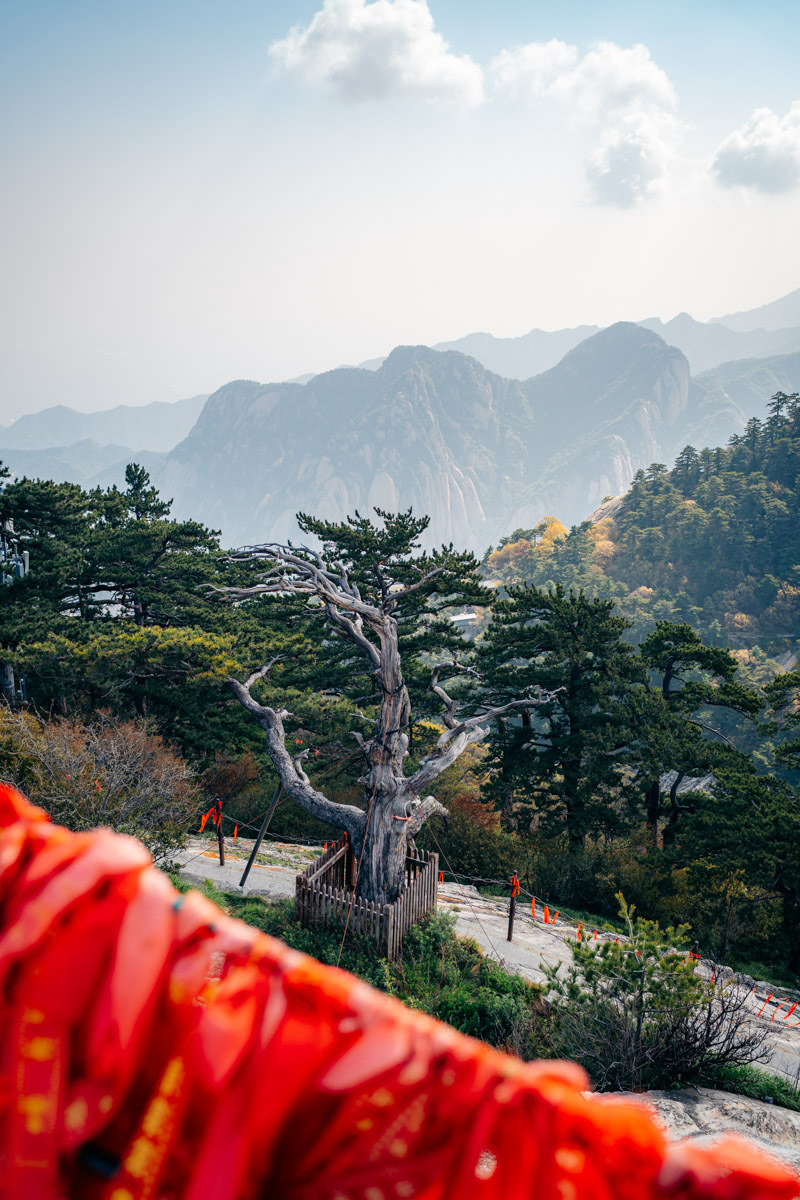
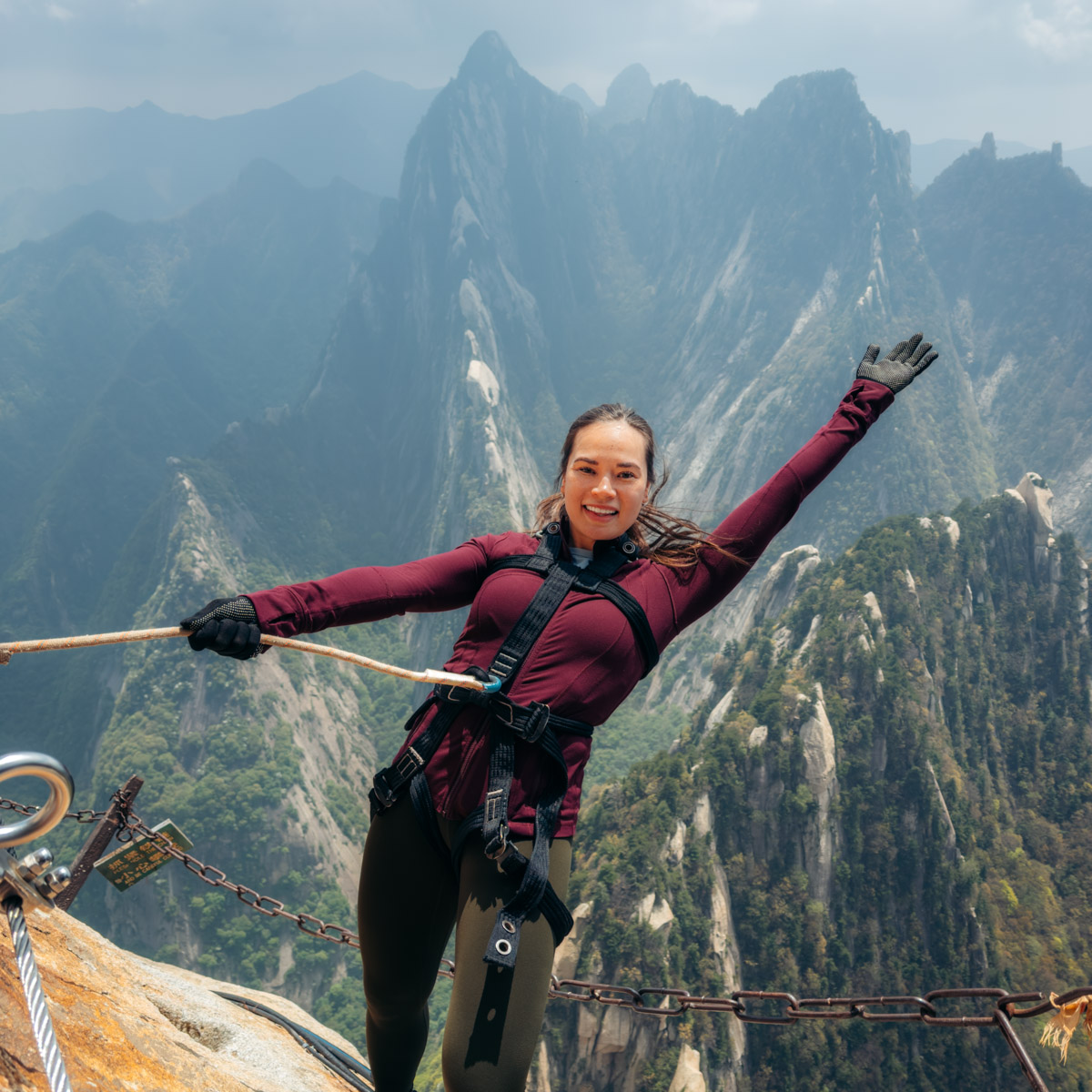
There was a fun photo op just beside the summit where, for 60 RMB, you can be fitted with a safety harness and have your photo taken standing on a narrow rock ledge overlooking the cliffs. The price includes a printed copy of your photo, making it a memorable souvenir if you’re looking for something a little different. Yes, it’s a little gimmicky, but a fun perspective shot nonetheless.
Walking to South Peak
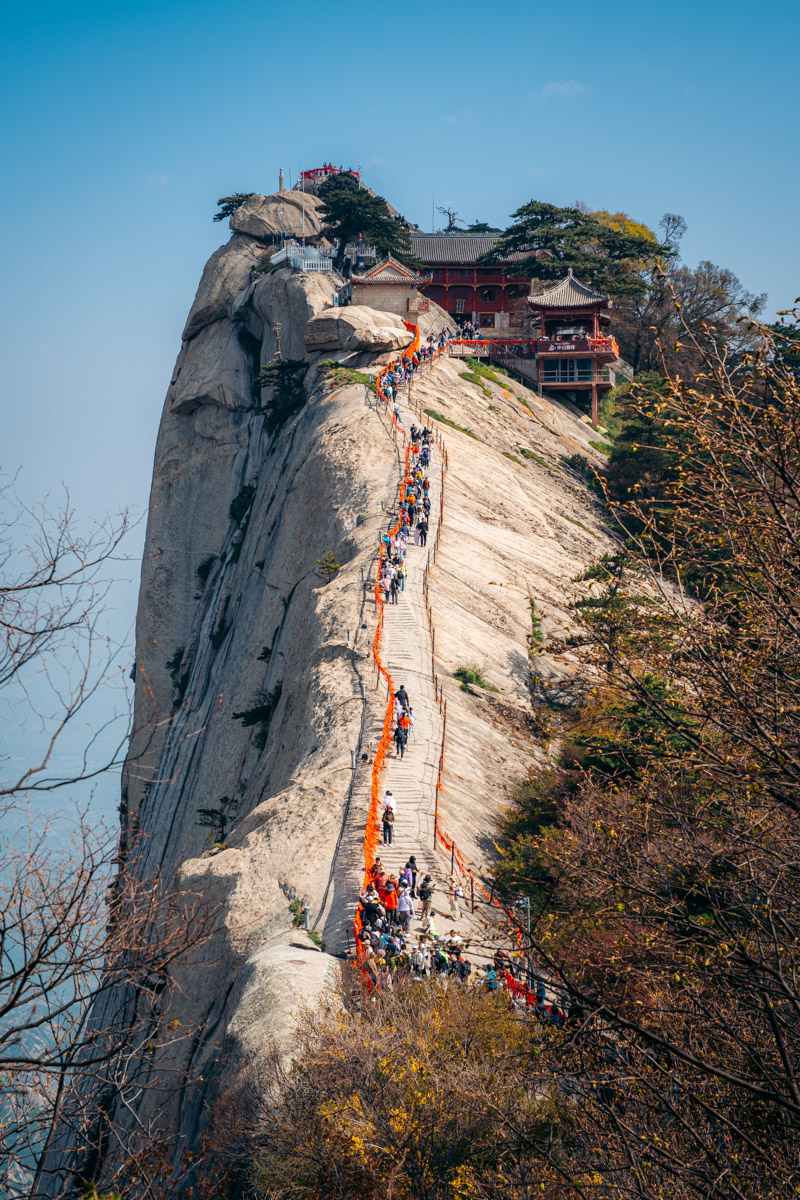
As we descended from West Peak, the crowds were getting noticeably fuller, but it got better once we veered off on the trail towards South Peak. One of my favourite lookouts of the entire day was actually along this uphill section of the trail. Looking back, you get a photo-worthy perspective of the carved out stone staircase tracing its way along the ridgeline of West Peak, a view that’s just as impressive as the summit itself.
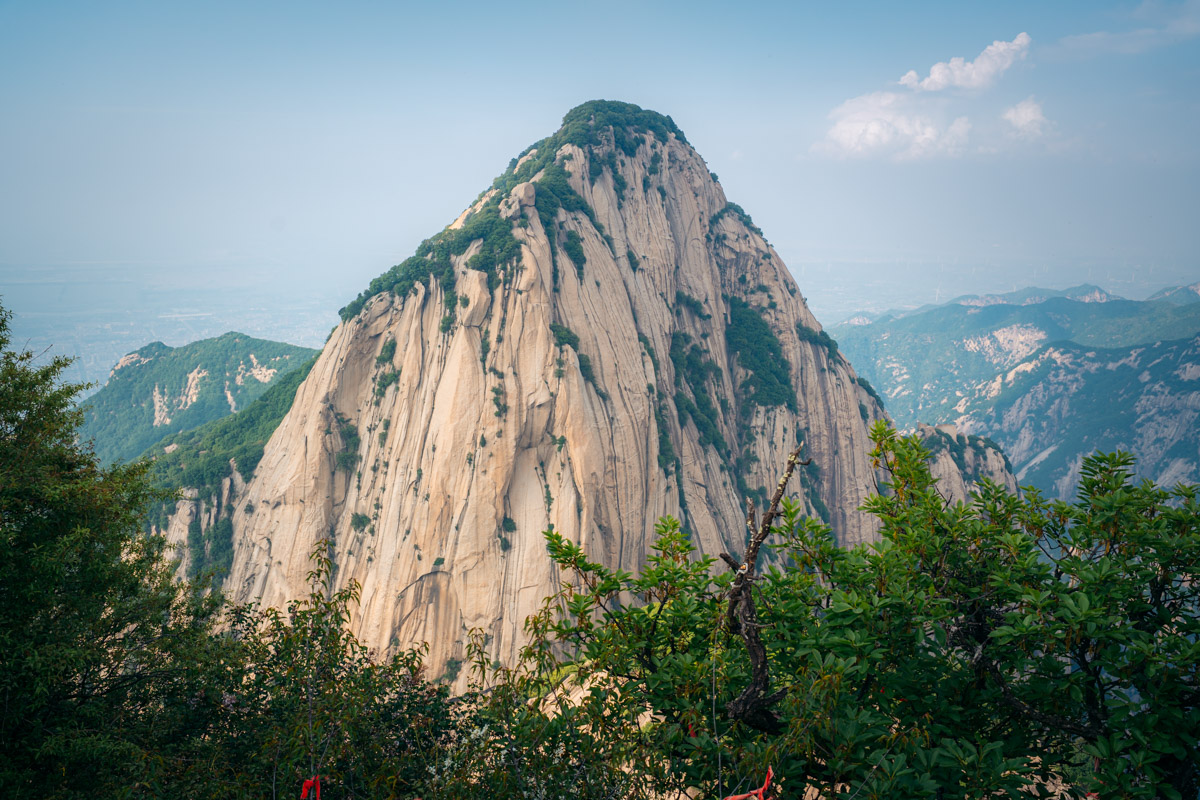
About five minutes later, we reached our first truly iconic viewpoint on Huashan. The view isn’t of Huashan itself, but of the adjacent mountain that often comes up when you look up Huashan. We’d caught a glimpse of the mountain near the end of the cablecar ride, but this was the first time we could fully appreciate the dramatic conical mountain with a ridgeline that spirals into itself. Seeing the jagged granite spine plunge almost vertically into the lush green centre of the mountain below is one of those views that instantly makes you understand why Huashan is considered one of China’s most spectacular mountains.
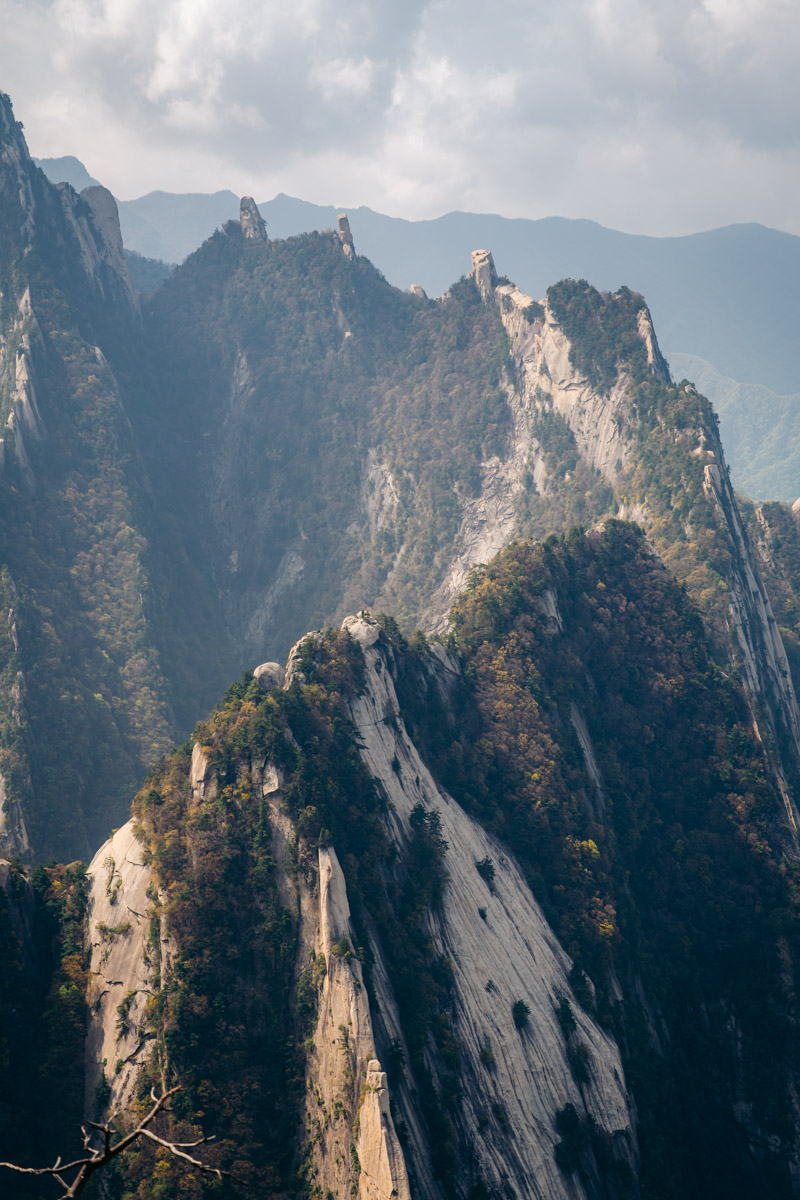
As we continued climbing toward South Peak, the scenery became even more open, with fewer trees blocking the panoramic views. Interestingly, one of our favourite viewpoints wasn’t actually from the summit itself. Along the way up, there’s a small stone laden lookout with a bench that offers virtually the same breathtaking panorama, just slightly lower, but with far fewer people.

The summit of South Peak (2,155 m / 7,070 ft) was by far the busiest place we encountered all morning. So many visitors crowded around the stone marker announcing the mountain’s highest elevation, often resulting in long waits for photos.
The summit itself also deserves a little caution. Rather than being a large, flat platform, it sits atop a natural granite outcrop with uneven footing in several places. Combined with the crowds, it’s worth taking your time and paying attention to where you’re stepping rather than focusing solely on getting a photo.

After snapping a few quick pictures of the view from the top, we decided not to linger and began making our way down toward one of Huashan’s most famous attractions: the Plank Walk in the Sky.
Undertaking the Plank Walk (Optional)
Leaving South Peak, we followed the trail downhill headed for the Plank Walk. Along the way, we walked through this temple courtyard that gave us brief pause from the vastness of the mountain summit.

We arrived at the entrance around 10:30am, expecting to queue up and head straight in. Instead, we found a short lineup and quickly learned that the Plank Walk operates on a scheduled entry system.
At first, we were completely confused. We soon discovered that the Plank Walk only opens approximately every two hours, with around five to six entry times each day depending on the season. The next available group wasn’t until 11:30am, meaning we’d have to wait another hour before even beginning the experience.
You’ll notice a sign displaying a WeChat QR code that allows visitors to reserve a time slot in advance. Unfortunately, this didn’t work for us as foreign visitors because it requires a Chinese ID to complete the booking, and every reservation for the day had already been claimed. Thankfully, there’s no need to panic if you can’t book online, as the park reserves a number of spaces in every time slot for walk-in visitors. But the earlier in the day you get here, the better. Spoiler alert: the line was insanely long, way past the bottom of the entrance staircase, by the time we were done.
Although waiting another hour for what’s essentially a 100-m attraction initially seemed ridiculous, it made complete sense once we understood how the Plank Walk actually operates.
Why Does the Plank Walk Operate on a Schedule?
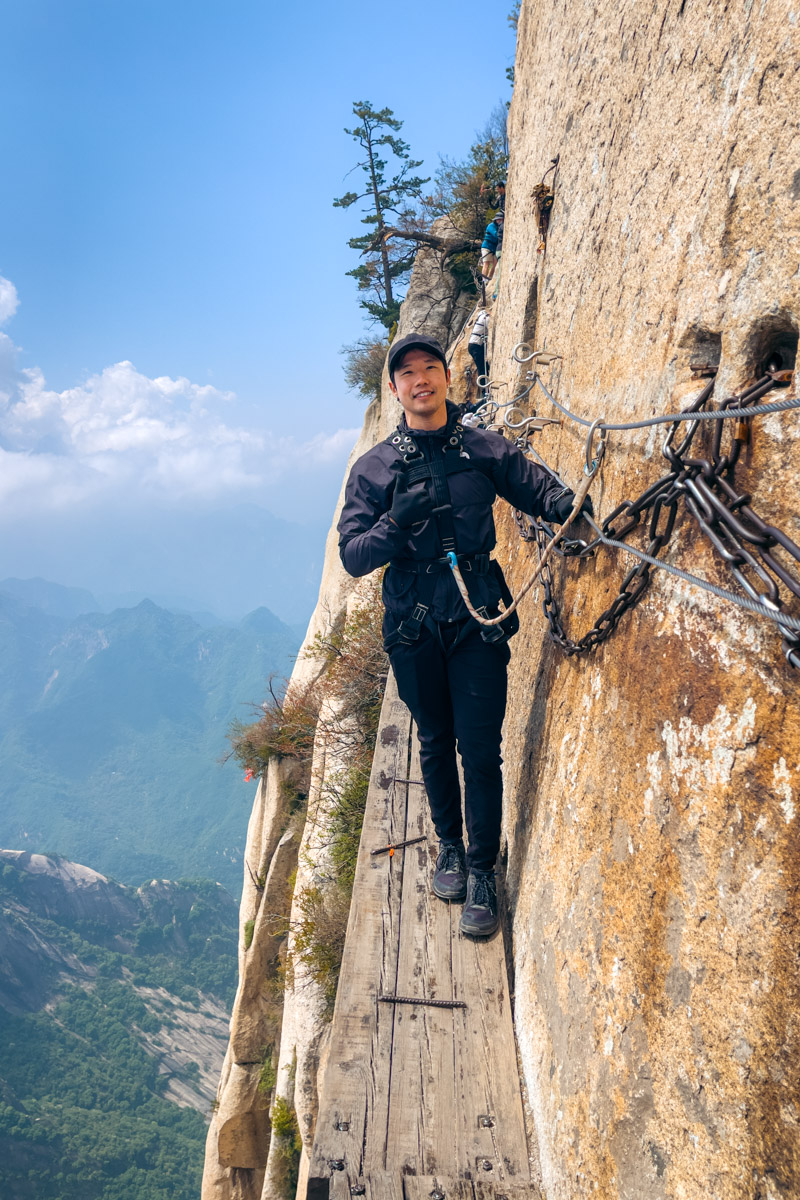
Despite its reputation, the Plank Walk itself is surprisingly short—only around 100-130 m one way. The reason for the scheduled entry isn’t the length of the walk, but rather how it’s designed.
The Plank Walk is essentially an out-and-back via ferrata, or “iron path.” Normally, this would mean visitors travelling in opposite directions while clipped to the same safety cable. With the popularity of this attraction, that would create an obvious safety issue, not to mention constant bottlenecks as people tried to pass one another on a vertical cliff face.
To solve this problem, the park installed a continuous steel safety cable that forms a one-way loop. Visitors descend one side of the route and return on another, meaning nobody ever has to pass each other while suspended on the cliff.
Each session is limited to roughly 30 to 40 people, and the next group can’t begin until the previous group has completely finished. Although the walk itself is short, once you factor in gearing up, clipping in, navigating the route, waiting for everyone to move through each section, and stopping for photos, each group occupies the course for well over an hour.
In our case, we arrived at 10:30am, entered with the 11:30am group, and didn’t finish until 1:15pm. That’s almost three hours from arrival to completion for an experience that’s only about 100 metres long.
If you’re planning your Huashan itinerary, be sure to factor this into your day. It’s easily the most time-consuming stop on the mountain.
What Is the Plank Walk Actually Like?
I’ll admit, I expected it to be much scarier than it actually was. Having previously completed a Level 3 via ferrata in Mürren, Switzerland, the Plank Walk didn’t quite reach that same level of exposure. That said, there were definitely a few moments where I found myself white-knuckling the cable.
Ironically, I wasn’t worried about falling. I was worried about dropping my phone. We had our phones in our hands for photos, but neither of us had wrist straps or neck lanyards attached. Looking back, I would absolutely recommend bringing one. GoPros are allowed, but they must be securely mounted to your body, such as on a helmet or chest mount, rather than attached with a wrist strap.
The Plank Walk can be divided into three distinct sections:
1. The Ladder
The experience begins with a steel ladder that eases you into the exposure.
You first descend through a short hole and to get to the rock steps before the ladder gradually becomes almost completely vertical. At this point, you finally look beneath your feet and realize there’s roughly 1,000 metres of open air below.
2. The Cliff Steps
Surprisingly, this ended up being the section that made my palms sweat the most.
Here, the route follows a smooth granite wall where narrow footholds have been carved directly into the cliff. You’re essentially tiptoeing sideways across the rock while staring straight down into the valley below. Fortunately, this section is little more than a handful of steps long before reaching the wooden planks.
3. The Plank Walk
Finally, you step onto the famous wooden planks suspended from the cliff.
Each plank is less than a foot wide, yet I actually found this section less intimidating than the cliff steps. Having a flat wooden surface beneath both feet felt surprisingly reassuring compared to balancing on the narrow carved footholds.
The planks themselves are maybe about 10 metres long before you scramble up another short rock section to reach a wide resting platform and viewpoint.
At the end, where the viewpoint rest area was, our group waited while the remaining participants completed the route before retracing our steps back to the entrance. The adrenaline was still pumping, and it felt incredibly satisfying to have conquered one of China’s most famous bucket-list experiences, and we were cheering on the folks ahead of us and behind us before setting off once again.
Safety on the Plank Walk
If you’ve done a via ferrata before, you might notice one major difference. Rather than using the traditional dual-carabiner system, where you clip and unclip at each anchor point, the Plank Walk uses a specially designed single sliding hook. The opening is just large enough to glide over each metal anchor while remaining permanently attached to the cable. Watch our video that I linked at the beginning of this post to see what I’m talking about!
At first, we were honestly a little surprised by this system. By the end, though, it made perfect sense.
Not only does it eliminate the possibility of someone accidentally unclipping themselves from the cable, but it also prevents visitors from passing one another. The order you start in is exactly the order you finish in, making the entire experience much safer and easier for the staff to manage.
There are also several staff members stationed throughout the route. While they’re there to assist if needed, they were mostly just trying to usher us along when we took too long to take pictures, keeping everyone moving efficiently so the next group can begin on schedule.
A Few Helpful Tips
- The cost for the Plank Walk is 30 RMB per person currently, and weirdly enough, they only accept cash. No cards, no WeChat, no AliPay.
- Wear a wrist strap or neck lanyard if you plan on taking photos with your phone.
- Wear a pair of form-fitting gloves so you don’t get friction burn from the cable.
- Allow at least 2–3 hours in your itinerary if you plan on doing the Plank Walk.
- Don’t rely on the WeChat reservation system if you don’t have a Chinese ID. Simply join the walk-in queue (as early as you can), as a number of spots are kept open for non-booked visitors.
- A professional photographer is stationed beside the Plank Walk. If you agree to have your photo taken, expect that they’ll print it for you to purchase afterward, so only pose if you’re happy to buy the souvenir.
Don’t Skip the Viewpoint
Whether or not you decide to tackle the Plank Walk, don’t miss the viewpoint immediately beside it.
This ended up being our favourite viewpoint on the entire mountain. Looking out across Huashan’s jagged granite peaks and lush valleys, it’s somehow much quieter than the famous summits despite offering equally spectacular scenery, if not better.
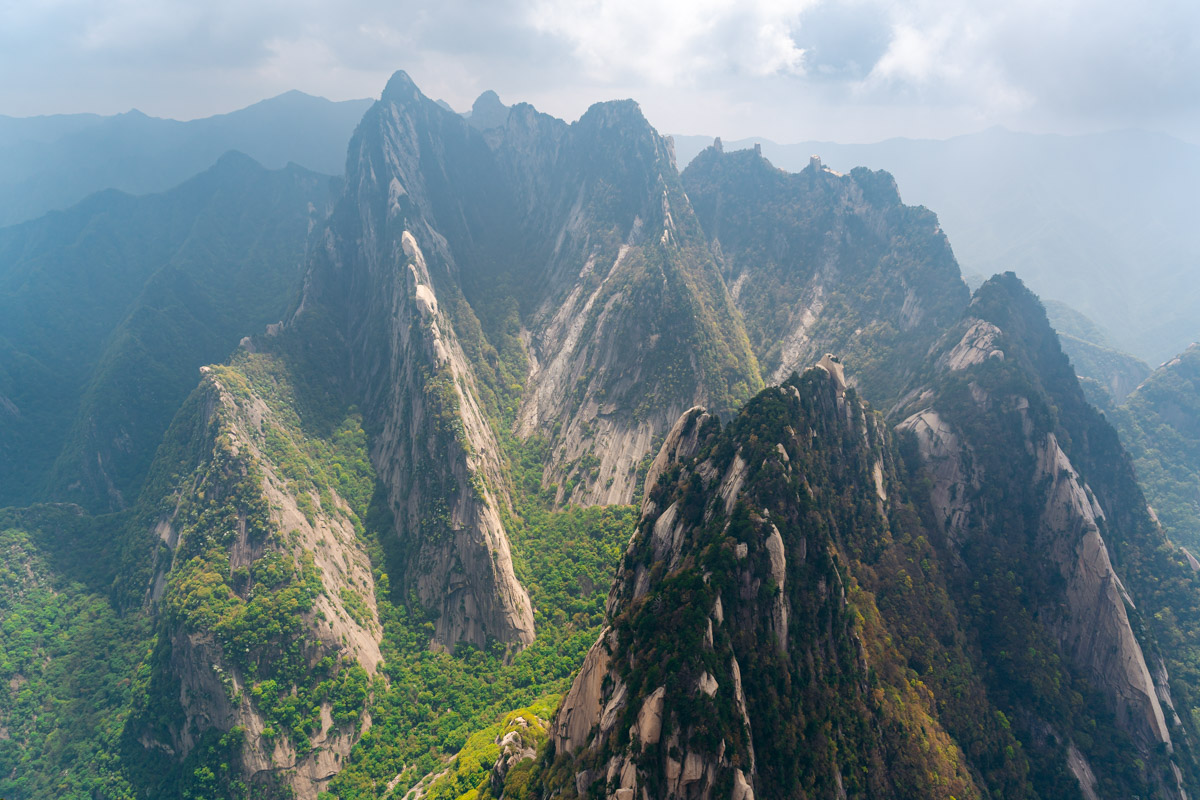
Even if you decide the Plank Walk isn’t for you, I’d still recommend making the short detour up to the observation deck. From here, you can watch participants carefully making their way down the first ladder while enjoying one of the most breathtaking panoramas anywhere on Huashan.
Walking to East Peak
After finally wrapping up our via ferrata adventure, we continued our journey towards East Peak around 1:30pm. The trail first descended through a peaceful section of forest before opening up to another rest area with a couple of food stalls, similar to the one by the Plank Walk. We hadd actually grabbed a rou jia mo (Chinese burger) while waiting in line for the Plank Walk, but after spending nearly three hours there, we were more than ready to fuel up again.
The food options on the mountain are fairly limited, but we ended up ordering a box of fried chicken bites that absolutely hit the spot. They were surprisingly delicious, the portions were generous, and it was the perfect opportunity to refuel, rehydrate, and give our legs a short break before tackling the final major climb of the day.
From there, we began ascending the impressive granite staircase we’d spotted earlier while making our descent from the South Peak. Once again, it’s incredible to see how the trail has been carved directly into the mountainside, transforming what would otherwise be an impossible climb into a surprisingly accessible one.
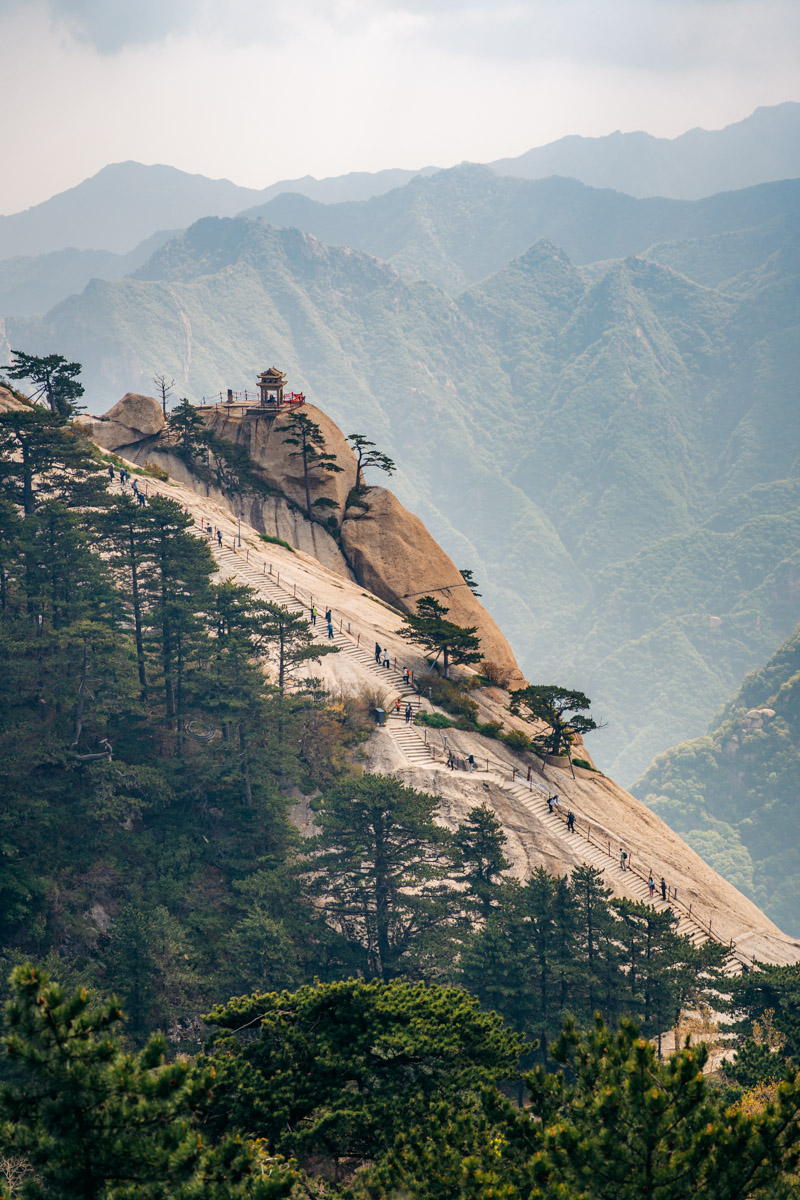
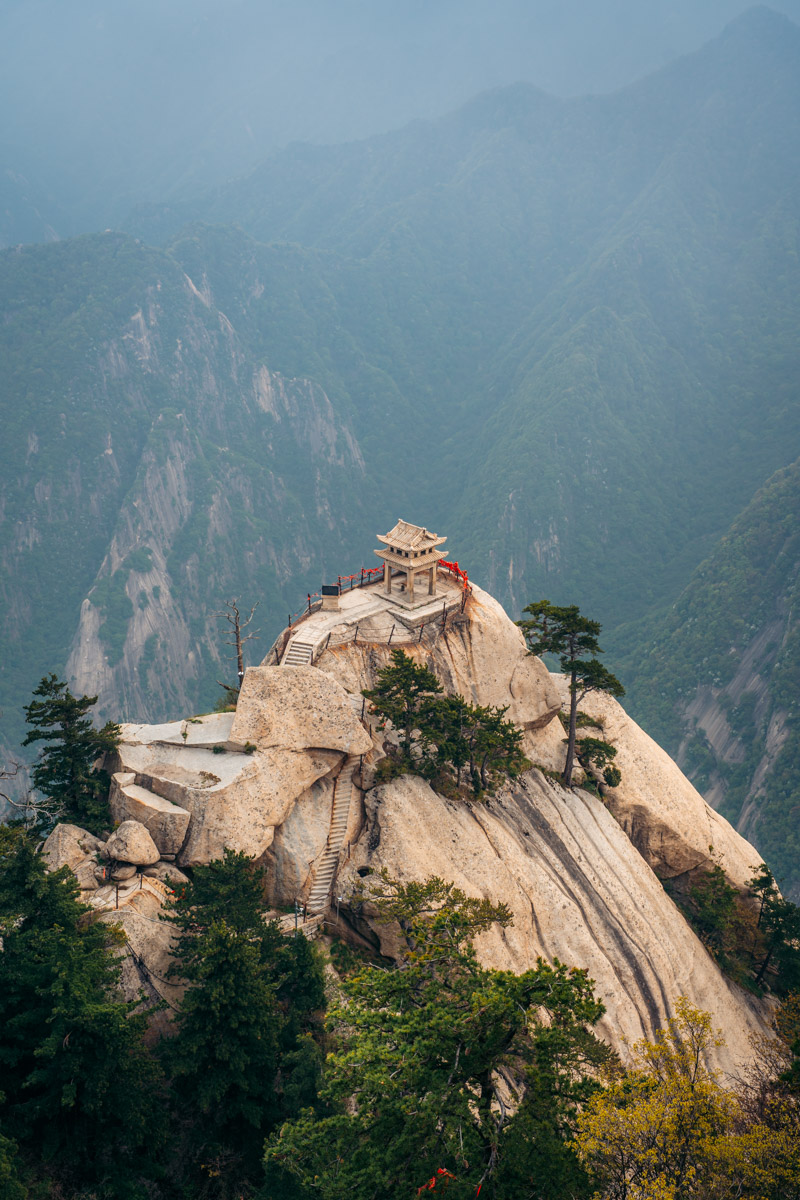
At the top, we passed the quiet East Peak Temple (Dongfeng Temple) before reaching the entrance to another one of Huashan’s famous cliffside adventures: Hawk’s Turn, or Falcon’s Flip (Yaozi Fanshen).
Often overshadowed by the Plank Walk, Hawk’s Turn is a fantastic alternative if you’re looking for another adrenaline-filled experience. For the same 30 RMB admission fee, you’ll descend narrow cliffside footholds and squeeze in between dramatic granite boulders before reaching the famous Chess Pavilion, a tiny pavilion perched on its own rocky pinnacle.
Like the Plank Walk, you’ll need to wear a safety harness, and be sure to bring cash, as card and mobile payments aren’t always accepted due to the unreliable signal on the mountain.
Groups are released periodically throughout the day, about every hour or so, to keep the route safe and avoid congestion. Compared to the Plank Walk, Hawk’s Turn feels much quieter and more off the beaten path. It’s still an exciting challenge, but we found it noticeably less intimidating. If you miss out on a Plank Walk time slot or simply don’t want to dedicate several hours to it, I’d seriously consider doing Hawk’s Turn instead. You still get the thrill of navigating exposed cliffside terrain, but without the crowds and lengthy wait.
Even if you don’t descend to the Chess Pavilion, don’t skip the viewpoint overlooking it. Looking down from above at the tiny pavilion clinging to the cliffside makes for one of the most spectacular scenes on Huashan, and it ended up being one of my favourite photos from the entire day.
From here, it was only a short walk along the ridgeline to East Peak (2,096 m / 6,877 ft). To be completely honest, after everything we’d already experienced throughout the day, the summit itself didn’t stand out as much. Still, reaching East Peak felt satisfying. It marked the completion of our panoramic tour across Huashan’s three highest peaks.
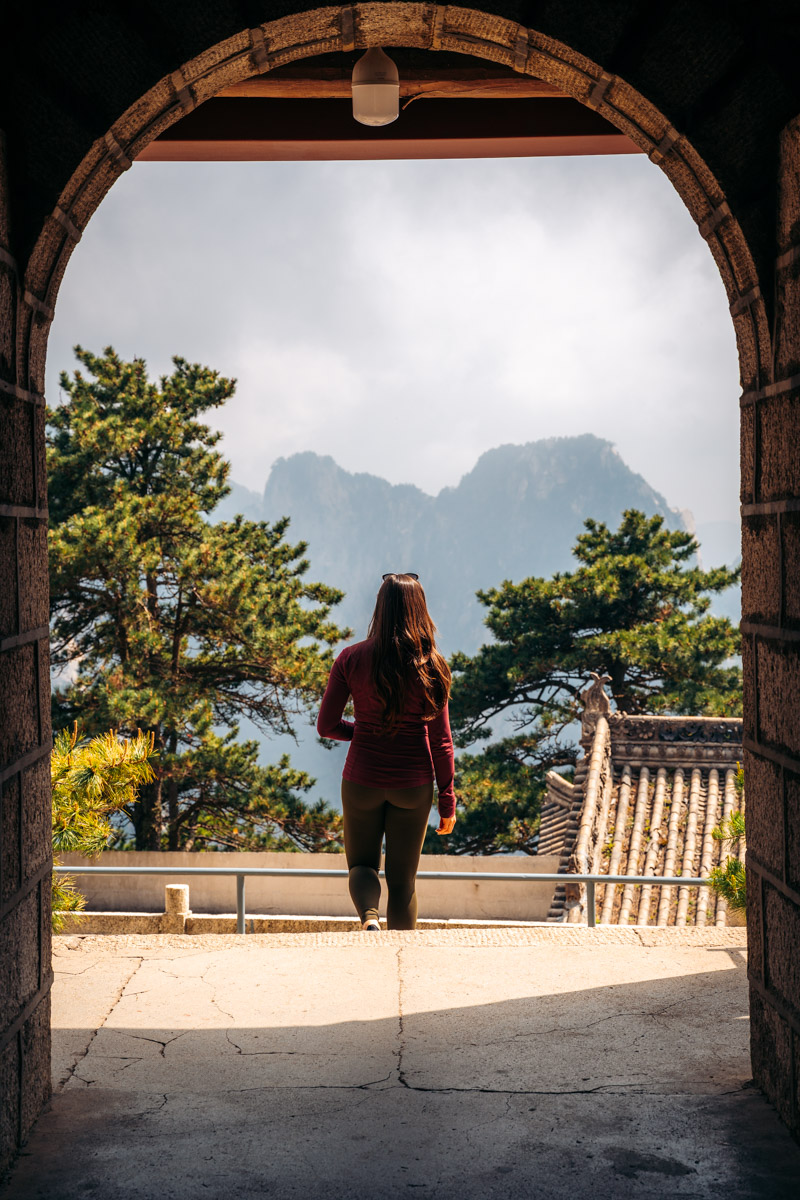
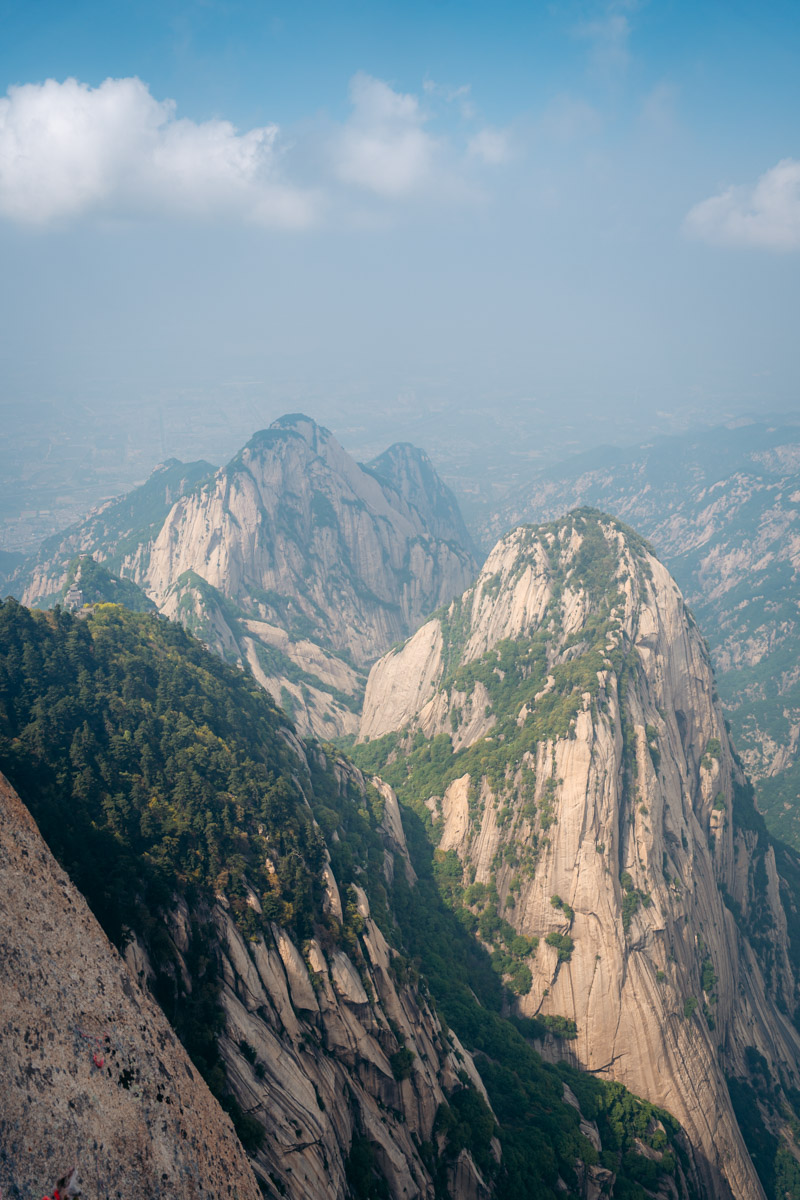
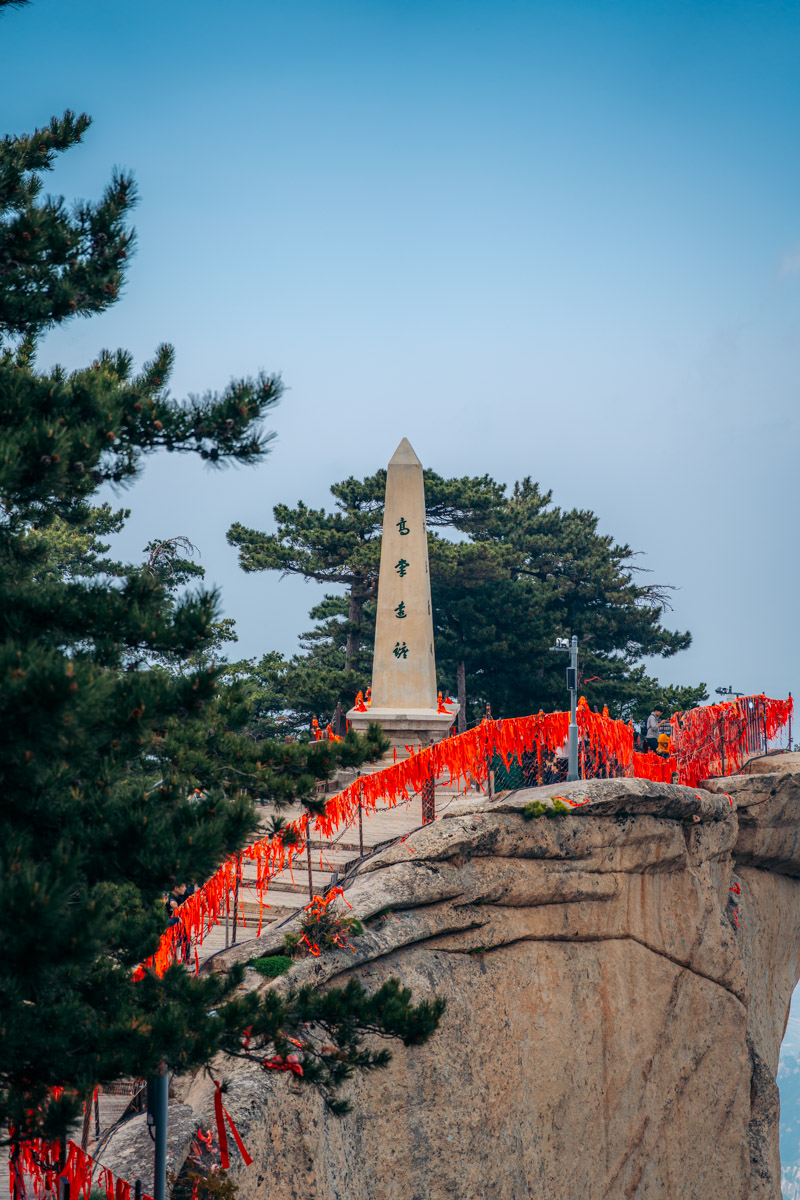
With the hardest climbing now behind us, it was finally time to begin making our way toward the final peaks and our descent from the mountain.
Heading to Middle Peak
From East Peak, we continued along the ridge for Middle Peak (2,038 m / 6,686 ft). It’s worth noting that Middle Peak is essentially an extension of the East Peak area rather than a completely separate destination, and compared to the other summits on Huashan, it doesn’t offer any particularly memorable viewpoints.
That said, the journey there was still entertaining. The descent from East Peak was relatively straightforward. As we made our way down a concrete staircase built along the mountainside, we noticed a growing crowd of people coming from the Middle Peak gathering at the bottom of the stairs. At first, we weren’t sure what they were waiting for, until we peered over a corner of the zigzagging staircase to see what they were about to climb.
Beside the staircase we were on was a near-overhang vertical “cloud ladder” carved into the cliff face, with nothing but chains bolted into the rock as handholds. The exposed climb rose at least 10 m straight upward, creating quite the spectacle as people carefully made their way up one at a time.

It was honestly incredible watching such a wide range of visitors take on the challenge. Young kids and older hikers alike tackled the climb with impressive determination, while we enjoyed the luxury of taking the much easier route in the opposite direction. The ladder is completely optional, by the way. If you’re travelling towards Middle Peak from the opposite direction, you can choose to take on this more adventurous climb, or simply continue along the regular staircase like we did.
Eventually, we reached the final set of jagged stone steps leading towards the Middle Peak platform. Unfortunately, there was some construction happening during our visit, which blocked part of the area and took away slightly from the experience.
Still, the viewpoint offered a unique perspective: looking back at the terrain we had already conquered, now laid out above us. After spending the day climbing from summit to summit, it was a pretty satisfying reminder of just how much ground we’d covered.

Descent to North Peak
From Middle Peak, the trail reaches an important junction where one path loops back towards West Peak, while the other heads towards North Peak. Before moving on, I’d recommend taking a few minutes to look at the large trail maps located here. They’re some of the best maps we saw on the mountain, showing all the major attractions, hotels, restaurants, washrooms, and the walking distances between them. It’s a great opportunity to get your bearings before tackling the longest uninterrupted section of the day.
We left Middle Peak at around 3:30 pm, knowing we had a fair bit of ground to cover before catching the North Peak Cablecar. Most of the next hour would be spent descending—seemingly endless flights of granite stairs that zigzagged down the mountainside.
We tried to pick up the pace during this section, but it wasn’t always easy. By late afternoon, the mountain had become noticeably busier. We found ourselves weaving around slower groups descending ahead of us while also making room for a steady stream of hikers climbing in the opposite direction. The narrow pathways and frequent switchbacks meant there were only so many opportunities to pass.
After what felt like an endless descent, we reached another trail junction. This is where the famous Canglong Ridge branches off—a narrow ridgeline climb that’s notorious for its steep staircases and dramatic exposure. If you’re hiking from North Peak to the higher summits, this is one of Huashan’s most iconic climbs. Since we were travelling in the opposite direction, however, we simply admired the ridge from afar.
From here, we had another choice. We could continue along the wider Jinhu Road, the more direct route towards North Peak, or take one of the quieter trails that hugged the ridgeline and passed a few additional unobstructed viewpoints. We opted for the latter, and I’m so glad we did.
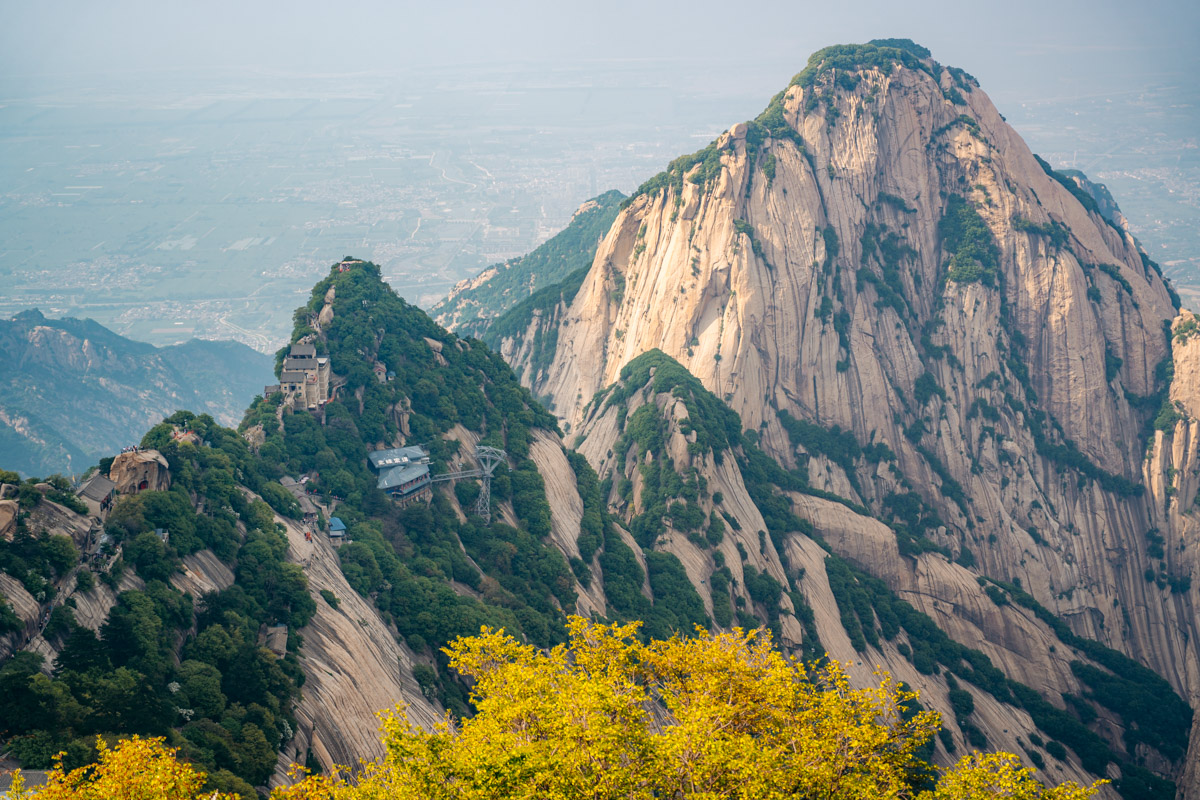
Almost immediately, the crowds disappeared. Our first stop was Jiuku Platform, which quickly became one of our favourite viewpoints on the northern side of the mountain. From here, we had a fantastic view of hikers making their way up the steep staircase of Canglong Ridge while the towering cliffs of Huashan rose dramatically behind them. Looking back towards West Peak, now soaring high above us, really put into perspective just how much elevation we’d lost over the past hour.
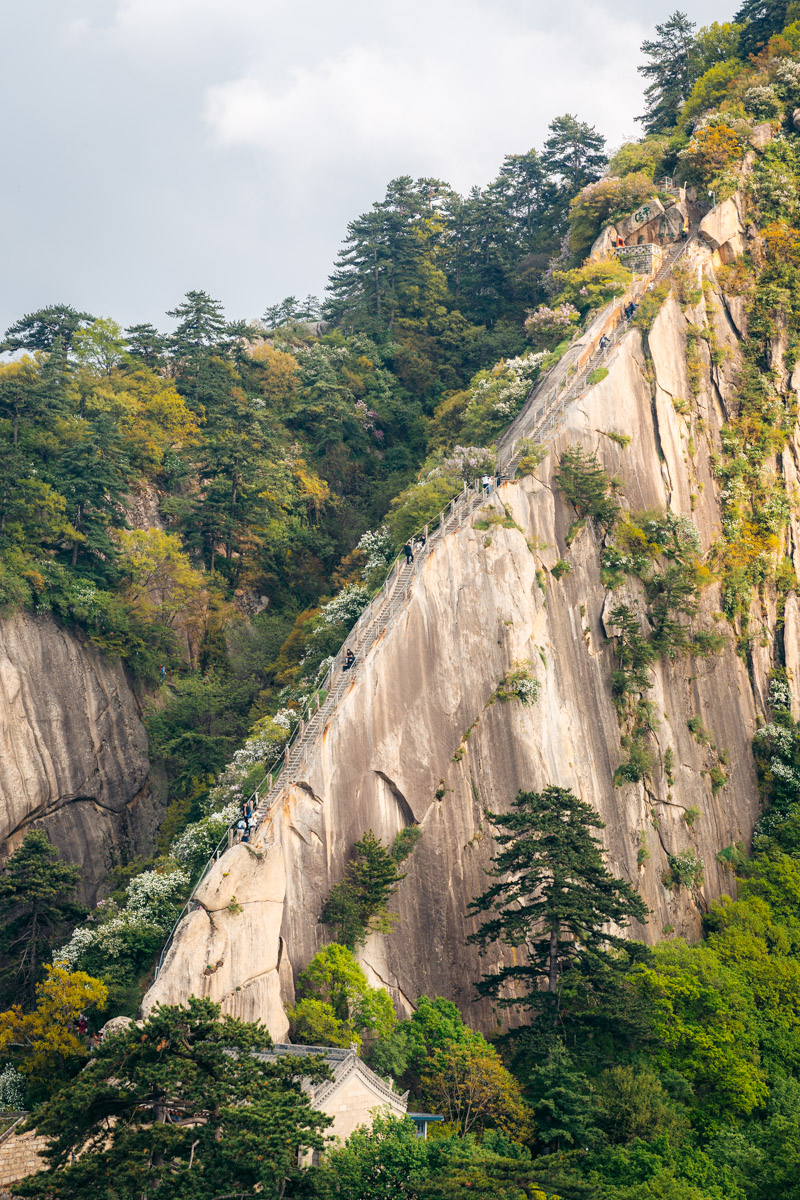
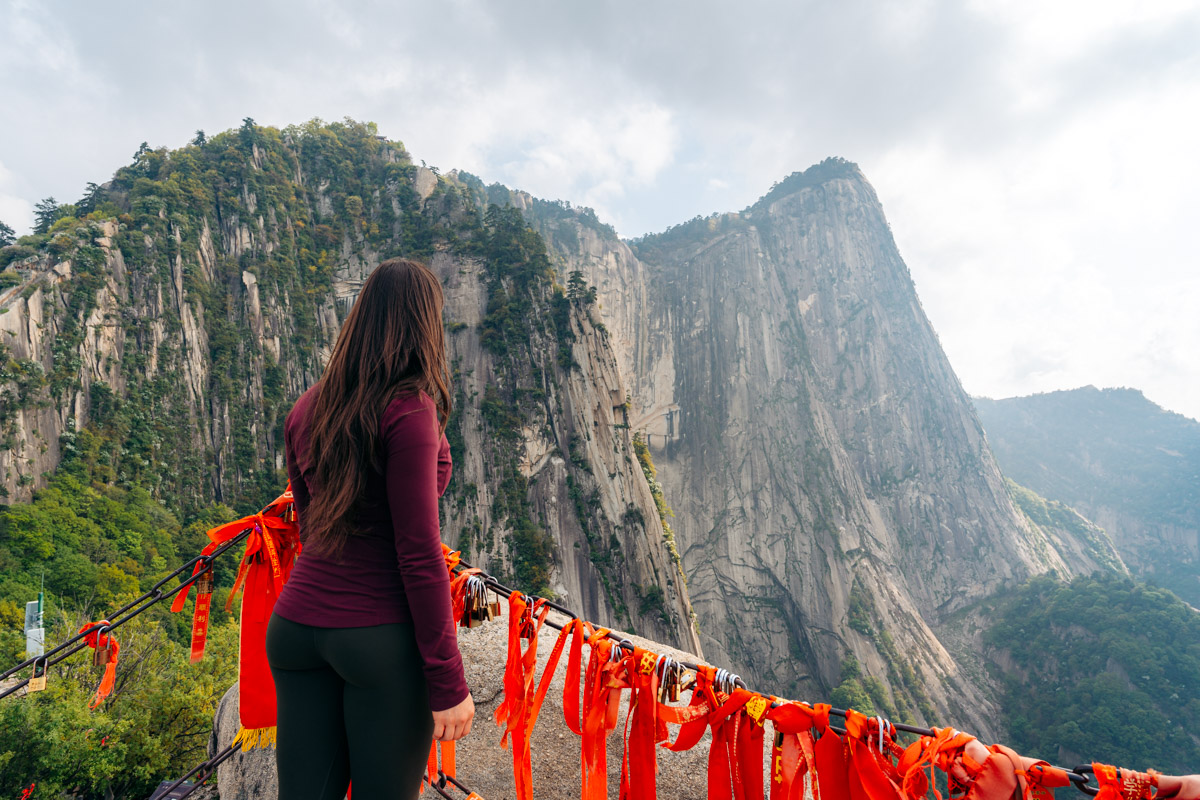
The quieter trail continued along the ridgeline before descending through a few slightly more technical sections, eventually leading us to Woniu Rock. This striking granite formation has its own small viewpoint, reached by a staircase that curves up the back of the rock. It was another unexpectedly beautiful stop and one that many visitors miss by sticking to the main trail.
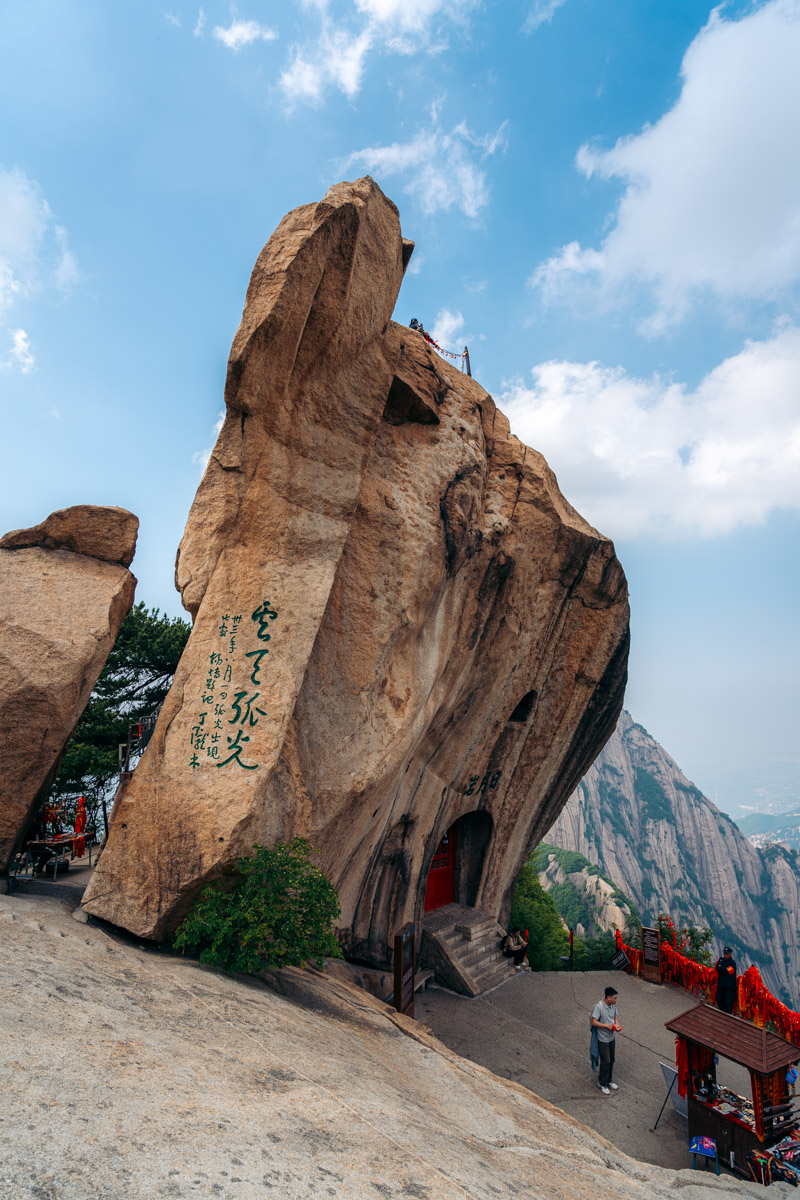
By 4:40 pm, we arrived at the spacious North Peak platform. While North Peak offers a lovely view towards the distinctive pyramidal mountain rising to the north, I have to admit I actually preferred the scenery along the quieter ridgeline trail. Between Jiuku Platform, Woniu Rock, and the sweeping views back towards Huashan’s towering cliffs, I found this final stretch far more memorable than the summit itself.
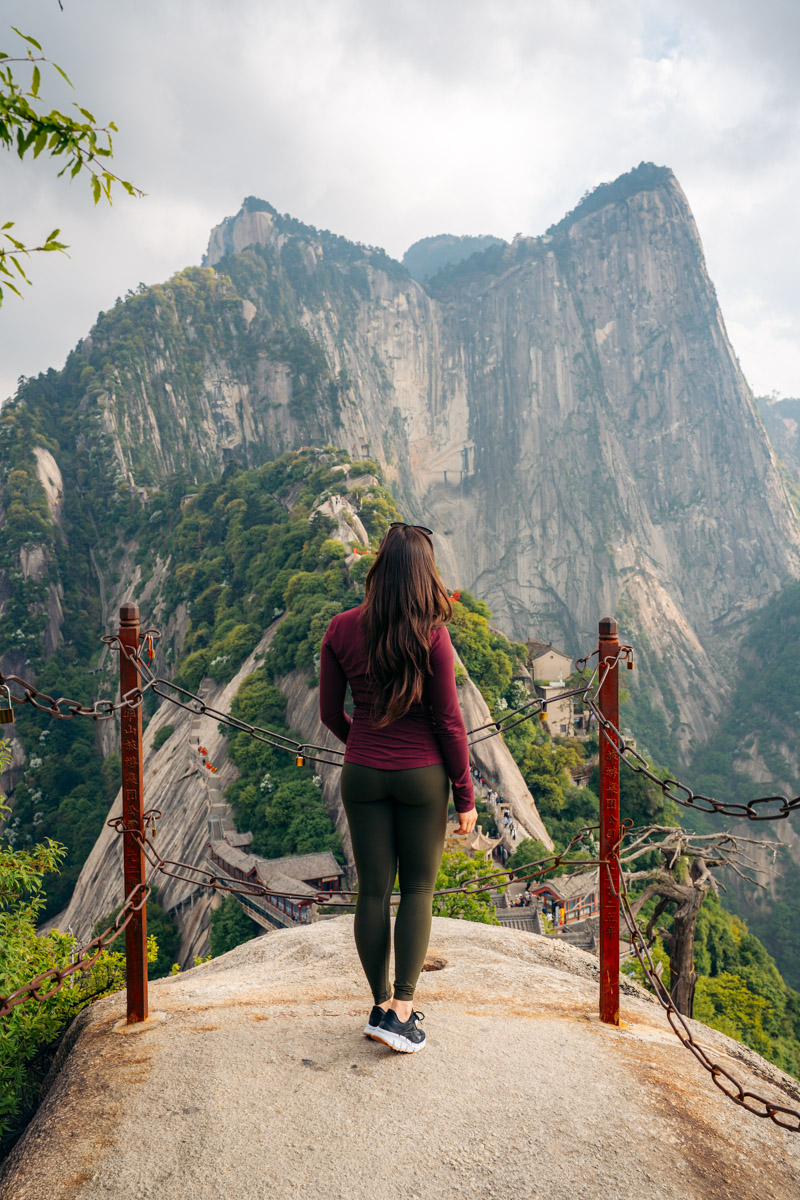
If you’re not in a rush to catch the cablecar, I’d definitely recommend taking the scenic detour. It adds very little time to your day but rewards you with some of the best—and least crowded—viewpoints on the mountain.
Riding the North Peak Cablecar Down
The North Peak upper cablecar station is about 280 m down from the peak itself, so we quick stepped our way down to get ourselves in line. There was a line that snaked around the metal queue barriers, but it moved so fast that we were on the cablecar in 20 minutes. Of course, during peak seasons, it could take hours to finally be at the gate for the cablecar.
It was nice to get one last hurrah as we made our way down the 10-minute ride back into the valley, but it definitely didn’t compare to the West Peak cablecar ride. Soon enough, we made it down to the bus terminal.

Here, we actually needed to buy bus tickets to get us back to the Visitor Centre, only because as foreigners getting our Huashan admission and cablecar tickets purchased by a hotel or other agency doesn’t have this last ride covered. Make sure to double check whether your ticket package has this covered or not! The ticket office is just at the end and easy to spot, so you can have one person in your party get the tickets and another wait in the queue for the bus.

We were on the bus and moving by 5:45pm, and made it full circle back to our hotel by dinner time!
Is the Huashan Plank Walk Worth It?
Yes! The Plank Walk in the Sky is 100% worth it, if you manage to wait no more than 2 hours in line before you get a timeslot. The cost of 30 RMB per person is such a steal for a bucket list experience like this, and it basically just pays for the equipment rental. But you’ll have to remember to bring cash with you to pay for your ticket (for now anyway) or be able to ask someone to spot you so long as you can WeChatPay them back.
Safety-wise, it is quite foolproof, given that you don’t unclip yourself, thanks to the closed metal hook that doesn’t allow the cable to pass through but can go over the support anchors. You’re still fully harnessed in, which wraps around your chest, your waist and your legs. But the rope doesn’t have a bungee-like energy absorber, which you typically want to have on a via ferrata. When ascending or descending the ladder section, you could still take a decent fall, which can lead to injury without the energy absorption on the rope.
So definitely take on the plank walk at your own risk! It is still a dangerous experience, giving you the fear factor you might be chasing. But all in all, it is beginner friendly, and can be done without any previous rope or climbing experience. A lot of the people doing it with us were beginners!
I would hands down recommend the Plank Walk, or Hawk’s Turn if you prefer to avoid the crowds. But it all comes down to what time you can make it here to beat the line of people who want to do it too. The earlier you can line up, the better!

What to Pack
It’s easy to forget what you need to bring for a full day excursion like this, and if you’re doing it as a day trip from Xi’an, you definitely want to make sure you have everything you need. So here’s a brief packing list of your must-have’s for Huashan:
- Passport for gate entry ID verification
- Cash (needed for the Plank Walk or Hawk’s Turn)
- Water & snacks (although you’ll find stalls throughout the mountain selling drinks and food)
- Hiking shoes or runners
- Layers
- Sunscreen
- Gloves for the via ferrata experiences
- Power bank
FAQ
1. Can you visit Huashan in one day?
Yes, most people do, although you can also break it up in two days and stay overnight on the mountain.
2. Which Huashan route is best?
West Peak to North Peak is the most ideal route for the least amount of effort, and you can enjoy both cablecars that way.
3. How difficult is Huashan?
It’s a moderate level of difficulty when doing the best route, mostly because of the total distance covered.
4. Can beginners hike Huashan?
Yes, absolutely, if taking the cablecars up and down. It’s not technical so long as you keep to the main track, and consists of mostly stairs and walkable trails. Kids and older folks do this hike alike.c ab
5. Is the cablecar worth it?
It’s worth every penny to take the cablecars. Hiking up will add 3-5 hours to your day with a ton of elevation, whereas the cablecars will get you up in as little as 10-20 minutes. I would save my energy to explore up at the top of the mountain, and the West Peak cablecar is such a magical experience.
6. Which peak has the best views?
I would say that the peaks themselves don’t have the best views, but the viewpoints along the way do. If I had to choose one, it would be South Peak as it faces one of the most imposing mountains I have ever seen. But it’s just so crowded and only the top ledge of the peak gets the view. If you want the truly best view, it’s at the Plank Walk lookout!
7. How long does it take to hike Huashan?
Taking the most ideal route (West Peak to North Peak) it takes 6-8 hours. But all the time added together, including the buses to and from the cablecar stations, the cablecar rides themselves, the Plank Walk and everything in between, I would say reserve 11 hours from entering to leaving.
8. Is Huashan safe?
Yes, very safe. You take on the liability when you choose to do the Plank Walk or Hawk’s Turn, but the main trails are easy to navigate, even for inexperienced hikers.
9. Do you need to book tickets in advance?
Yes, especially during higher seasons. During the low and shoulder seasons, you may be able to book tickets the day of, or the day before like we did.
10. Can you hike Huashan without taking the cablecars?
You definitely can, but that is a full day undertaking that is very challenging. I’m not crazy enough to do it, but I would recommend it if you are thinking of spending a night at one of the hotels on the mountain.
Thanks for Reading!
Thanks so much for tagging along our Huashan adventure! It’s our third time in China, exploring yet another iconic mountain, and we are once again blown away. I know you will be too if things work out well with the weather and crowds!
If you’re planning your trip soon, make sure to read up on my guide detailing everything to know before visiting China.